


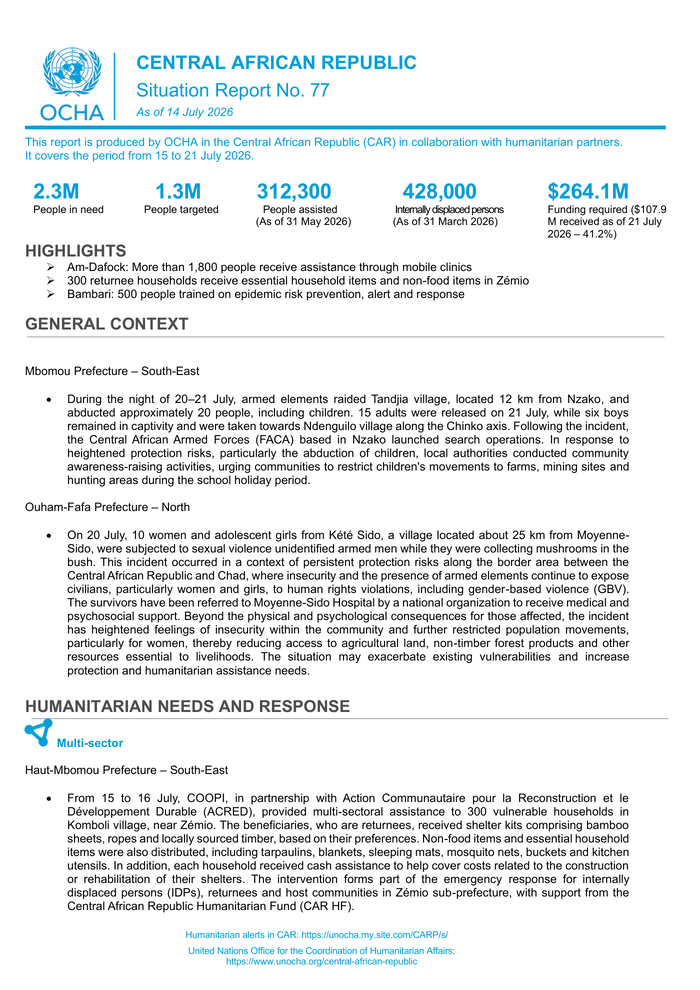
Country: Central African Republic Source: UN Office for the Coordination of Humanitarian Affairs Please refer to the attached file. HIGHLIGHTS Am-Dafock: More than 1, 800 people receive assistance through mobile clinics 300 returnee households receive essential household items and non-food items in Zémio Bambari: 500 people trained on epidemic risk prevention, alert and response GENERAL CONTEXT Mbomou Prefecture – South-East During the night of 20–21 July, armed elements raided Tandjia village, located 12 km from Nzako, and abducted approximately 20 people, including children. 15 adults were released on 21 July, while six boys remained in captivity and were taken towards Ndenguilo village along the Chinko axis. Following the incident, the Central African Armed Forces (FACA) based in Nzako launched search operations. In response to heightened protection risks, particularly the abduction of children, local authorities conducted community awareness-raising activities, urging communities to restrict children’s movements to farms, mining sites and hunting areas during the school holiday period. HUMANITARIAN NEEDS AND RESPONSE Multi-sector Haut-Mbomou Prefecture – South-East From 15 to 16 July, COOPI, in partnership with Action Communautaire pour la Reconstruction et le Développement Durable (ACRED), provided multi-sectoral assistance to 300 vulnerable households in Komboli village, near Zémio. The beneficiaries, who are returnees, received shelter kits comprising bamboo sheets, ropes and locally sourced timber, based on their preferences. Non-food items and essential household items were also distributed, including tarpaulins, blankets, sleeping mats, mosquito nets, buckets and kitchen utensils. In addition, each household received cash assistance to help cover costs related to the construction or rehabilitation of their shelters. The intervention forms part of the emergency response for internally displaced persons (IDPs), returnees and host communities in Zémio sub-prefecture, with support from the Central African Republic Humanitarian Fund (CAR HF). Health Countrywide Between 10 and 20 July, seven new suspected cholera cases were reported, including four in health facilities and three in communities. No deaths were recorded during the reporting period. Since the outbreak was declared on 26 June, a cumulative total of 650 suspected cases and 44 deaths have been reported, while 595 people have recovered. Under the coordination of the Ministry of Health, response activities continued in affected areas. As part of efforts to strengthen epidemiological surveillance, 40 epidemiologists and data managers were trained to ensure the daily updating of surveillance data at the health district level. In addition, 25 traditional practitioners in Bangui were trained in active case finding and rapid referral of suspected cases to treatment facilities. Of the seven newly reported suspected cases, four are currently receiving treatment, including two at the Community Hospital, one at Bimbo Hospital and one at Maman Elisabeth Domitien University Hospital Center (CHUMED). Infection prevention and control activities continued, with 3, 093 people sensitized on household water treatment and 69, 120 water purifying tablets distributed. 21 households located around identified cases in Bokassa 1 and Bangui were disinfected. In addition, 125 handwashing stations were installed in the Bimbo and Mbaïki districts, and hygiene staff at the Community Hospital received training on infection prevention and control measures in healthcare settings. Key challenges to the response are data management and the mobilization of the resources required to contain the outbreak.



GrowthPakistan brings you the latest news to keep an eye on Pakistan’s startup ecosystem. Business keeps you growing when you stay aware of your competitors' moves. GrowthPakistan offers Business, Tech, Global Tech, Global, Auto, and Startup News straight from industries all around the globe. This platform will help you identify upcoming opportunities not only in Pakistan but worldwide.
Email : growthpakistan@gmail.com
Whatsapp : +92320-9497079
© growthpakistan