


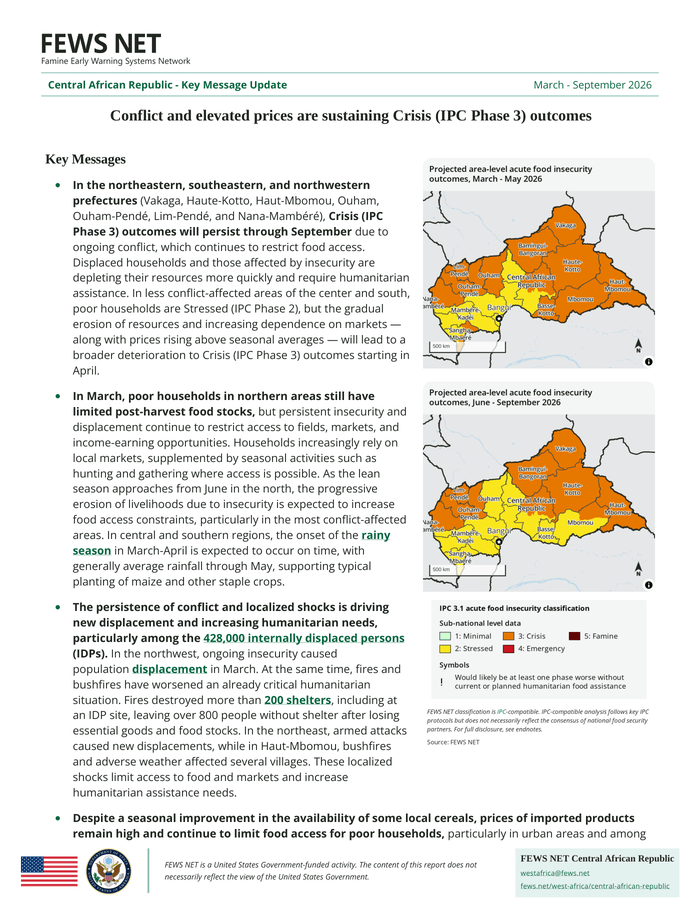
Country: Central African Republic Source: Famine Early Warning System Network Please refer to the attached file. Key Messages In the northeastern, southeastern, and northwestern prefectures (Vakaga, Haute-Kotto, Haut-Mbomou, Ouham, Ouham-Pendé, Lim-Pendé, and Nana-Mambéré), Crisis (IPC Phase 3) outcomes will persist through September due to ongoing conflict, which continues to restrict food access. Displaced households and those affected by insecurity are depleting their resources more quickly and require humanitarian assistance. In less conflict-affected areas of the center and south, poor households are Stressed (IPC Phase 2), but the gradual erosion of resources and increasing dependence on markets — along with prices rising above seasonal averages — will lead to a broader deterioration to Crisis (IPC Phase 3) outcomes starting in April. In March, poor households in northern areas still have limited post-harvest food stocks, but persistent insecurity and displacement continue to restrict access to fields, markets, and income-earning opportunities. Households increasingly rely on local markets, supplemented by seasonal activities such as hunting and gathering where access is possible. As the lean season approaches from June in the north, the progressive erosion of livelihoods due to insecurity is expected to increase food access constraints, particularly in the most conflict-affected areas. In central and southern regions, the onset of the rainy season in March-April is expected to occur on time, with generally average rainfall through May, supporting typical planting of maize and other staple crops. The persistence of conflict and localized shocks is driving new displacement and increasing humanitarian needs, particularly among the 428, 000 internally displaced persons (IDPs). In the northwest, ongoing insecurity caused population displacement in March. At the same time, fires and bushfires have worsened an already critical humanitarian situation. Fires destroyed more than 200 shelters, including at an IDP site, leaving over 800 people without shelter after losing essential goods and food stocks. In the northeast, armed attacks caused new displacements, while in Haut-Mbomou, bushfires and adverse weather affected several villages. These localized shocks limit access to food and markets and increase humanitarian assistance needs. Despite a seasonal improvement in the availability of some local cereals, prices of imported products remain high and continue to limit food access for poor households, particularly in urban areas and among displaced populations. According to the Food and Agriculture Organization/GIEWS Country Brief, local maize prices declined by about 20 percent between December 2024 and December 2025, while imported rice prices were about 10 percent higher than the previous year, partly due to reduced imports via river corridors from the Democratic Republic of the Congo and the Republic of the Congo. Disruptions linked to the conflict in the Middle East continue to exert upward pressure on global oil prices and freight costs, contributing to expected increases in fuel and imported food prices in the short and medium term. In the Central African Republic — a landlocked country dependent on imports via the Douala-Bangui corridor, particularly for fuel supply — these higher transport costs are quickly transmitted to domestic markets. Although fuel prices remain government-regulated, they are among the highest in the region and weigh heavily on transport costs. Any increase in prices/costs is likely to be reflected in the prices of imported food products — such as rice, wheat flour, vegetable oil, and sugar — which make up a significant share of national consumption. These increases also raise domestic transport costs, particularly along routes linking production areas to major urban markets. These cost dynamics are expected to sustain high food prices and erode the purchasing power of market-dependent households, particularly poor urban households and displaced populations.



GrowthPakistan brings you the latest news to keep an eye on Pakistan’s startup ecosystem. Business keeps you growing when you stay aware of your competitors' moves. GrowthPakistan offers Business, Tech, Global Tech, Global, Auto, and Startup News straight from industries all around the globe. This platform will help you identify upcoming opportunities not only in Pakistan but worldwide.
Email : growthpakistan@gmail.com
Whatsapp : +92320-9497079
© growthpakistan