

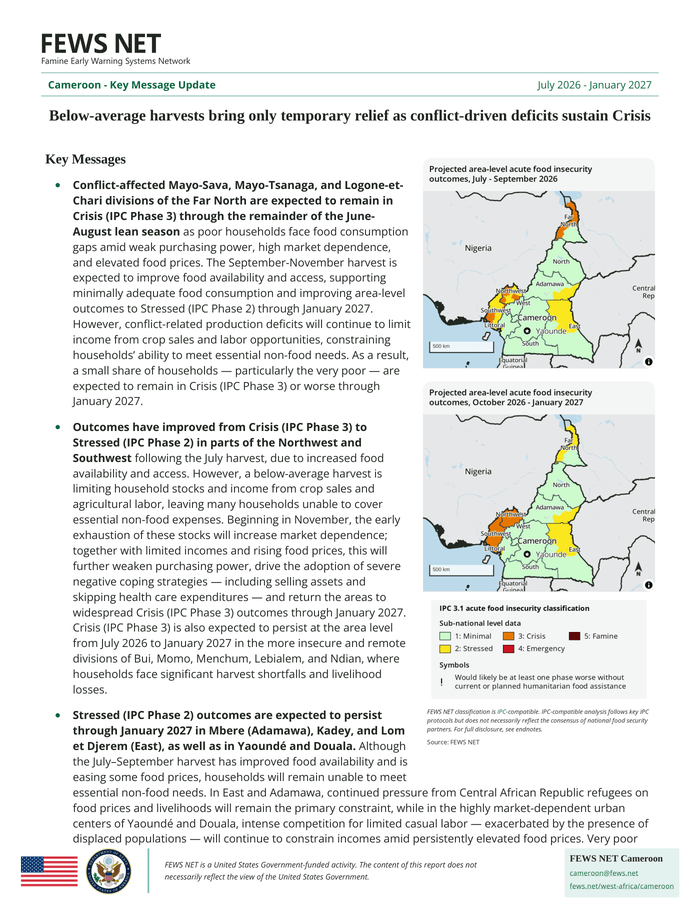
Country: Cameroon Source: Famine Early Warning System Network Please refer to the attached file. Key Messages Conflict-affected Mayo-Sava, Mayo-Tsanaga, and Logone-et-Chari divisions of the Far North are expected to remain in Crisis (IPC Phase 3) through the remainder of the June-August lean season aspoor households face food consumption gaps amid weak purchasing power, high market dependence, and elevated food prices. The September-November harvest is expected to improve food availability and access, supporting minimally adequate food consumption and improving area-level outcomes to Stressed (IPC Phase 2) through January 2027. However, conflict-related production deficits will continue to limit income from crop sales and labor opportunities, constraining households’ ability to meet essential non-food needs. As a result, a small share of households — particularly the very poor — are expected to remain in Crisis (IPC Phase 3) or worse through January 2027. Outcomes have improved from Crisis (IPC Phase 3) to Stressed (IPC Phase 2) in parts of the Northwest and Southwest following the July harvest, due to increased food availability and access. However, a below-average harvest is limiting household stocks and income from crop sales and agricultural labor, leaving many households unable to cover essential non-food expenses. Beginning in November, the early exhaustion of these stocks will increase market dependence; together with limited incomes and rising food prices, this will further weaken purchasing power, drive the adoption of severe negative coping strategies — including selling assets and skipping health care expenditures — and return the areas to widespread Crisis (IPC Phase 3) outcomes through January 2027. Crisis (IPC Phase 3) is also expected to persist at the area level from July 2026 to January 2027 in the more insecure and remote divisions of Bui, Momo, Menchum, Lebialem, and Ndian, where households face significant harvest shortfalls and livelihood losses. Stressed (IPC Phase 2) outcomes are expected to persist through January 2027 in Mbere (Adamawa), Kadey, and Lom et Djerem (East), as well as in Yaoundé and Douala. Although the July–September harvest has improved food availability and is easing some food prices, households will remain unable to meet essential non-food needs. In East and Adamawa, continued pressure from Central African Republic refugees on food prices and livelihoods will remain the primary constraint, while in the highly market-dependent urban centers of Yaoundé and Douala, intense competition for limited casual labor — exacerbated by the presence of displaced populations — will continue to constrain incomes amid persistently elevated food prices. Very poor households, including refugees, will remain in Crisis (IPC Phase 3) through the projection period. Agricultural production prospects remain below average in conflict-affected areas of the northern zone, despite generally favorable rainfall in July that supported typical crop growth and improved rangeland conditions across much of the region. In these areas, persistent insecurity and disruptions to farming activities continue to constrain household engagements. Rising fertilizer prices — 30 to 40 percent higher in July than in March — combined with reduced humanitarian support and limited access to subsidized government inputs, have further constrained poor households’ access to inputs during the critical June-August fertilizer application window.
Cameroon – Key Message Update: Below-average harvests bring only temporary relief as conflict-driven deficits sustain Crisis, July 2026 – January 2027

RELATED ARTICLES


