


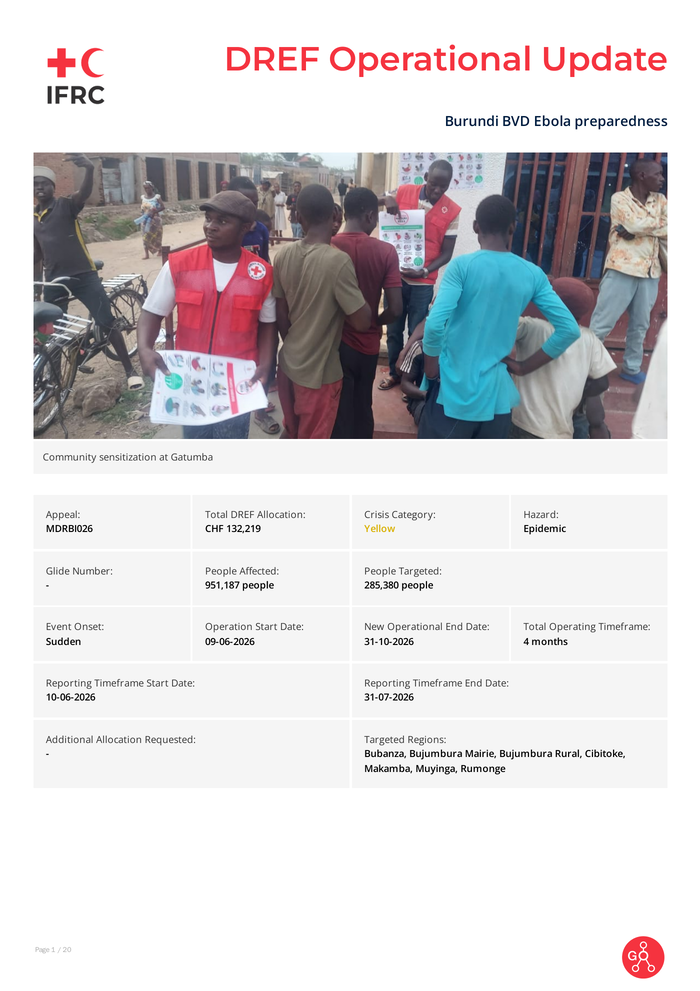
Country: Burundi Source: International Federation of Red Cross and Red Crescent Societies Please refer to the attached file. Description of the Event Date of event 21-05-2026 What happened, where and when? On 15 May 2026, the Government of the Democratic Republic of the Congo (DRC) officially declared an outbreak of Ebola Virus Disease (BVD) caused by the Bundibugyo strain in Ituri Province, in the northeastern part of the country. On the same day, the Republic of Uganda also declared an outbreak of the same Ebola strain, with the epicenter located in Ituri. In response to the evolving situation and the cross-border implications of the outbreak, the World Health Organization (WHO) subsequently recognized the event as a major public health concern due to its spread in border areas and the high risk of regional transmission. The Bundibugyo strain currently has no approved vaccine, increasing concerns among health authorities and humanitarian partners. Ebola Virus Disease is a severe and often fatal illness transmitted through direct contact with infected bodily fluids, contaminated materials, or infected animals. The disease can cause large outbreaks with significant mortality if not rapidly contained. As of the date the emergency plan of action was written (May 2026), the epidemiological situation was showing more than 1, 000 suspected cases and 220 deaths had been reported across the affected provinces of Ituri, North Kivu, and South Kivu in the DRC, including cases linked to Uganda. As of 3 August 2026, more than 3300 confirmed cases had been reported in the Democratic Republic of the Congo (DRC), compared with 20 confirmed cases in Uganda. In addition, more than 1, 400 confirmed deaths had been recorded in the DRC, while Uganda had reported two confirmed deaths. Although Uganda declared the end of the outbreak on 28 July 2026, the epidemiological situation in the DRC remained highly concerning. The outbreak had not yet reached its peak, with transmission continuing to expand and new health zones being affected. Given the close cross-border population movements between the DRC and neighbouring countries, including Burundi, the continued spread of the disease in the DRC posed a significant risk of cross-border transmission and underscored the need to maintain heightened surveillance, preparedness, and response capacities. The situation continues to evolve, creating heightened concern for neighboring countries due to intense cross-border population movements and trade. Burundi is considered a high-risk country due to its geographical proximity to the affected areas and its strong social and economic links with both the DRC and Uganda. Particular concern exists along major travel and trade corridors connecting Burundi to affected areas, including the Bujumbura–Goma, Bujumbura–Kivu, and Bujumbura–Entebbe routes, through both land and air transport. The provinces bordering the DRC, as well as major entry points and urban centers receiving travelers, are considered areas at heightened risk of disease importation. Recognizing the threat posed by the outbreak, the Government of Burundi, in collaboration with health partners including the Burundi Red Cross Society and the IFRC, finalized and validated a National Ebola Preparedness and Response Plan on 22 May 2026. Preparedness efforts remain ongoing as the outbreak continues to evolve in neighboring countries and the risk of importation into Burundi remains high.



GrowthPakistan brings you the latest news to keep an eye on Pakistan’s startup ecosystem. Business keeps you growing when you stay aware of your competitors' moves. GrowthPakistan offers Business, Tech, Global Tech, Global, Auto, and Startup News straight from industries all around the globe. This platform will help you identify upcoming opportunities not only in Pakistan but worldwide.
Email : growthpakistan@gmail.com
Whatsapp : +92320-9497079
© growthpakistan