

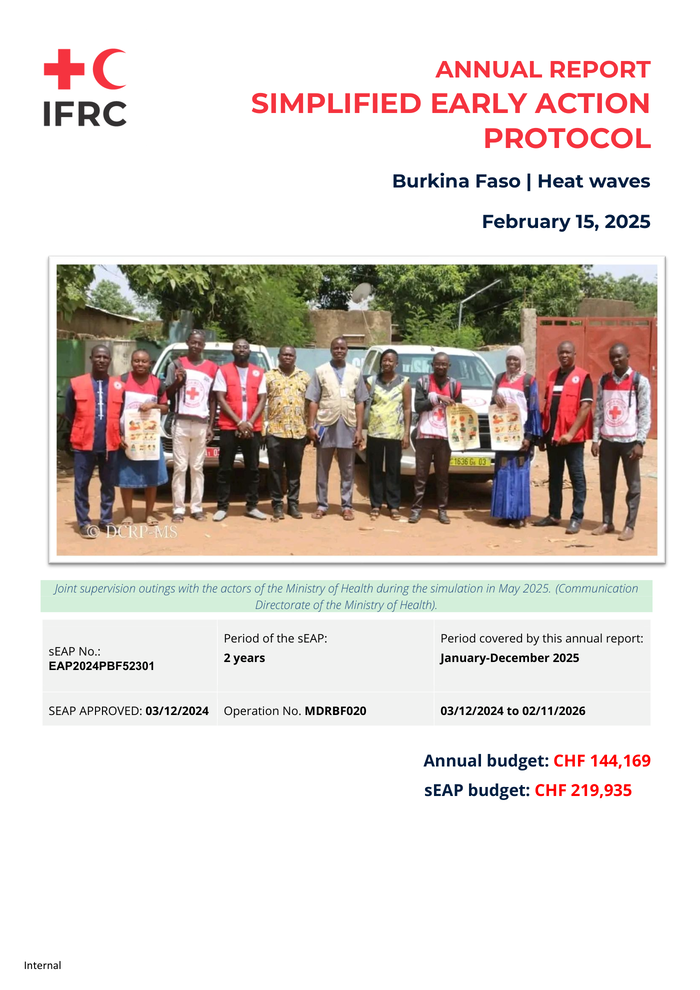
Country: Burkina Faso Source: International Federation of Red Cross and Red Crescent Societies Please refer to the attached file. SUMMARY OF THE SIMPLIFIED EARLY ACTION PROTOCOL The IFRC Disaster Response Emergency Fund (DREF) has allocated CHF 219, 935 to implement anticipated actions to reduce and mitigate the impact of heatwaves in the city of Ouagadougou in Burkina Faso. This simplified early action protocol includes an allocation of CHF 81, 650 to pre-position stocks and CHF 57, 212 conduct annual preparedness activities to implement early actions, if and when the trigger is reached. The first actions to be taken have been previously agreed with the National Society and are described in the simplified early action protocol. This report summarizes the annual preparation and pre-positioning activities carried out during the period from January to December 2025. At the end of the first year of implementation of the heatwave PAP in the city of Ouagadougou, significant progress has been made in terms of preparedness and operational capacities for the protection of vulnerable populations. : MOU signed with ANAM for the provision of alerts on heat waves; Eighty (80) volunteers have been trained on the risks associated with heat waves and the management of people at risk; An operational simulation made it possible to test the alert and intervention mechanisms through community awareness-raising actions, home visits and coordination with technical services; Process underway for the pre-positioning of WASH kits for water storage, food for vulnerable people working under the sun, specific products for people with albinism, medical products (blood pressure monitors, thermometers), as well as solar lighting kits for school girls. These kits will be distributed if the trigger is reached; A contract is being signed with ONEA for the supply of drinking water in cisterns in the event of an alert; A framework contract is being signed with a private service provider for the rental of tanks in the event of a trip; Participatory targeting identified the most at-risk groups, including people living in undeveloped areas, the elderly, people living with disabilities, people with albinism or leprosy; A 2026-2027 heatwave response action plan has been developed to enable the CRBF to be more operational in the event that triggers are reached throughout the country. These actions have contributed to strengthening the capacity of the National Society and improving coordination with national actors involved in climate risk management.
Burkina Faso | Heat waves – Simplified Early Action Protocol Annual Report (MDRBF020), February 15, 2025

RELATED ARTICLES


