


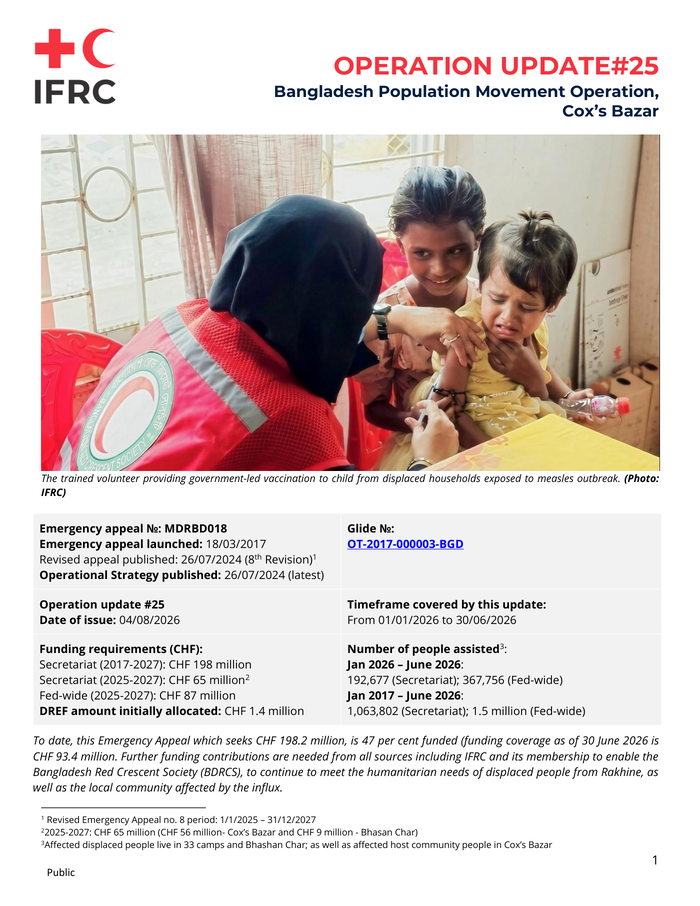
Countries: Bangladesh, Myanmar Source: International Federation of Red Cross and Red Crescent Societies Please refer to the attached file. A. SITUATION ANALYSIS Description of the crisis Nearly nine years after the large-scale influx of displaced people from Rakhine State in Myanmar into Bangladesh, the situation in Cox’s Bazar remains one of the world’s most protracted and underfunded humanitarian crises. As of 30 June 2026, a total of 1, 200, 171 displaced people4 live in 33 overcrowded camps in Cox’s Bazar and Bhasan char Island (where 33, 819 people live, relocated since 2021), with density reaching 47, 000 people/km among the highest globally (Please find Annex 1: PMO 4W map of camp and host). Displaced people continue to remain dependent on humanitarian aid due to restrictions on movement, employment, and the provision of parmanent shelters or community structures. There are currently no durable solutions to the protracted displacement in sight and continued uncertainty surrounding possible repatriation up to the present. According to the Government of Bangladesh (GoB) – UNHCR Population Dashboard as of June 2026, while 51 per cent of the population is female and 49 per cent male, 44 per cent comprises the largest adult group (18–59). The people living in camp settlements are particularly vulnerable as 78 per cent of them are women and children, and 12 per cent are Persons with Special Needs (EVIs), including persons with disabilities, single parents, children/older persons at risks. The humanitarian situation has further deteriorated due to renewed violence in Myanmar’s Rakhine State, resulting in a fresh influx of displaced people into Bangladesh. Since 2024, an estimated 220, 000 people have entered Bangladesh from Rakhine State, placing additional pressure on the already confined and overcrowded camp. However, according to the population dashboard, 153, 640 new arrivals out of 220, 000 have been biometrically registered as of June 2026 and remaining is in process. Many newly arrived families are currently sharing overcrowded shelters with relatives and host households, exposing them to heightened protection, health, and psychosocial risks. The developments/changes in the situation in Rakhine State, Myanmar could trigger another wave of displacement into Bangladesh, further intensifying security risks, border instability, and pressure on already overstretched humanitarian resources in Cox’s Bazar. This ongoing, complex, and protracted displacement crisis has left the affected population living in camps almost fully reliant on humanitarian assistance to meet their basic needs. The situation is further compounded by frequent cyclones, seasonal rainfall, flash floods, fire incidents, and heightened security concerns within the camps. The host community people, particularly in the Ukhiya and Teknaf sub-districts of Cox’s Bazar, have been significantly affected by the prolonged displacement crisis. The strain on forest resources, shrinking opportunities in the daily labour market, and rising tensions between the displaced and host communities are ongoing challenges. To continuously support the host population living close to the camps, as in the previous response plans, the UN-led Joint Response Plan (JRP) 2025-265 includes interventions aimed at supporting over 300, 000 people in the host



GrowthPakistan brings you the latest news to keep an eye on Pakistan’s startup ecosystem. Business keeps you growing when you stay aware of your competitors' moves. GrowthPakistan offers Business, Tech, Global Tech, Global, Auto, and Startup News straight from industries all around the globe. This platform will help you identify upcoming opportunities not only in Pakistan but worldwide.
Email : growthpakistan@gmail.com
Whatsapp : +92320-9497079
© growthpakistan