


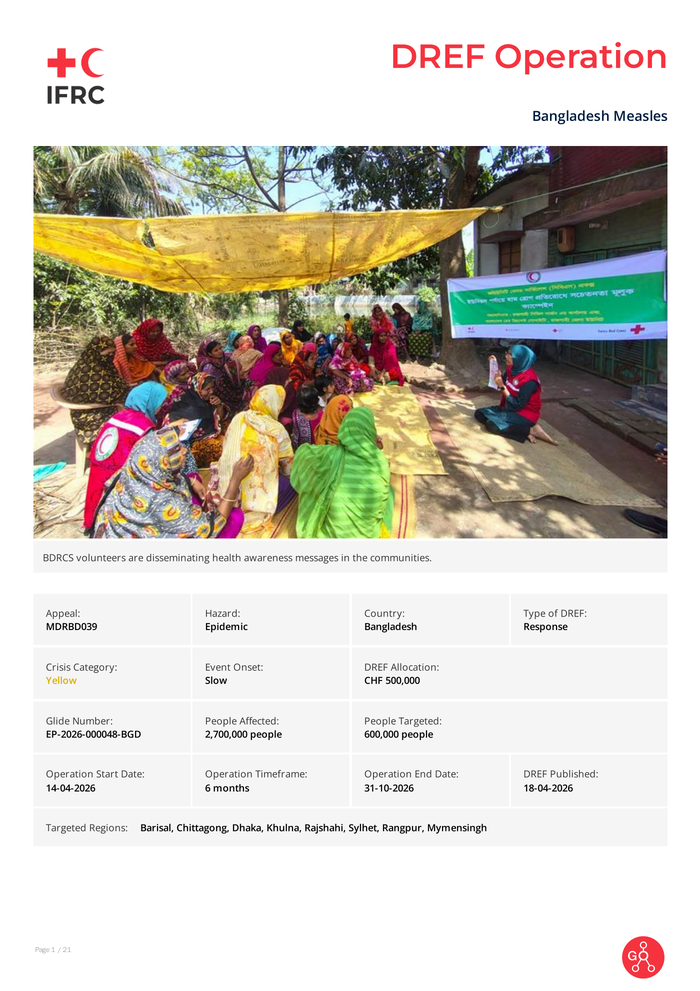
Countries: Bangladesh, Myanmar Source: International Federation of Red Cross and Red Crescent Societies Please refer to the attached file. Description of the Event Date when the trigger was met 05-04-2026 What happened, where and when? After several years of progress towards measles elimination, Bangladesh has experienced a significant resurgence of measles since early 2026, reversing previous positive trends and posing a major public health concern, particularly for young children. Measles is a highly contagious viral disease that spreads rapidly in low‐immunity settings and can lead to severe complications, including pneumonia, encephalitis, blindness, malnutrition, and death. Children under five years of age are the most affected, especially those who are unvaccinated or partially vaccinated. The current outbreak began to escalate in January 2026, with a steady increase in reported measles cases across the country. By March 2026, transmission had intensified and expanded geographically, resulting in a nationwide surge affecting all eight administrative divisions. A sharp acceleration in cases was observed from mid‐March onwards, reflecting sustained community transmission and persistent immunity gaps linked to uneven routine immunization coverage and disruptions to routine and supplementary immunisation activities in recent years. Between 15 March and 8 April 2026, a total of 1, 599 confirmed cases and 7, 577 suspected admitted cases and total suspected cases were 11, 133 reported nationwide, alongside increasing reports of severe complications and child deaths. The outbreak has affected both urban and rural settings, including densely populated cities and hard‐to‐reach areas. High transmission has been reported in Dhaka, Rajshahi, Chattogram, and Barishal divisions, with several locations experiencing growing pressure on health facilities due to paediatric admissions and measles‐related complications. In Cox’s Bazar District, measles cases have also been reported in the Rohingya refugee camps and in Bhasan Char, prompting the Health Sector, together with the Civil Surgeon and partners, to develop a phased Preparedness and Response Plan to address the evolving risks in these humanitarian settings. In response to the rising caseload, the Government of Bangladesh activated its Incident Management System (IMS) at the Public Health mergency Operations Centre (PHEOC) and intensified surveillance, coordination, and response measures at national and sub‐national levels. On 5 April 2026, the Ministry of Health and Family Welfare launched an emergency measles‐rubella vaccination campaign targeting children aged six months to under five years in high‐risk districts, including 30 upazilas across 18 districts, supported by the deployment of Rapid Response Teams and strengthened district‐level coordination, particularly in high‐burden urban areas. The Bangladesh Red Crescent Society (BDRCS) has been engaged from the early stages of the response, participating in coordination and information‐sharing meetings with DGHS, The Institute of Epidemiology, Disease Control and Research (IEDCR), WHO, UNICEF, and the Health Cluster, while mobilising trained volunteers and health workers to support vaccination activities, community engagement, and surveillance. UNICEF and WHO issued updated situation reports in early April highlighting the rapidly evolving context and response needs. In light of the accelerating transmission, increasing strain on health services, and following a formal request from DGHS, BDRCS requested IFRC support through the Disaster Response Emergency Fund (DREF) on 7 April 2026, with 5 April 2026 considered as the trigger date for the operation. While the measles outbreak is not expected to be a primary driver of large‐scale population movements, it represents a significant compounding stress factor for highly vulnerable households, particularly families caring for sick children. As a proportionate measure, BDRCS volunteers will remain attentive to protection concerns during community engagement and will provide accurate information, psychosocial support, and referrals through existing CEA, PGI, and MHPSS mechanisms, while maintaining close coordination with camp management and partners in Cox’s Bazar to ensure a risk‐informed response



GrowthPakistan brings you the latest news to keep an eye on Pakistan’s startup ecosystem. Business keeps you growing when you stay aware of your competitors' moves. GrowthPakistan offers Business, Tech, Global Tech, Global, Auto, and Startup News straight from industries all around the globe. This platform will help you identify upcoming opportunities not only in Pakistan but worldwide.
Email : growthpakistan@gmail.com
Whatsapp : +92320-9497079
© growthpakistan