

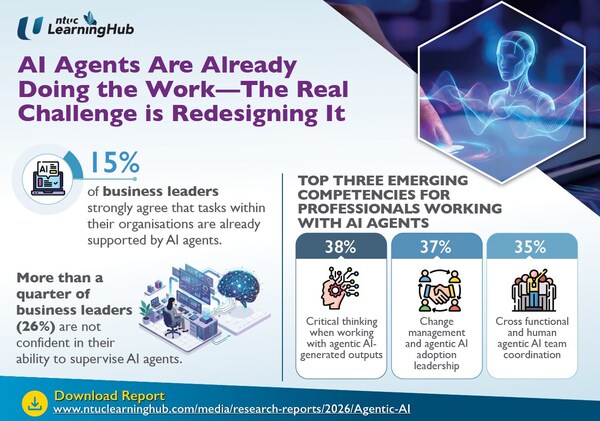
Agentic AI adoption is already taking shape, with 15% of business leaders strongly agreeing that tasks within their organisations are already supported by AI agents. Yet formal job scopes are not keeping pace, with only 27% of business leaders saying job scopes accurately reflect AI agent involvement, while 42% say AI responsibilities are under-represented and 25% report job scopes have not been updated at all, contributing to gaps in supervision and accountability. Control is uneven, with more than a quarter of business leaders not being confident in their ability to supervise AI agents (24% are not very confident, 2% are not confident at all), while 24% say accountability is unclear when AI agents are involved in decisions. Workforce readiness is trailing adoption, with 44% of business leaders citing a lack of skills required for AI-augmented roles as the most significant workforce challenge, followed by difficulty measuring performance fairly (43%) and lack of relevant upskilling opportunities (42%). SINGAPORE, June 5, 2026 /PRNewswire/ — Agentic AI adoption is already taking shape, with 15% of business leaders strongly agreeing that tasks within their organisations are supported by AI agents, particularly in functions such as data analysis and reporting (46%), compliance (30%), customer support and service (30%), IT and cybersecurity (29%), and marketing and sales enablement (28%). As adoption advances, organisations are grappling with how this shift is being managed. While AI agents are taking on more responsibility within workflows, the structures that define governance, accountability and workforce readiness are not always evolving at the same pace. One area where this disconnect is most visible is in formal job scopes. Only 27% of business leaders say job scopes accurately reflect the involvement of AI agents, while 42% report that AI agent responsibilities are under-represented and 25% say job scopes have not been updated at all. This misalignment indicates that while AI agents are influencing daily work, yet responsibility for supervision, decision‐making and outcomes is not always clearly defined. These structural gaps are reflected in the levels of confidence among leaders. More than a quarter of business leaders say they are not confident in their ability in supervising AI agents (24% are not very confident, 2% are not confident at all), and a further 24% report that accountability is unclear when AI agents are involved in decisions. These findings point to ongoing challenges in supervision and governance as AI agents are integrated into organisational decision‐making. These are some of the key findings from NTUC LearningHub’s Industry Insights Report on Agentic AI and Organisational Transformation, which surveyed 200 business leaders to examine how agentic AI is reshaping job control, decision-making and accountability. All respondents have experience working with agentic AI in their roles, with 24% reporting it as a regular and integral part of their daily work and a further 33% engaging with it frequently. In terms of decision‐making involvement, 31% lead or directly influence decisions on AI agents, while 49% provide input and recommendations. Challenges around measurement and oversight add further complexity. Fairness and bias are cited by 39% of business leaders as the most difficult AI agent performance area to quantify, followed by accountability attribution (36%). While many organisations can track productivity and cost metrics, assessing how AI agents perform across these harder‐to‐measure dimensions is a key issue. At the same time, workforce readiness is failing to keep pace with the speed of adoption. The most significant workforce challenge organisations face is the lack of skills required for AI-augmented roles, cited by 44% of business leaders. This is followed closely by difficulty measuring individual and team performance fairly in AI-integrated environments (43%) and limited access to relevant training and upskilling opportunities (42%). As AI agents undertake more tasks, job scopes and role definitions may not be reflecting how work is actually being done. The shift towards agentic AI is also reshaping demand for specific roles and capabilities. Business leaders report that the most sought‐after job functions driven by the emergence of AI agents are data privacy and protection (46%), followed by AI operations and performance monitoring (45%), AI risk and compliance (43%), AI workflow integration (42%) and AI security and threat management (42%). Alongside this, the competencies that organisations prioritise are also evolving. The top emerging competency cited by business leaders is critical thinking when working with agentic AI‐generated outputs (38%), followed by change management and agentic AI adoption leadership (37%), cross‐functional and human–AI team coordination (35%), agentic AI governance, accountability and regulatory compliance (34%), and ethical judgement and responsible agentic AI deployment (34%). Together, these findings highlight a shift towards skills that support oversight, judgement and coordination as AI agents become more embedded in organisational workflows. Despite widespread AI adoption, human judgement is central. The most important criterion for trusting AI agents cited by 37% of business leaders, is ensuring that a human remains in the loop to review and approve AI recommendations before any action is taken. This highlights that even as AI systems become more autonomous, organisations still depend heavily on human oversight to manage risk, accountability and ethical considerations. Commenting on the report’s findings, Mr Amos Tan, Assistant Chief Executive and Chief Core Skills Officer, NTUC LearningHub, says, “AI agents are already embedded in daily operations, but many organisations are scaling faster than what their workforce and control structures can manage. As AI systems take on more autonomous decision‐making, gaps in supervision, accountability and governance become real risks if not thought through and properly designed. Our findings suggest that without deliberate investment in skills such as AI oversight, critical thinking and ethical judgement, organisations may struggle to maintain trust and control as AI adoption accelerates. To scale agentic AI responsibly, companies must redesign roles, update job scopes and strengthen human capabilities in parallel—because while AI may act, accountability must ultimately rest with people.” As agentic AI becomes embedded in day-to-day operations, organisations face a defining choice—continue accelerating adoption without adequate control, or invest in the workforce, governance and operating models needed to manage autonomous systems responsibly at scale. To download the Industry Insights Report on Impact of Agentic AI on Jobs, please visit www. ntuclearninghub. com/media/research-reports/2026/Agentic-AI. To find out more about the courses, training, and grants, please contact NTUC LearningHub at www. ntuclearninghub. com. About NTUC LearningHub NTUC LearningHub is the leading Continuing Education and Training provider in Singapore which aims to transform the lifelong employability of working people. Since our corporatisation in 2004, we have been working with employers and individual learners to provide learning solutions in areas such as Infocomm Technology, Generative AI & Cloud, Healthcare, Retail & Food Services, Employability & Literacy, Business Excellence, Workplace Safety & Health, Security, Human Resources & Coaching and Foreign Workers Training. To date, NTUC LearningHub has helped over 34, 000 organisations and achieved more than 3. 2 million training places across more than 1, 000 courses with a pool of about 1, 000 certified trainers. As a Total Learning Solutions provider to organisations, we also forge partnerships to offer a wide range of relevant end-to-end training. Besides in-person training, we also offer instructor-led virtual live classes (VLCs) and asynchronous online learning. The NTUC LearningHub Learning eXperience Platform (LXP)—a one-stop online learning platform—offers timely, bite-sized and quality content for learners to upskill anytime and anywhere. Beyond learning, LXP also serves as a platform for jobs and skills development for both workers and companies. For more information, visit www. ntuclearninghub. com.
AI Agents Are Already Doing the Work–The Real Challenge is Redesigning It

RELATED ARTICLES


