


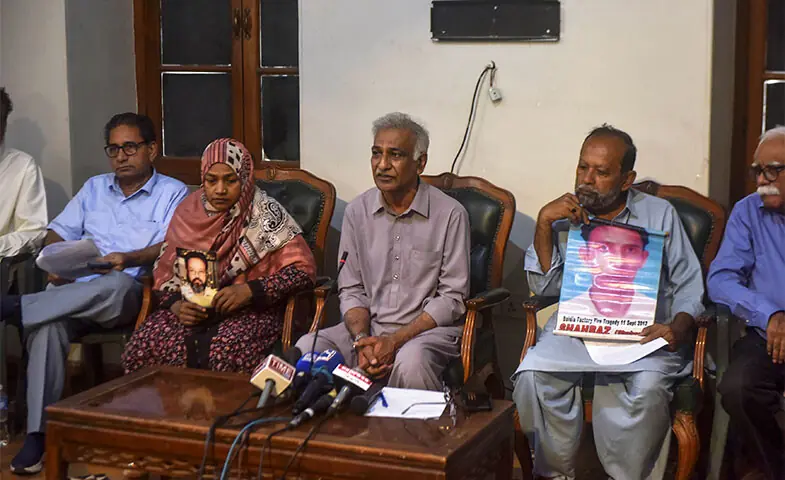
KARACHI: The grieving families of the Baldia Town factory fire victims walked into the Karachi Press Club on Saturday along with labour organisations, wanting to know who they should hold responsible for the death of their loved ones. Holding tightly to the framed photographs of their dear father, son, husband, brother, sister or daughter, the families wanted to know why they had been fed lies for the past 14 years. The recent decision of the three-member bench of the Supreme Court of Pakistan has reopened old wounds as the bench acquitted two Muttahida Qaumi Movement (MQM) activists Abdul Rehman Bhola and Zubair alias Chariya of starting the fire in the factory on September 11, 2012. Both men were given the benefit of doubt by the court as out of approximately 400 witnesses, only one claimed to have seen one of the accused with a chemical bag, while none actually saw the fire being ignited. “It means that what the affected families and labour organisations have been saying from the very beginning, that the tragedy happened because of the criminal negligence of the factory owners and the failure of relevant government departments, which failed to enforce safety laws and conduct proper inspections, was true,” said Nasir Mansoor, General Secretary of the National Trade Union Federation (NTUF). Labour leaders and activists want case reopened for investigation into the failures of labour dept, fire services, EOBI, SESSI and other relevant bodies “Multiple individuals were acquitted throughout various stages of the case. The trial court initially acquitted certain MQM leaders who had been accused of extortion, while later the Sindh High Court also acquitted factory security guards and other employees. And, following the Supreme Court judgement, it now appears that no one is responsible for the deaths of more than 260 workers of the Baldia factory,” he pointed out. “It is also a fact that had the case not been framed as one of terrorism and extortion, the responsibilities and failures of the Labour Department, Fire Brigade, EOBI, Social Security institutions, and other relevant bodies would have come under serious scrutiny,” he said. “It is unfortunate that the course of the case was deliberately diverted in a specific direction to shield these responsible actors. As a result, not only were the real perpetrators spared accountability, but all legal avenues that could have brought the actual culprits to justice were effectively blocked,” Mr Mansoor added. “But we firmly believe that had there been effective accountability of those individuals and institutions involved in this horrific crime, and had they been punished according to law, the lives of millions of workers in thousands of small and large industrial units across the country would be significantly safer today. Unfortunately, this did not happen. The blood of more than 260 workers still demands justice,” the NTUF leader reminded. It is also a matter of record that the factory owners did not provide any direct compensation to the victims. The monthly pension system established for the affected families was made possible through the continuous efforts of labour organisations, lawyers, and international solidarity networks such as the European Centre for Constitutional and Human Rights, Clean Clothes Campaign, IndustriALL Global Union, etc. Compensation was arranged via the German company KIK, providing lifelong monthly pensions to the affected families, currently ranging from approximately Rs9,000 to 35,000 per month. Academic Dr Tauseef Ahmed Khan said that the issue of worker safety was not considered important in the Baldia factory fire case. “If we had done something about worker safety and maintenance of buildings back then, the Gul Plaza tragedy could have been prevented,” he observed. Co-chair of the IndustriALL Global Union Textile Garments Sector and General Secretary of the Home-Based Women Workers Federation, Zehra Khan, said that the Baldia factory case was not tried on its merit while being called a case of terrorism and extortion. “We want the case reopened after a full investigation into the responsibilities and failures of the Labour Department, the Fire Brigade, Social Security institutions, EOBI, and other relevant bodies. Accountability must be ensured wherever negligence is proven,” she said. Chairperson of the Ali Enterprises Factory Fire Affectees Association (AEFFAA), Husna Khatoon, said that she lost her husband in the tragedy. “Most workers in the factory died because factory exits and windows were locked and sealed to prevent theft. They were effectively forced to work inside a sealed building. They were trapped. It was not an accident. It was murder,” she said. General Secretary, Pakistan Fisherfolk Forum, and representative of Pakistan United Workers Federation, Saeed Baloch, said that government departments should have taken their work seriously after such a huge tragedy. Progressive intellectual Dr Asghar Dashti said that it is also a tragedy that the narrative was changed to terrorism and extortion in the Baldia factory case to save the real culprits. General Secretary of the AEFFAA, Muhammad Siddiq, also spoke. Published in Dawn, June 14th, 2026



GrowthPakistan brings you the latest news to keep an eye on Pakistan’s startup ecosystem. Business keeps you growing when you stay aware of your competitors' moves. GrowthPakistan offers Business, Tech, Global Tech, Global, Auto, and Startup News straight from industries all around the globe. This platform will help you identify upcoming opportunities not only in Pakistan but worldwide.
Email : growthpakistan@gmail.com
Whatsapp : +92320-9497079
© growthpakistan