


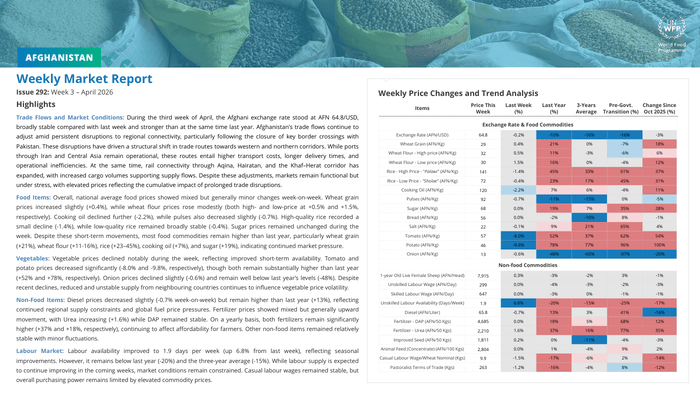
Country: Afghanistan Source: World Food Programme Please refer to the attached file. Highlights Trade Flows and Market Conditions: During the third week of April, the Afghani exchange rate stood at AFN 64. 8/USD, broadly stable compared with last week and stronger than at the same time last year. Afghanistan’s trade flows continue to adjust amid persistent disruptions to regional connectivity, particularly following the closure of key border crossings with Pakistan. These disruptions have driven a structural shift in trade routes towards western and northern corridors. While ports through Iran and Central Asia remain operational, these routes entail higher transport costs, longer delivery times, and operational inefficiencies. At the same time, rail connectivity through Aqina, Hairatan, and the Khaf–Herat corridor has expanded, with increased cargo volumes supporting supply flows. Despite these adjustments, markets remain functional but under stress, with elevated prices reflecting the cumulative impact of prolonged trade disruptions. Food Items: Overall, national average food prices showed mixed but generally minor changes week-on-week. Wheat grain prices increased slightly (+0. 4%), while wheat flour prices rose modestly (both high- and low-price at +0. 5% and +1. 5%, respectively). Cooking oil declined further (-2. 2%), while pulses also decreased slightly (-0. 7%). High-quality rice recorded a small decline (-1. 4%), while low-quality rice remained broadly stable (-0. 4%). Sugar prices remained unchanged during the week. Despite these short-term movements, most food commodities remain higher than last year, particularly wheat grain (+21%), wheat flour (+11-16%), rice (+23–45%), cooking oil (+7%), and sugar (+19%), indicating continued market pressure. Vegetables: Vegetable prices declined notably during the week, reflecting improved short-term availability. Tomato and potato prices decreased significantly (-8. 0% and -9. 8%, respectively), though both remain substantially higher than last year (+52% and +78%, respectively). Onion prices declined slightly (-0. 6%) and remain well below last year’s levels (-48%). Despite recent declines, reduced and unstable supply from neighbouring countries continues to influence vegetable price volatility. Non-Food Items: Diesel prices decreased slightly (-0. 7% week-on-week) but remain higher than last year (+13%), reflecting continued regional supply constraints and global fuel price pressures. Fertilizer prices showed mixed but generally upward movement, with Urea increasing (+1. 6%) while DAP remained stable. On a yearly basis, both fertilizers remain significantly higher (+37% and +18%, respectively), continuing to affect affordability for farmers. Other non-food items remained relatively stable with minor fluctuations. Labour Market: Labour availability improved to 1. 9 days per week (up 6. 8% from last week), reflecting seasonal improvements. However, it remains below last year (-20%) and the three-year average (-15%). While labour supply is expected to continue improving in the coming weeks, market conditions remain constrained. Casual labour wages remained stable, but overall purchasing power remains limited by elevated commodity prices.



GrowthPakistan brings you the latest news to keep an eye on Pakistan’s startup ecosystem. Business keeps you growing when you stay aware of your competitors' moves. GrowthPakistan offers Business, Tech, Global Tech, Global, Auto, and Startup News straight from industries all around the globe. This platform will help you identify upcoming opportunities not only in Pakistan but worldwide.
Email : growthpakistan@gmail.com
Whatsapp : +92320-9497079
© growthpakistan