

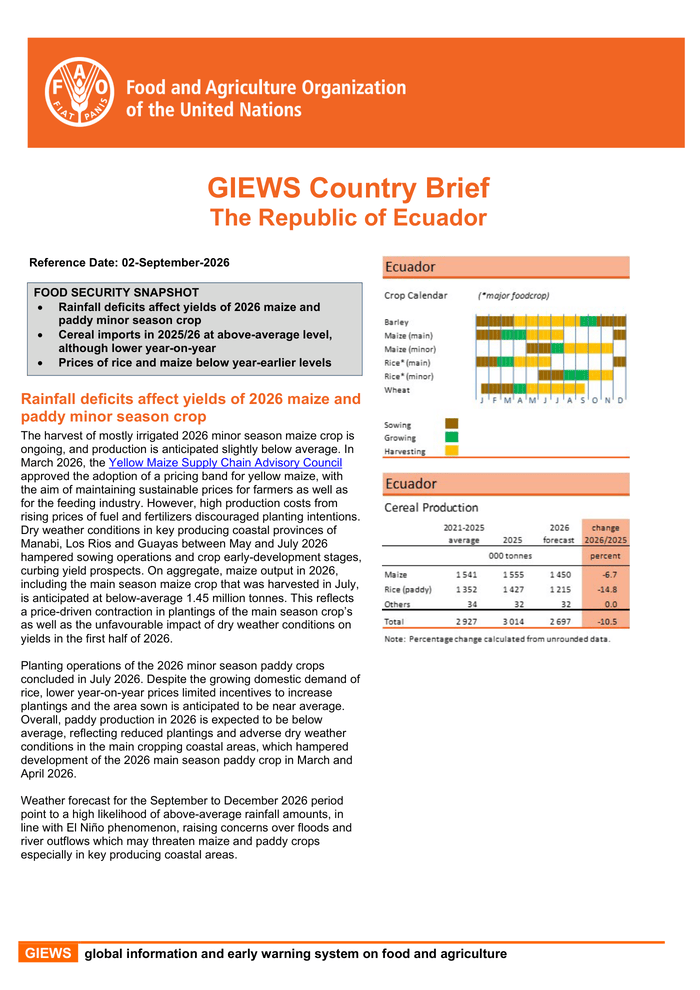
Country: Ecuador Source: Food and Agriculture Organization of the United Nations Please refer to the attached file. FOOD SECURITY SNAPSHOT Rainfall deficits affect yields of 2026 maize and paddy minor season crop Cereal imports in 2025/26 at above‐average level, although lower year‐on‐year Prices of rice and maize below year‐earlier levels Rainfall deficits affect yields of 2026 maize and paddy minor season crop The harvest of mostly irrigated 2026 minor season maize crop is ongoing, and production is anticipated slightly below average. In March 2026, the Yellow Maize Supply Chain Advisory Council approved the adoption of a pricing band for yellow maize, with the aim of maintaining sustainable prices for farmers as well as for the feeding industry. However, high production costs from rising prices of fuel and fertilizers discouraged planting intentions. Dry weather conditions in key producing coastal provinces of Manabi, Los Rios and Guayas between May and July 2026 hampered sowing operations and crop early‐development stages, curbing yield prospects. On aggregate, maize output in 2026, including the main season maize crop that was harvested in July, is anticipated at below‐average 1. 45 million tonnes. This reflects a price‐driven contraction in plantings of the main season crop’s as well as the unfavourable impact of dry weather conditions on yields in the first half of 2026. Planting operations of the 2026 minor season paddy crops concluded in July 2026. Despite the growing domestic demand of rice, lower year‐on‐year prices limited incentives to increase plantings and the area sown is anticipated to be near average. Overall, paddy production in 2026 is expected to be below average, reflecting reduced plantings and adverse dry weather conditions in the main cropping coastal areas, which hampered development of the 2026 main season paddy crop in March and April 2026. Weather forecast for the September to December 2026 period point to a high likelihood of above‐average rainfall amounts, in line with El Niño phenomenon, raising concerns over floods and river outflows which may threaten maize and paddy crops especially in key producing coastal areas. Cereal imports in 2025/26 at above‐average level, although lower year‐on‐year About 40 percent of the country’s cereal consumption needs are usually met through imports. Cereal imports in the 2025/26 marketing year (July/June), mostly wheat grain, are estimated at 2. 2 million tonnes, about 24 percent above the previous five‐year average, but below the record amount of 2024/25. High wheat imports primarily reflect the rising demand for human consumption, as well as increased feed use by the expanding export‐oriented shrimp industry and the poultry sector. In contrast, maize import requirements in the 2025/26 marketing year were estimated at less than half the average level, reflecting abundant carryover stocks following the large domestic production harvested in 2025. In 2026/27, cereal import requirements are forecast to remain above average, due to rising demand of wheat grain, as well as high maize import demand, in line with limited carryover stocks of maize from 2026 below‐average outturn. Prices of rice and maize below year‐earlier levels Wholesale prices of maize in Quito Market declined seasonally between May and July 2026 with the onset of the main season harvest. However, in the country’s two largest markets, Quito and Guayaquil, prices remained above their level of the previous year as the above‐average harvest in 2025 had kept prices comparatively low. Rice prices were mostly stable from May to July 2026 across the markets reflecting adequate seasonal availability and were up to 23 percent lower than one year earlier, pressured downward by 2025 large output as well as by declining international quotations. Disclaimer: The designations employed and the presentation of material in this information product do not imply the expression of any opinion whatsoever on the part of FAO concerning the legal status of any country, territory, city or area or of its authorities, or concerning the delimitation of its frontiers or boundaries. This brief was prepared using the following data/tools: FAO/GIEWS Country Cereal Balance Sheet (CCBS) https: //www. fao. org/giews/data-tools/en/. FAO/GIEWS Food Price Monitoring and Analysis (FPMA) Tool https: //fpma. fao. org/. FAO/GIEWS Earth Observation for Crop Monitoring https: //www. fao. org/giews/earthobservation/. Integrated Food Security Phase Classification (IPC) https: //www. ipcinfo. org/.
GIEWS Country Brief Ecuador 02-September-2026

RELATED ARTICLES


