


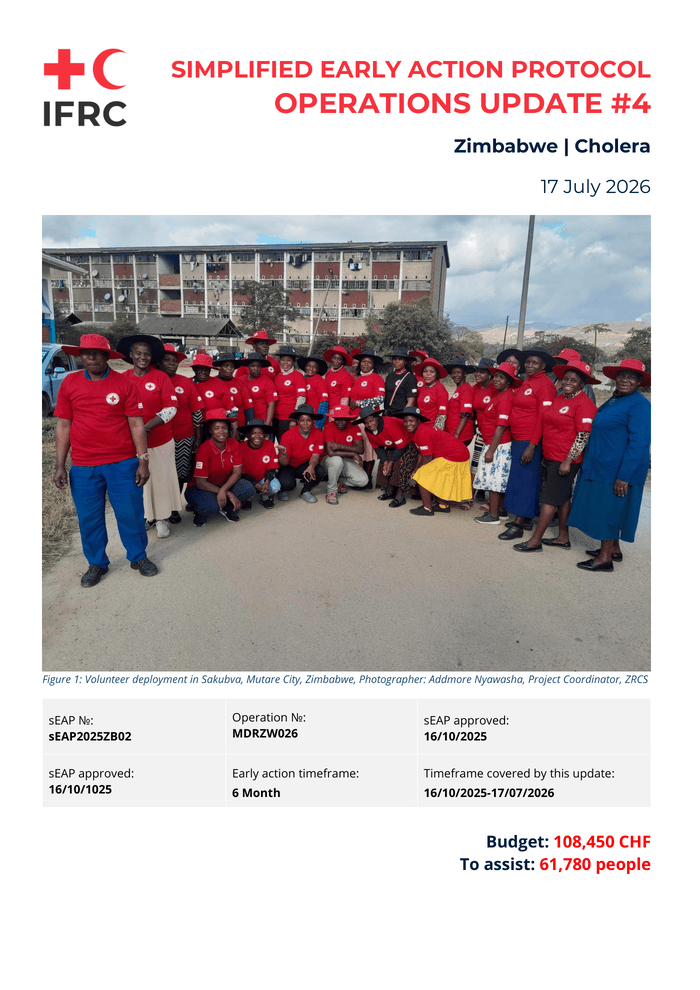
Country: Zimbabwe Source: International Federation of Red Cross and Red Crescent Societies Please refer to the attached file. SIMPLIFIED EARLY ACTION PROTOCOL Summary of revisions to the operation The Zimbabwe Red Cross Society (ZRCS) requests a no-cost extension of the Cholera Simplified Early Action Protocol (sEAP) implementation period until 30 September 2026. No changes are proposed to the approved budget, geographical coverage, target population, intervention strategy, or planned activities. The requested extension is solely intended to provide sufficient time to complete critical operational learning and review processes that are essential for strengthening the current and future effectiveness of the Cholera anticipatory action. The current implementation period concludes before the planned Cholera sEAP Operational Review, which has been scheduled for the last week of August 2026. This review will bring together the NS, PNSs and IFRC to assess the implementation of the sEAP, review operational performance, identify good practices and operational challenges, and document recommendations for strengthening future anticipatory action for cholera. Immediately following the Operational Review, ZRCS will conduct a Lessons Learnt Workshop to consolidate findings from the review, capture experiences from volunteers, staff, government counterparts and partners, and identify practical recommendations for improving the design, activation triggers, implementation arrangements, coordination mechanisms, monitoring systems and operational readiness of the future Cholera sEAPs. The requested no-cost extension will therefore ensure that both the Operational Review and Lessons Learnt Workshop are completed within the implementation period, allowing their findings to be formally incorporated into the final operational documentation and future revisions of the Cholera sEAP. These activities are consistent with ZRCS commitments to learning, accountability, and continuous improvement of anticipatory action programming. No additional funding is being requested. All activities associated with the extension will be implemented using the existing approved budget. Operations Update 4 represents a transition from implementation of early actions to consolidation, learning and institutionalisation of the Cholera sEAP experience. While Operations Update 3 documented significant delivery of preparedness and response actions, Update 4 focuses on ensuring that these achievements are reviewed, lessons are captured and the model is strengthened for future activations. Key achievements • Early action implementation was successfully advanced from preparedness to operational delivery. In the previous update, ZRCS established and strengthened community-level RC-CATI capacity, including volunteer training, community engagement, surveillance and preparedness activities. Update 4 confirms that ZRCS has continued implementing preparedness and early actions in close coordination with MoHCC and IFRC, demonstrating continuity from the initial activation through to the finalisation phase. • The operation has progressed from immediate response readiness to consolidation of operational experience. Operations Update 3 demonstrated strengthened frontline capacity through RC-CATI volunteers, prepositioning of cholera supplies, water safety interventions and community-level activities. Update 4 now shifts the emphasis toward documenting performance, validating lessons and identifying improvements for future activations, indicating that the operational experience generated through these interventions is being deliberately converted into institutional learning. • The sEAP has generated sufficient operational experience to support a structured review of the anticipatory action approach. The planned Operational Review (24-28 August 2026), will assess implementation performance, identify good practices and challenges, and develop recommendations for future cholera anticipatory action. This builds directly on the operational achievements reported in the earlier updates, including early detection, RC-CATI deployment, WASH interventions, coordination and preparedness. • Learning will be broadened beyond ZRCS to include key operational stakeholders. The planned Lessons Learnt Workshop will capture experiences from volunteers, ZRCS staff, government counterparts and partners. This provides an opportunity to consolidate lessons from the community-level and institutional interventions implemented during the operation and translate them into practical recommendations. • The operation is strengthening the future design of the Cholera sEAP. Lessons from implementation will inform improvements to activation triggers, implementation arrangements, coordination mechanisms, monitoring systems and operational readiness. • Operational continuity has been maintained without additional funding. ZRCS requested a no-cost extension to allow the Operational Review and Lessons Learnt Workshop to be completed within the implementation period. Importantly, there are no proposed changes to the approved budget, geographical coverage, target population, intervention strategy or planned activities, and the extension will use the existing approved budget



GrowthPakistan brings you the latest news to keep an eye on Pakistan’s startup ecosystem. Business keeps you growing when you stay aware of your competitors' moves. GrowthPakistan offers Business, Tech, Global Tech, Global, Auto, and Startup News straight from industries all around the globe. This platform will help you identify upcoming opportunities not only in Pakistan but worldwide.
Email : growthpakistan@gmail.com
Whatsapp : +92320-9497079
© growthpakistan