

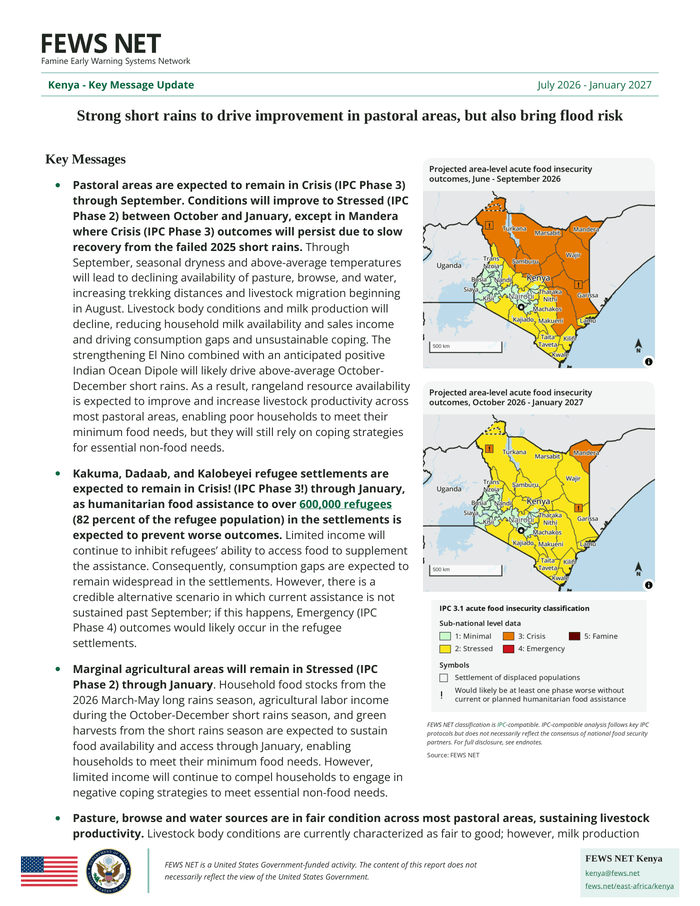
Country: Kenya Source: Famine Early Warning System Network Please refer to the attached file. Key Messages Pastoral areas are expected to remain in Crisis (IPC Phase 3) through September. Conditions will improve to Stressed (IPC Phase 2) between October and January, except in Mandera where Crisis (IPC Phase 3) outcomes will persist due to slow recovery from the failed 2025 short rains. Through September, seasonal dryness and above-average temperatures will lead to declining availability of pasture, browse, and water, increasing trekking distances and livestock migration beginning in August. Livestock body conditions and milk production will decline, reducing household milk availability and sales income and driving consumption gaps and unsustainable coping. The strengthening El Nino combined with an anticipated positive Indian Ocean Dipole will likely drive above-average October-December short rains. As a result, rangeland resource availability is expected to improve and increase livestock productivity across most pastoral areas, enabling poor households to meet their minimum food needs, but they will still rely on coping strategies for essential non-food needs. Kakuma, Dadaab, and Kalobeyei refugee settlements are expected to remain in Crisis! (IPC Phase 3!) through January, as humanitarian food assistance to over 600, 000 refugees (82 percent of the refugee population) in the settlements is expected to prevent worse outcomes. Limited income will continue to inhibit refugees’ ability to access food to supplement the assistance. Consequently, consumption gaps are expected to remain widespread in the settlements. However, there is a credible alternative scenario in which current assistance is not sustained past September; if this happens, Emergency (IPC Phase 4) outcomes would likely occur in the refugee settlements. Marginal agricultural areas will remain in Stressed (IPC Phase 2) through January. Household food stocks from the 2026 March-May long rains season, agricultural labor income during the October-December short rains season, and green harvests from the short rains season are expected to sustain food availability and access through January, enabling households to meet their minimum food needs. However, limited income will continue to compel households to engage in negative coping strategies to meet essential non-food needs. Pasture, browse and water sources are in fair condition across most pastoral areas, sustaining livestock productivity. Livestock body conditions are currently characterized as fair to good; however, milk production remains below average across most areas due to limited herd sizes. In Garissa, Mandera, Marsabit, Samburu, and Turkana, milk production is 16 to 50 percent below average. As of late July, vegetation greenness was 70-80 percent of the long-term mean across most areas, while most surface water points were classified as Watch (50-100 percent of the long-term median) or seasonally dry (10 percent or less of the long-term median). While livestock remain in wet-season grazing areas across most regions, trekking distances vary. They are approximately 10-40 percent further than average in Wajir, Samburu, Turkana, and Mandera and 10-50 percent shorter than average in Garissa, Isiolo, Marsabit and Tana River. Availability of rangeland resources is expected to decline during the dry season, reducing livestock productivity from August through September. In Turkana, pasture, browse and water resources are declining faster than typically due to limited off-season rainfall, which typically occurs during June-September. Consequently, livestock movements toward and across the border with Uganda are occurring earlier than typical. The March-May long rains crop production prospects are mixed across the country largely due to temporal variability of rainfall. In southeastern and coastal marginal agricultural areas, harvest of cereals (maize, sorghum and millet) and pulses is ongoing and nearly complete in some areas. Near-average production is expected across most marginal agricultural areas. Overall, household food availability in these areas has improved, reducing market dependence. In the unimodal medium and high potential areas of the North Rift and western Kenya, the maize crop is experiencing acute water deficits due to below-average rainfall, including prolonged dry spells, since April. The water deficit is likely to worsen, given the forecast El-Nino-driven dryness through September. Consequently, crop production in these key grain production regions of Kenya is likely to be substantially below average; preliminary estimates suggest a 15 percent yield loss for maize in these areas. Below-average maize production in addition to persistently high fuel costs will likely sustain upward pressure on staple food prices. The government of Kenya has initiated preparedness for the forecast October-December 2026 El Niño rains, which are expected to cause flooding, through a coordinated national response framework led by the National Disaster Risk Management Authority (NDRMA) and overseen by the Ad Hoc Cabinet Committee on El Niño Preparedness and Response. Key preparedness measures include public awareness campaigns, infrastructure and drainage improvements, evacuation logistics and shelter planning, and agriculture and public health interventions. NDRMA is coordinating the development of the National El Niño Contingency Plan, engaging national government ministries and agencies, county governments, humanitarian and development agencies, and the private sector.
Kenya – Key Message Update: Strong short rains to drive improvement in pastoral areas, but also bring flood risk, July 2026 – January 2027

RELATED ARTICLES


