


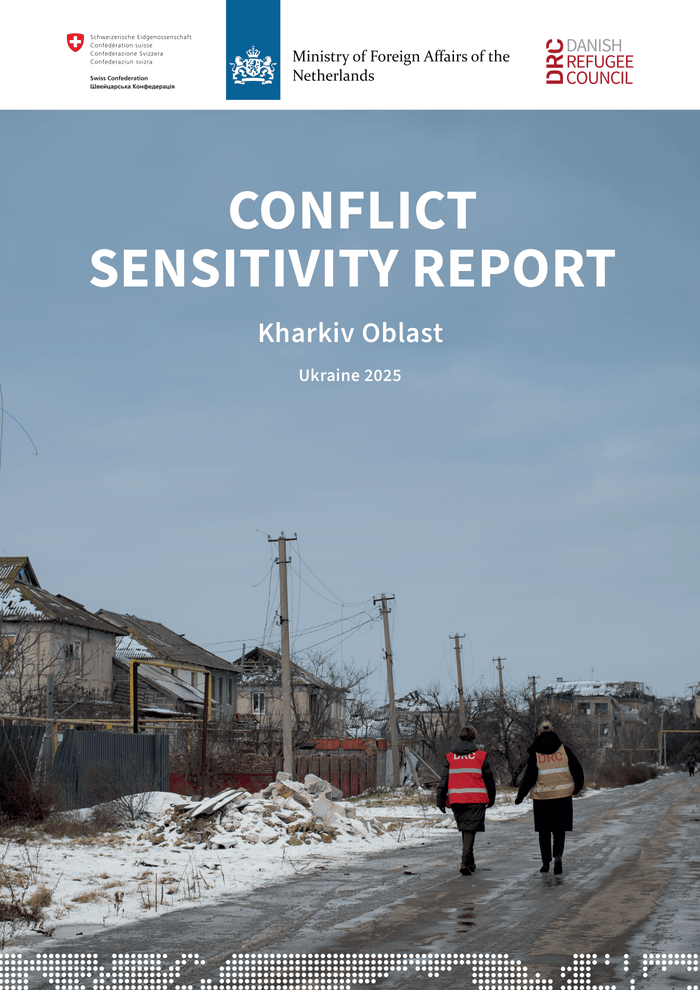
Country: Ukraine Source: Danish Refugee Council Please refer to the attached file. Executive summary Kharkiv Oblast continues to face the cumulative effects of Russia’s full-scale invasion, including large-scale displacement, infrastructure damage, ongoing security threats, and Explosive Ordnance (EO) contamination. This conflict sensitivity analysis examines how war-related pressures shape community relations, trust dynamics, and perceptions of fairness – factors critical to effective humanitarian and recovery programming. Based on assessment data from nine communities collected in November 2025, the report identifies key conflict sensitivity risks and opportunities, providing actionable recommendations for conflict-sensitive assistance. Key insights Economic strain and risks of aid-related tensions Households face severe financial strain from lost income, destroyed assets, and rising costs. Local governance budgets are depleted, limiting service delivery. These pressures create fertile ground for tensions when assistance is perceived as insufficient or unfairly distributed. Communities closely compare who receives support and why, making transparency about targeting criteria essential. Trust depends on visible performance and transparent communication Trust in local authorities and humanitarian actors is shaped by their visible crisis response, transparent decision-making, and clear communication. While internally displaced person (IDP)-host relations are generally positive, tensions emerge where resources are limited or aid distribution seems unfair. Perceptions of corruption, particularly in reconstruction and aid allocation, can rapidly undermine legitimacy, even without evidence of systemic wrongdoing. Some groups, including elderly people, people with disabilities, and those in remote areas, may have limited access to commonly used communication channels such as social media, local bulletins, or community meetings, which can reduce their awareness of decisions and aid processes. Fairness judged through observable micro-level signals Residents judge fairness based on visible allocation decisions, for example, who gets housing repairs first, aid distribution or beneficiary selection. Lack of clarity about why certain neighbourhoods are prioritised fuels grievances and rumours. Communication becomes a substitute for participation under wartime constraints, making transparent explanation of criteria and timelines critical. Multiple groups face heightened exclusion risks Overall intergroup relations in the region remain largely positive, with communities demonstrating solidarity and relatively low levels of open tension. However, the prolonged impact of the war has affected groups unevenly. Certain vulnerable and at-risk populations experience more acute socioeconomic strain, barriers to services, and reduced coping capacity, which increases their exposure to exclusion even in otherwise cohesive communities. For instance, IDPs experience discrimination in employment and housing. Elderly people struggle with mobility and service access. People with disabilities encounter physical barriers and limited support. Single-parent households face economic vulnerability. Veterans experience social distance due to gaps in reintegration programming. Addressing these overlapping vulnerabilities requires intentional inclusive approaches.



GrowthPakistan brings you the latest news to keep an eye on Pakistan’s startup ecosystem. Business keeps you growing when you stay aware of your competitors' moves. GrowthPakistan offers Business, Tech, Global Tech, Global, Auto, and Startup News straight from industries all around the globe. This platform will help you identify upcoming opportunities not only in Pakistan but worldwide.
Email : growthpakistan@gmail.com
Whatsapp : +92320-9497079
© growthpakistan