

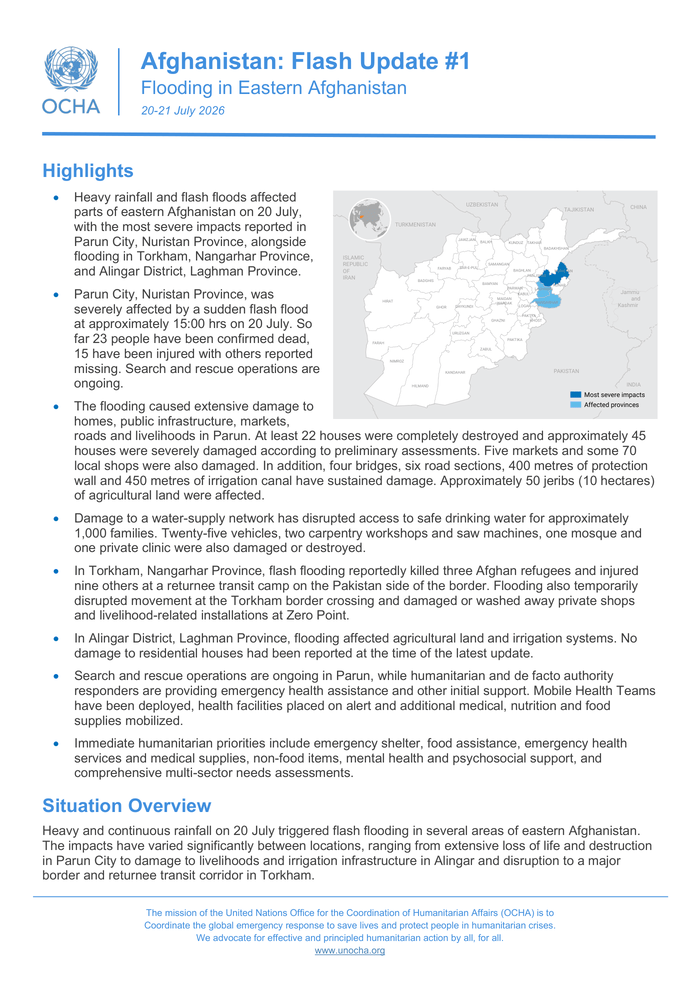
Country: Afghanistan Source: UN Office for the Coordination of Humanitarian Affairs Please refer to the attached file. Highlights Heavy rainfall and flash floods affected parts of eastern Afghanistan on 20 July, with the most severe impacts reported in Parun City, Nuristan Province, alongside flooding in Torkham, Nangarhar Province, and Alingar District, Laghman Province. Parun City, Nuristan Province, was severely affected by a sudden flash flood at approximately 15: 00 hrs on 20 July. So far 23 people have been confirmed dead, 15 have been injured with others reported missing. Search and rescue operations are ongoing. The flooding caused extensive damage to homes, public infrastructure, markets, roads and livelihoods in Parun. At least 22 houses were completely destroyed and approximately 45 houses were severely damaged according to preliminary assessments. Five markets and some 70 local shops were also damaged. In addition, four bridges, six road sections, 400 metres of protection wall and 450 metres of irrigation canal have sustained damage. Approximately 50 jeribs (10 hectares) of agricultural land were affected. Damage to a water-supply network has disrupted access to safe drinking water for approximately 1, 000 families. Twenty-five vehicles, two carpentry workshops and saw machines, one mosque and one private clinic were also damaged or destroyed. In Torkham, Nangarhar Province, flash flooding reportedly killed three Afghan refugees and injured nine others at a returnee transit camp on the Pakistan side of the border. Flooding also temporarily disrupted movement at the Torkham border crossing and damaged or washed away private shops and livelihood-related installations at Zero Point. In Alingar District, Laghman Province, flooding affected agricultural land and irrigation systems. No damage to residential houses had been reported at the time of the latest update. Search and rescue operations are ongoing in Parun, while humanitarian and de facto authority responders are providing emergency health assistance and other initial support. Mobile Health Teams have been deployed, health facilities placed on alert and additional medical, nutrition and food supplies mobilized. Immediate humanitarian priorities include emergency shelter, food assistance, emergency health services and medical supplies, non-food items, mental health and psychosocial support, and comprehensive multi-sector needs assessments. Situation Overview Heavy and continuous rainfall on 20 July triggered flash flooding in several areas of eastern Afghanistan. The impacts have varied significantly between locations, ranging from extensive loss of life and destruction in Parun City to damage to livelihoods and irrigation infrastructure in Alingar and disruption to a major border and returnee transit corridor in Torkham. In Parun City, the sudden onset of flooding rapidly affected residential areas, public facilities and commercial premises. The latest preliminary assessment by the Afghanistan National Disaster Management Authority (ANDMA) in Nuristan indicates that 23 people have been killed, 15 confirmed injured while others remain missing. The flood damaged the local water-supply network disrupting access to safe drinking water for approximately 1, 000 families. Damage to bridges and roads is affecting movement and access, while damage to irrigation infrastructure has increased risks to communities and agricultural livelihoods. Markets, local shops, vehicles, carpentry workshops and saw machines were damaged or destroyed, while agricultural land was flooded. The flood also caused significant damage to humanitarian and development actors operating in the city. The office of ODESC, a UNESCO implementing partner, was destroyed, while the warehouse and other assets of New Consultancy and Relief Organization (NCRO), including a vehicle and motorbike, were damaged. One national NGO staff member is reportedly missing. The impact in Torkham extended beyond physical damage to infrastructure and livelihoods. Flooding affected a returnee transit camp on the Pakistan side of the border, resulting in three reported deaths and nine injuries, while movement through the Torkham crossing was temporarily delayed. The flooding also damaged the protection wall of the Directorate of Refugees and Repatriation compound at Zero Point, Torkham, where humanitarian partners are providing basic services to returnees. In Alingar District, Laghman Province, the reported impact has primarily been on agricultural land and irrigation systems. The damage may affect agricultural production and livelihoods, although no damage to residential houses had been reported at the time of the latest update. In the southeastern region, flooding has affected communities and infrastructure in several areas, with assessments and verification ongoing. The full scale of the regional impact remains under assessment. In Parun in particular, search and rescue operations continue and the number of casualties and missing people may change as additional information is verified. Further rainfall and unstable weather conditions also continue to pose a risk of additional flooding. Humanitarian Response Humanitarian partners and relevant authorities are working to verify the impact of the floods and identify the most urgent needs in affected areas. Priority response activities include search and rescue, the recovery and identification of people who have died, assistance to injured people and support to affected families. Initial response priorities include: Emergency shelter and non-food items for families whose homes have been damaged or destroyed; Food assistance for households that have lost access to food stocks, markets or livelihoods; Safe drinking water, hygiene supplies and sanitation support, particularly in areas where water infrastructure has been damaged or contaminated; Emergency health assistance, including support for injured people and the deployment of mobile health services where required; Protection assistance for families affected by loss of life, displacement, unsafe shelter conditions and access constraints; Debris removal and clearance of roads and other access routes; Repair and restoration of damaged irrigation infrastructure and other critical community infrastructure; and Multi-purpose cash assistance, where markets remain functional and cash assistance is feasible, to help affected households meet their most urgent needs. Response efforts remain constrained by difficult terrain, damaged roads and limited access to some affected communities. Further assessments are required to determine the scale and severity of needs, particularly in remote areas of Nuristan and other mountainous locations. Coordination OCHA is coordinating with relevant stakeholders, including disaster-management structures, UN agencies, international and national NGOs and other humanitarian partners to support the assessment and response to the flooding. In Nuristan, ANDMA provided an updated preliminary assessment to the Nuristan OCT on 21 July. OCHA and SHPOUL coordinated an ad hoc OCT meeting on 21 July to review the evolving situation, coordinate the initial humanitarian response and prepare for inter-agency needs assessments. A rapid needs assessment is being conducted on 21 July. Three inter-agency needs assessment teams have also been constituted, with surge support from Kunar and Jalalabad, and are scheduled to begin assessments on 22 July. OCHA’s Eastern Region team remains in close contact with ANDMA, the Nuristan OCT, local authorities and humanitarian partners. Coordination is also ongoing with relevant authorities and partners in Nangarhar and Laghman. Weather forecasts and early-warning information have been disseminated to humanitarian partners and the OCT network to support preparedness and monitoring of further rainfall and flood risks. A medical site has been established in collaboration with the Directorate of Public Health and two mobile health teams have been deployed. Medical items and food and nutrition items have also been dispatched with high energy biscuits expected to arrive on 21 July. At the national level, ANDMA convened a meeting on 21 July to plan the next steps and coordinate response. Coordination efforts are focused on: Verifying reported casualties, missing persons and the number of affected households; Supporting the deployment of assessment teams to affected areas; Identifying urgent needs and prioritizing assistance to the most severely affected communities; Coordinating search-and-rescue, emergency response and early recovery efforts; Facilitating information-sharing among humanitarian partners and authorities; Identifying access constraints and supporting efforts to restore critical roads and routes; and Monitoring the humanitarian situation, including the potential impacts on food security, livelihoods, health, water and sanitation, and protection. Further assessments are ongoing. Humanitarian partners continue to coordinate with authorities and affected communities to establish the full scale of the disaster and scale up assistance according to verified needs.
Afghanistan: Flash Update #1: Flooding in Eastern Afghanistan (20 to 21 July 2026)

RELATED ARTICLES


