


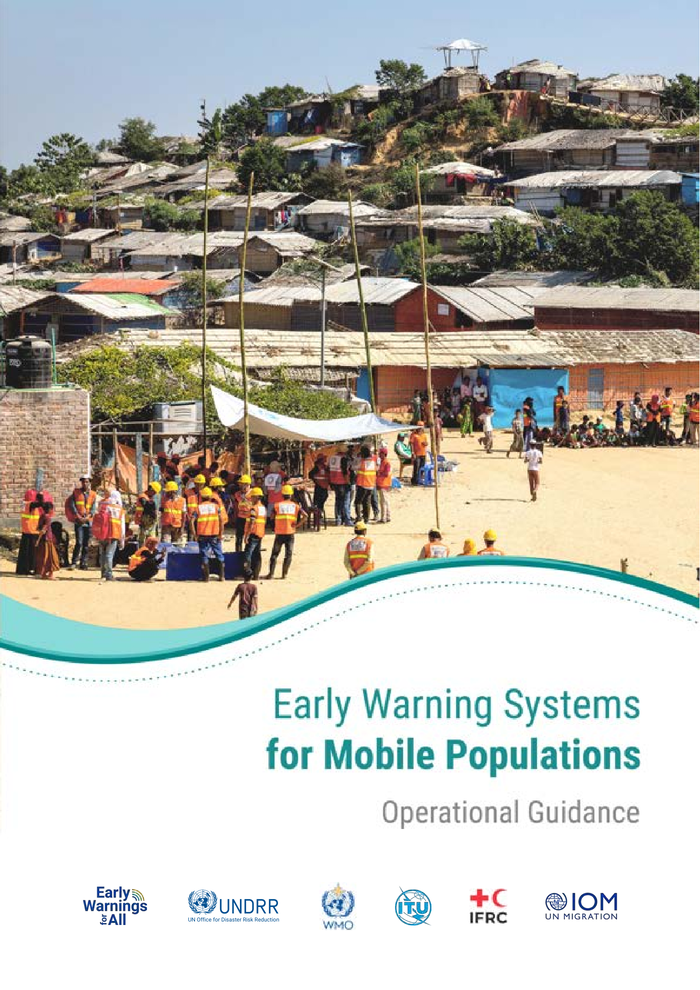
Country: World Sources: International Federation of Red Cross and Red Crescent Societies, International Organization for Migration, International Telecommunication Union, UN Office for Disaster Risk Reduction, World Meteorological Organization Please refer to the attached file. This operational guidance provides practical direction for designing and implementing people-centred, inclusive multi-hazard early warning systems that effectively reach and protect mobile populations, including displaced persons, refugees, migrants in vulnerable situations and other groups affected by changing locations or circumstances. Human mobility shapes disaster risk in multiple ways. People may move into hazard-prone areas due to economic necessity, displacement or insecurity; they may be temporarily present along routes, in workplaces or transit hubs; or they may be unable to move at all because of poverty, disability or insecurity. It concludes that a MHEWS that effectively includes mobile populations is not a separate or specialized system. It is a more robust and resilient system that recognizes mobility as a persistent feature of risk and designs early warning processes that can function despite movement, uncertainty and constraint. By grounding inclusion in existing institutions, mandates and operational realities, this guidance aims to support incremental but meaningful improvements in how early warnings reach and protect people on the move. Executive summary Multi-hazard early warning systems (MHEWS) are a core pillar of disaster risk reduction, enabling timely action to reduce loss of life, livelihoods and essential services. To be effective, MHEWS must be people-centred and inclusive, ensuring that all populations at risk can access, understand and act on warnings. In practice, however, many existing systems continue to be designed around relatively static populations and fixed administrative boundaries, and do not adequately account for human mobility. This operational guidance responds to that gap. It provides practical direction for designing and implementing MHEWS that work for mobile populations, including displaced persons, refugees, migrants in vulnerable situations, and other groups whose location, legal status, access to services or communication channels may change over time. The guidance focuses on forecastable natural hazards and on strengthening existing national and local early warning systems. The primary audience is national disaster risk management authorities, national meteorological and hydrological services, geophysical agencies, and line ministries, working in coordination with humanitarian actors, local authorities, civil society and community partners. The guidance is intended to be adaptable across development, humanitarian, and fragile or conflict-affected contexts. Understanding why mobility matters is essential to improving the performance of early warning systems. Human mobility shapes disaster risk in multiple ways. People may move into hazard-prone areas due to economic necessity, displacement or insecurity; they may be temporarily present along routes, in workplaces or transit hubs; or they may be unable to move at all because of poverty, disability or insecurity. These dynamics influence exposure, vulnerability and the ability to act on warnings. At the same time, mobile populations often face language barriers, documentation constraints, limited connectivity, mistrust of authorities or protection risks that undermine access to and use of early warning information. In view of the above, the guidance adopts human mobility as an analytical lens rather than a legal categorization. The emphasis is not on status, but on identifying where, when and how people are likely to be exposed to hazards, and what enables or constrains their ability to receive and act on warnings. Mobility is treated as a dynamic modifier of risk, not as a hazard in itself. The guidance is organized into two complementary parts. Part A establishes the conceptual and institutional foundations for inclusive MHEWS in mobility-affected contexts. Chapter 1 sets out the rationale for focusing on mobile populations within people-centred MHEWS, situating the guidance within global disaster risk reduction and early warning commitments. It clarifies the scope and limitations of the document and its alignment with existing systems. Chapter 2 examines how mobility interacts with disaster risk, highlighting implications for exposure, vulnerability and response capacity. It introduces key operational dimensions of mobility and identifies common contexts in which early warning systems tend to fail for mobile populations, synthesized in an illustrative table linking mobility situations with early warning system (EWS) design considerations. Chapter 3 addresses governance, coordination and cross-border action, focusing on the institutional arrangements required for inclusive EWS. It highlights the importance of clear roles, coordination across sectors, protection-sensitive data practices, and cooperation across borders where hazards and population movements intersect. Part B translates these foundations into operational guidance across the core components of MHEWS. Chapter 4 provides step-by-step guidance on risk assessment and mapping for EWS in mobile settings. It frames risk assessment as a decision support function for early warning, trigger-setting, and early and anticipatory action, prioritizing forecastable hazards, foreseeable impacts, and protection-sensitive, usable risk outputs. Chapter 5 addresses monitoring, analysis and forecasting, focusing on the interface between authoritative hazard information and EWS decision-making in mobility contexts. It clarifies roles and responsibilities, and outlines how hazard information can be interpreted and applied in ways that reflect dynamic exposure and mobility patterns, without replacing formal forecasting systems. Chapter 6 focuses on dissemination and communication as well as preparedness to respond to warnings through early and anticipatory action. It provides guidance on translating forecasts into decision-relevant warnings for mobile populations, co-designing messages and dissemination arrangements, linking warnings to feasible actions, and verifying whether warnings were received, understood and acted upon. Across all chapters, the guidance emphasizes cost-effective, locally adaptable and protection-sensitive approaches. It recognizes that data may be incomplete, capacities uneven and contexts fluid, particularly in fragile or displacement-affected settings. It offers structured questions, decision points, tables and templates to support contextual adaptation. A MHEWS that effectively includes mobile populations is not a separate or specialized system. It is a more robust and resilient system that recognizes mobility as a persistent feature of risk and designs early warning processes that can function despite movement, uncertainty and constraint. By grounding inclusion in existing institutions, mandates and operational realities, this guidance aims to support incremental but meaningful improvements in how early warnings reach and protect people on the move.



GrowthPakistan brings you the latest news to keep an eye on Pakistan’s startup ecosystem. Business keeps you growing when you stay aware of your competitors' moves. GrowthPakistan offers Business, Tech, Global Tech, Global, Auto, and Startup News straight from industries all around the globe. This platform will help you identify upcoming opportunities not only in Pakistan but worldwide.
Email : growthpakistan@gmail.com
Whatsapp : +92320-9497079
© growthpakistan