

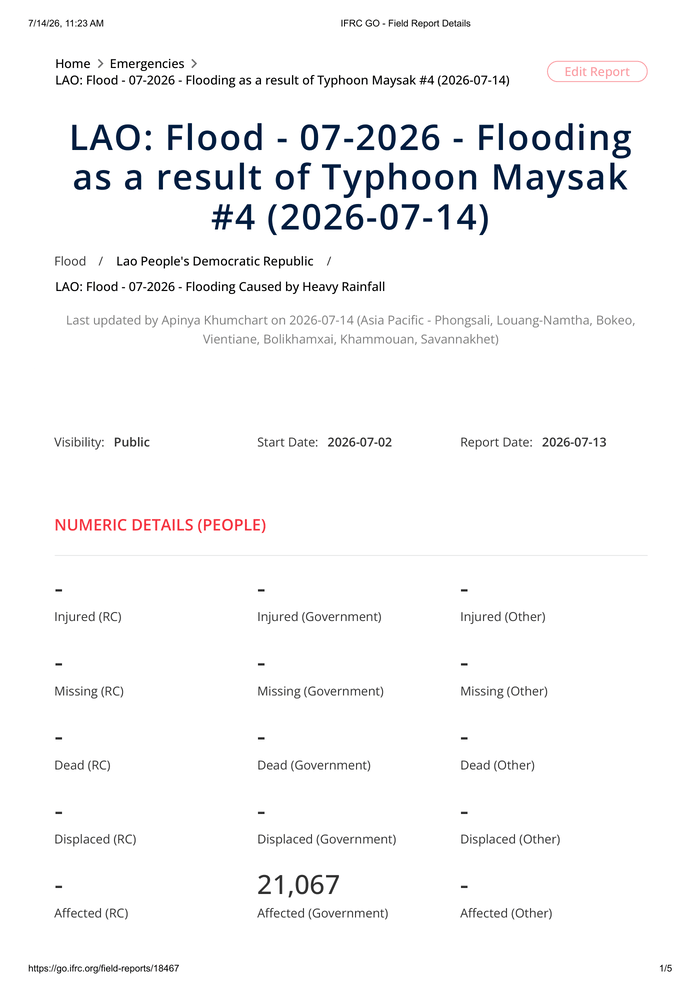
Country: Lao People’s Democratic Republic (the) Sources: International Federation of Red Cross and Red Crescent Societies, Lao Red Cross Please refer to the attached file. Description Following Typhoon Maysak, which brought several days of moderate-to-heavy rainfall beginning on 2 July 2026, widespread flooding affected multiple parts of the Lao PDR. The combined effects of flash floods, river flooding, landslides and prolonged inundation caused significant damage to housing, agriculture, transportation infrastructure, livelihoods, and other community assets across Luang Namtha, Bokeo, Phongsali, Vientiane, Bolikhamxai, Khammouane, and Savannakhet provinces. According to the Lao National Disaster Management Committee (NDMC), four provinces, five districts and 28 villages were affected. A total of 3, 822 households, representing approximately 21, 067 people, including 8, 217 women, were impacted by the flooding. Khammouane Province was among the worst-affected areas, particularly Nakai and Koun Kham districts, where flooding resulted in evacuations, damage to residential areas and agricultural land, and disruption to transportation and essential services. In Koun Kham District, 14 households were evacuated to temporary shelters, while additional stranded travellers were accommodated by local authorities. Although floodwaters have begun to recede in some areas, damage assessments remain ongoing. Government authorities and humanitarian partners continue to monitor the situation and identify priority recovery needs, including food assistance, safe drinking water, agricultural inputs and support for vulnerable households. Request For Assistance Government Requests International Assistance: No NS Requests International Assistance: No Information Bulletin Published No Actions taken by National Society General Damage/Needs assessment Water & Sanitation Summary The Lao Red Cross (LRC) National Headquarters has instructed its Disaster Management Office and provincial branches to closely monitor the evolving situation and coordinate with disaster management committees at all levels to support affected communities. Provincial and district Red Cross branches have conducted rapid assessments, coordinated with local authorities to identify humanitarian needs and regularly reported updates to the National Headquarters. In Khammouane Province, the Provincial Red Cross and Nakai District Red Cross installed an AP700 water treatment unit in Na Hang Village on 8 July 2026 to provide safe drinking water to flood-affected communities. LRC is continuing detailed assessments to identify households with significant losses and plans to provide cash-based assistance during the recovery phase based on assessment findings. Many of the affected villages are located within the SAFER Project, which is supported by the Swiss Red Cross (SRC). LRC is working with project partners to utilize available emergency response resources, conduct detailed needs assessments, and integrate recovery planning with planned Enhanced Vulnerability and Capacity Assessment (EVCA) activities where appropriate. Actions taken by Federation Summary The IFRC continues to coordinate closely with the LRC and Movement partners to monitor the evolving flood situation and humanitarian needs. IFRC is supporting information management and operational coordination and remains ready to provide technical and operational support should additional humanitarian assistance be required. Actions taken by RCRC General Other Summary SRC continues to support the LRC through the SAFER Project. During a coordination meeting held with the LRC and IFRC, SRC confirmed that emergency funds available under the project may be utilised to support rapid needs assessments and emergency response activities in affected project communities. SRC also recommended regular coordination meetings with LRC and IFRC to facilitate timely information sharing, monitor the evolving situation, and support coordinated planning for response and early recovery. Actions taken by others The Government of Lao PDR, through NDMC, provincial and district disaster management committees, and relevant line ministries, has coordinated emergency response and assessment activities across the affected provinces. Following the flooding, provincial and district authorities conducted rapid damage and needs assessments to determine the impacts on households, agricultural land, public infrastructure and livelihoods. Assessment teams continue to collect detailed information to support recovery planning and inform resource allocation as floodwaters recede in affected areas. Local authorities implemented a range of emergency response measures to protect affected communities. These included issuing early warning messages, monitoring flood conditions, and coordinating the evacuation of residents, livestock and household belongings from high-risk areas to temporary shelters established in schools, temples and other public facilities. Security forces, military personnel, youth volunteers and local authorities were mobilised to support evacuation efforts, transport essential items and assist affected communities using available boats and other resources. Initial relief assistance has been provided in several affected provinces. In Phongsali Province, provincial authorities allocated rice to Bountai District for distribution to affected households, with each affected household receiving one 40-kilogram bag of rice as immediate assistance. In Khammouane Province, provincial authorities coordinated with relevant agencies to deploy water treatment equipment to provide safe drinking water to flood-affected communities, while community members contributed rice and other food items to support displaced households. In Bolikhamxai Province, authorities issued advance warnings before the controlled release of water from the Nam Theun hydropower system, enabling residents in downstream communities to relocate to higher ground and safeguard household belongings and livestock before river levels rose. Comprehensive damage assessments are continuing as floodwaters recede. The Government has identified priority recovery needs, including food assistance, safe drinking water, essential household items, rice seed for agricultural recovery, and support to restore livelihoods and damaged infrastructure. Relevant authorities continue to monitor the evolving situation and coordinate response and early recovery efforts with humanitarian partners.
Lao PDR: LAO: Flood – 07-2026 – Flooding as a result of Typhoon Maysak #4 (2026-07-14)

RELATED ARTICLES


