

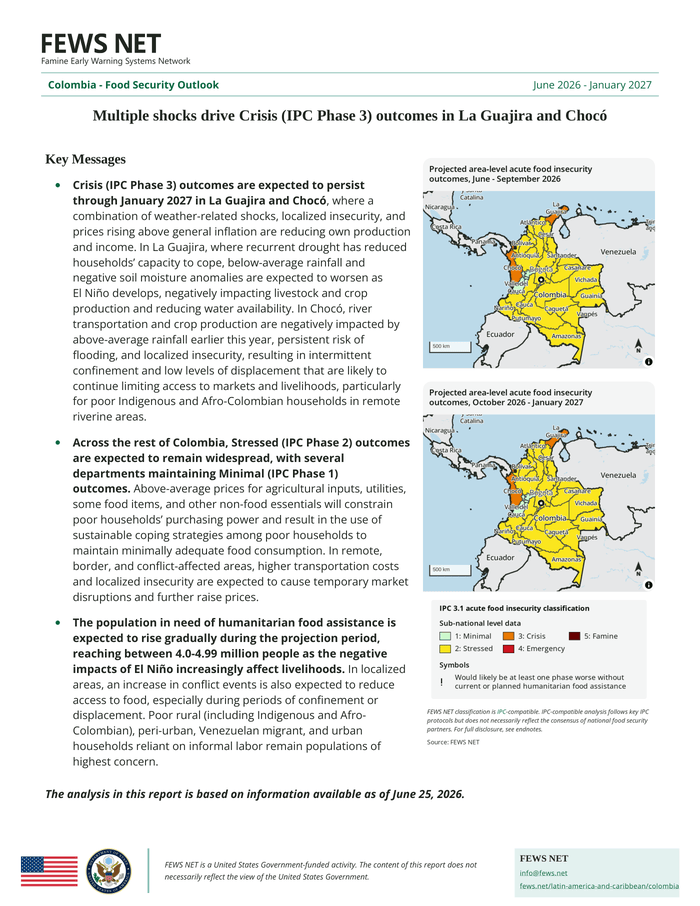
Country: Colombia Source: Famine Early Warning System Network Please refer to the attached file. Key Messages Crisis (IPC Phase 3) outcomes are expected to persist through January 2027 in La Guajira and Chocó, where a combination of weather-related shocks, localized insecurity, and prices rising above general inflation are reducing own production and income. In La Guajira, where recurrent drought has reduced households’ capacity to cope, below-average rainfall and negative soil moisture anomalies are expected to worsen as El Niño develops, negatively impacting livestock and crop production and reducing water availability. In Chocó, river transportation and crop production are negatively impacted by above-average rainfall earlier this year, persistent risk of flooding, and localized insecurity, resulting in intermittent confinement and low levels of displacement that are likely to continue limiting access to markets and livelihoods, particularly for poor Indigenous and Afro-Colombian households in remote riverine areas. Across the rest of Colombia, Stressed (IPC Phase 2) outcomes are expected to remain widespread, with several departments maintaining Minimal (IPC Phase 1) outcomes. Above-average prices for agricultural inputs, utilities, some food items, and other non-food essentials will constrain poor households’ purchasing power and result in the use of sustainable coping strategies among poor households to maintain minimally adequate food consumption. In remote, border, and conflict-affected areas, higher transportation costs and localized insecurity are expected to cause temporary market disruptions and further raise prices. The population in need of humanitarian food assistance is expected to rise gradually during the projection period, reaching between 4. 0-4. 99 million people as the negative impacts of El Niño increasingly affect livelihoods. In localized areas, an increase in conflict events is also expected to reduce access to food, especially during periods of confinement or displacement. Poor rural (including Indigenous and Afro-Colombian), peri-urban, Venezuelan migrant, and urban households reliant on informal labor remain populations of highest concern. The analysis in this report is based on information available as of June 25, 2026.
Colombia – Food Security Outlook (June 2026 – January 2027): Multiple shocks drive Crisis (IPC Phase 3) outcomes in La Guajira and Chocó

RELATED ARTICLES


