


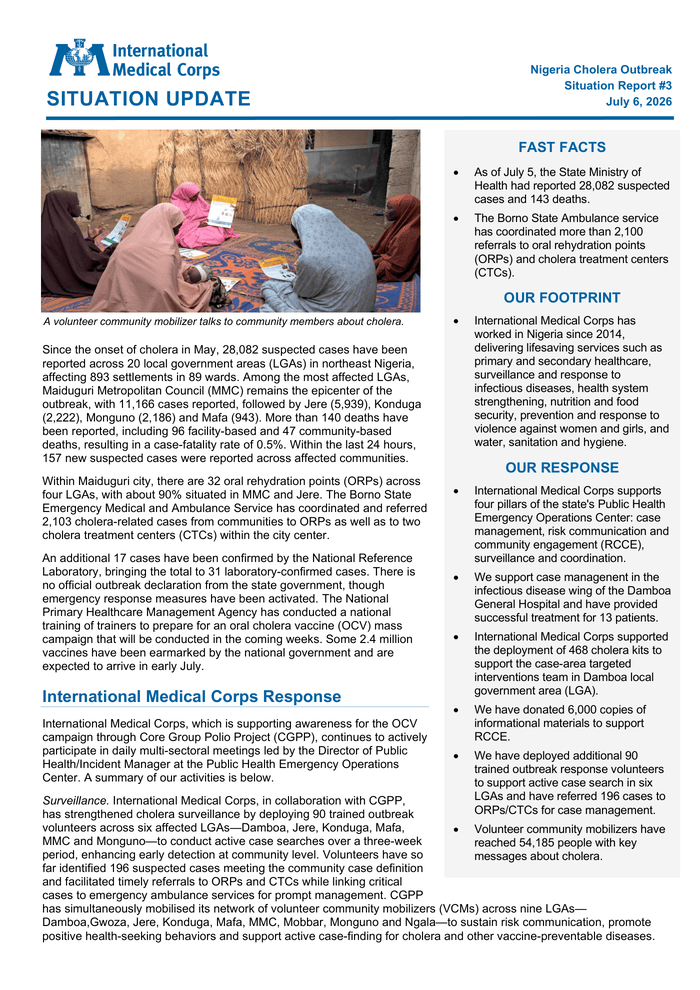
Country: Nigeria Source: International Medical Corps Please refer to the attached file. FAST FACTS As of July 5, the State Ministry of Health had reported 28, 082 suspected cases and 143 deaths. The Borno State Ambulance service has coordinated more than 2, 100 referrals to oral rehydration points (ORPs) and cholera treatment centers (CTCs). OUR FOOTPRINT International Medical Corps has worked in Nigeria since 2014, delivering lifesaving services such as primary and secondary healthcare, surveillance and response to infectious diseases, health system strengthening, nutrition and food security, prevention and response to violence against women and girls, and water, sanitation and hygiene. OUR RESPONSE International Medical Corps supports four pillars of the state’s Public Health Emergency Operations Center: case management, risk communication and community engagement (RCCE), surveillance and coordination. We support case managenent in the infectious disease wing of the Damboa General Hospital and have provided successful treatment for 13 patients. International Medical Corps supported the deployment of 468 cholera kits to support the case-area targeted interventions team in Damboa local government area (LGA). We have donated 6, 000 copies of informational materials to support RCCE. We have deployed additional 90 trained outbreak response volunteers to support active case search in six LGAs and have referred 196 cases to ORPs/CTCs for case management. Volunteer community mobilizers have reached 54, 185 people with key messages about cholera. International Medical Corps, which is supporting awareness for the OCV campaign through Core Group Polio Project (CGPP), continues to actively participate in daily multi-sectoral meetings led by the Director of Public Health/Incident Manager at the Public Health Emergency Operations Center. A summary of our activities is below. Surveillance. International Medical Corps, in collaboration with CGPP, has strengthened cholera surveillance by deploying 90 trained outbreak volunteers across six affected LGAs—Damboa, Jere, Konduga, Mafa, MMC and Monguno—to conduct active case searches over a three-week period, enhancing early detection at community level. Volunteers have so far identified 196 suspected cases meeting the community case definition and facilitated timely referrals to ORPs and CTCs while linking critical cases to emergency ambulance services for prompt management. CGPP has simultaneously mobilized its network of volunteer community mobilizers (VCMs) across nine LGAs—Damboa, Gwoza, Jere, Konduga, Mafa, MMC, Mobbar, Monguno and Ngala—to sustain risk communication, promote positive health-seeking behaviors and support active case-finding for cholera and other vaccine-preventable diseases. Risk Communication and Community Engagement (RCCE). To complement surveillance efforts, VCMs are conducting intensive house-to-house sensitization campaigns in hotspot areas and surrounding communities, reaching 54, 185 people as of July 5. Key messages focus on early recognition of cholera symptoms, prompt healthcare-seeking behaviors, clear referral pathways and improved hygiene practices. About 6, 000 copies of cholera-related informational materials were deployed through our partner Royal Heritage Health Foundation to help frontline mobilizers respond to the outbreak across the supported LGAs. To reinforce behavior change, VCMs also demonstrate proper hand-hygiene techniques, including handwashing with soap and ash, to reduce transmission risks and strengthen community-level prevention. VCMs also will help provide information to affected communities about the upcoming OCV campaign. Support to Case Management. International Medical Corps is supporting the management of cholera patients in the infectious-disease wing of Damboa General Hospital, pending the official activation of a designated cholera treatment unit there, to ensure the continuity of lifesaving care and adherence to standard case-management protocols. To date, 13 patients who met the cholera case definition have been successfully treated and discharged from the facility. This approach underscores International Medical Corps’ commitment to maintaining uninterrupted service delivery while supporting the transition toward a fully operational and dedicated cholera treatment facility. Water Access, Sanitation and Hygiene (WASH). We have prepositioned 468 cholera kits to strengthen and sustain the ongoing outbreak response, with about 85% strategically deployed across our primary operational areas in Damboa LGA to enable rapid and effective response interventions. The deployed supplies have been critical in supporting case-area targeted intervention (CATI) teams, which are being deployed in close collaboration with local government rapid-response teams to promptly interrupt transmission at community level.



GrowthPakistan brings you the latest news to keep an eye on Pakistan’s startup ecosystem. Business keeps you growing when you stay aware of your competitors' moves. GrowthPakistan offers Business, Tech, Global Tech, Global, Auto, and Startup News straight from industries all around the globe. This platform will help you identify upcoming opportunities not only in Pakistan but worldwide.
Email : growthpakistan@gmail.com
Whatsapp : +92320-9497079
© growthpakistan