


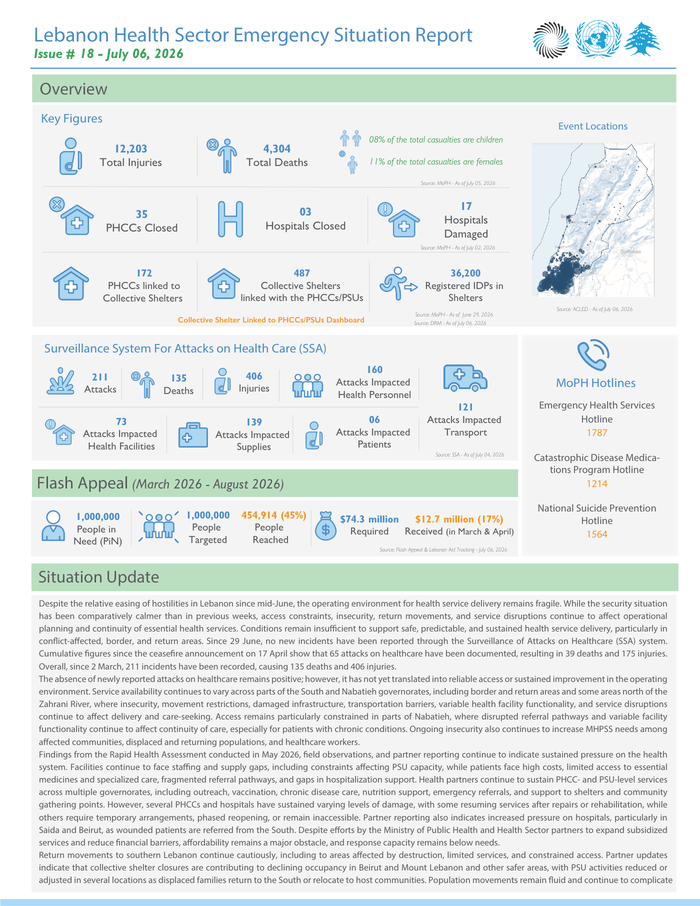
Country: Lebanon Sources: Health Cluster, World Health Organization Please refer to the attached file. Situation Update Despite the relative easing of hostilities in Lebanon since mid-June, the operating environment for health service delivery remains fragile. While the security situation has been comparatively calmer than in previous weeks, access constraints, insecurity, return movements, and service disruptions continue to aect operational planning and continuity of essential health services. Conditions remain insucient to support safe, predictable, and sustained health service delivery, particularly in conict-aected, border, and return areas. Since 29 June, no new incidents have been reported through the Surveillance of Attacks on Healthcare (SSA) system. Cumulative gures since the ceasere announcement on 17 April show that 65 attacks on healthcare have been documented, resulting in 39 deaths and 175 injuries. Overall, since 2 March, 211 incidents have been recorded, causing 135 deaths and 406 injuries. The absence of newly reported attacks on healthcare remains positive; however, it has not yet translated into reliable access or sustained improvement in the operating environment. Service availability continues to vary across parts of the South and Nabatieh governorates, including border and return areas and some areas north of the Zahrani River, where insecurity, movement restrictions, damaged infrastructure, transportation barriers, variable health facility functionality, and service disruptions continue to aect delivery and care-seeking. Access remains particularly constrained in parts of Nabatieh, where disrupted referral pathways and variable facility functionality continue to aect continuity of care, especially for patients with chronic conditions. Ongoing insecurity also continues to increase MHPSS needs among aected communities, displaced and returning populations, and healthcare workers. Findings from the Rapid Health Assessment conducted in May 2026, eld observations, and partner reporting continue to indicate sustained pressure on the health system. Facilities continue to face stang and supply gaps, including constraints aecting PSU capacity, while patients face high costs, limited access to essential medicines and specialized care, fragmented referral pathways, and gaps in hospitalization support. Health partners continue to sustain PHCC- and PSU-level services across multiple governorates, including outreach, vaccination, chronic disease care, nutrition support, emergency referrals, and support to shelters and community gathering points. However, several PHCCs and hospitals have sustained varying levels of damage, with some resuming services after repairs or rehabilitation, while others require temporary arrangements, phased reopening, or remain inaccessible. Partner reporting also indicates increased pressure on hospitals, particularly in Saida and Beirut, as wounded patients are referred from the South. Despite eorts by the Ministry of Public Health and Health Sector partners to expand subsidized services and reduce nancial barriers, aordability remains a major obstacle, and response capacity remains below needs.



GrowthPakistan brings you the latest news to keep an eye on Pakistan’s startup ecosystem. Business keeps you growing when you stay aware of your competitors' moves. GrowthPakistan offers Business, Tech, Global Tech, Global, Auto, and Startup News straight from industries all around the globe. This platform will help you identify upcoming opportunities not only in Pakistan but worldwide.
Email : growthpakistan@gmail.com
Whatsapp : +92320-9497079
© growthpakistan