


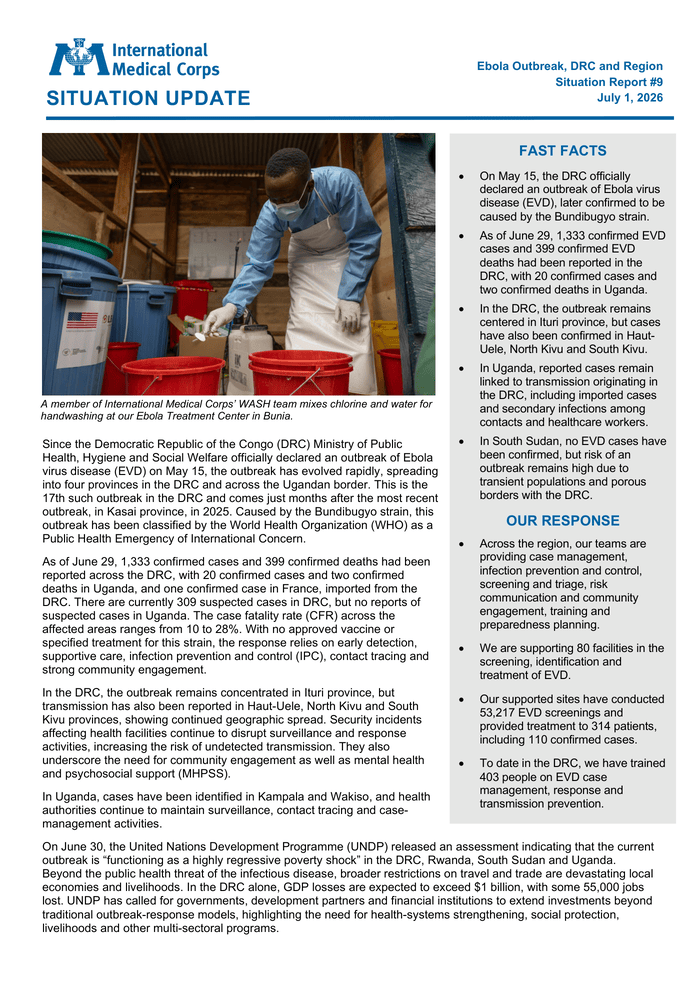
Country: Democratic Republic of the Congo Source: International Medical Corps Please refer to the attached file. FAST FACTS On May 15, the DRC officially declared an outbreak of Ebola virus disease (EVD), later confirmed to be caused by the Bundibugyo strain. As of June 29, 1, 333 confirmed EVD cases and 399 confirmed EVD deaths had been reported in the DRC, with 20 confirmed cases and two confirmed deaths in Uganda. In the DRC, the outbreak remains centered in Ituri province, but cases have also been confirmed in Haut-Uele, North Kivu and South Kivu. In Uganda, reported cases remain linked to transmission originating in the DRC, including imported cases and secondary infections among contacts and healthcare workers. In South Sudan, no EVD cases have been confirmed, but risk of an outbreak remains high due to transient populations and porous borders with the DRC. OUR RESPONSE Across the region, our teams are providing case management, infection prevention and control (IPC), screening and triage, risk communication and community engagement, training and preparedness planning. We are supporting 80 facilities in the screening, identification and treatment of EVD. Our supported sites have conducted 53, 217 EVD screenings and provided treatment to 314 patients, including 110 confirmed cases. To date in the DRC, we have trained 403 people on EVD case management, response and transmission prevention. With the support of the US Department of State, DG ECHO and other donors, International Medical Corps teams are actively responding to the outbreak and engaging with ministries of health, key actors and response partners. International Medical Corps has used a hub-and-spoke model since the outbreak was declared to provide case management support at designated treatment and transit facilities, strengthen IPC in referring health facilities, conduct screening and triage, support risk communication and community engagement (RCCE) in surrounding communities and train health workers on EVD response protocols. Across all operational areas in DRC, International Medical Corps continues to closely coordinate with the Ministry of Health and relevant partners to support case management, screening-and-referral units, facility-based surveillance, mental health services, IPC, logistics, just-in-time training, continuity of essential health services, and water, sanitation and hygiene services. International Medical Corps also is part of broader efforts to strengthen contact tracing, helping to strengthen mapping, daily monitoring and follow-up activities to address the risk of undetected transmission across operational areas and beyond. In Uganda, we continue to work with a partner to implement critical Ebola preparedness and response activities, including screening at transit points, IPC assessments and supervision, and EVD- and RCCE-related training and activities. In South Sudan, we continue to strengthen health-system readiness for EVD—including rehabilitation of infectious-disease units, capacity building for service providers and frontline staff, and positioning of essential supplies, including personal protective equipment.



GrowthPakistan brings you the latest news to keep an eye on Pakistan’s startup ecosystem. Business keeps you growing when you stay aware of your competitors' moves. GrowthPakistan offers Business, Tech, Global Tech, Global, Auto, and Startup News straight from industries all around the globe. This platform will help you identify upcoming opportunities not only in Pakistan but worldwide.
Email : growthpakistan@gmail.com
Whatsapp : +92320-9497079
© growthpakistan