


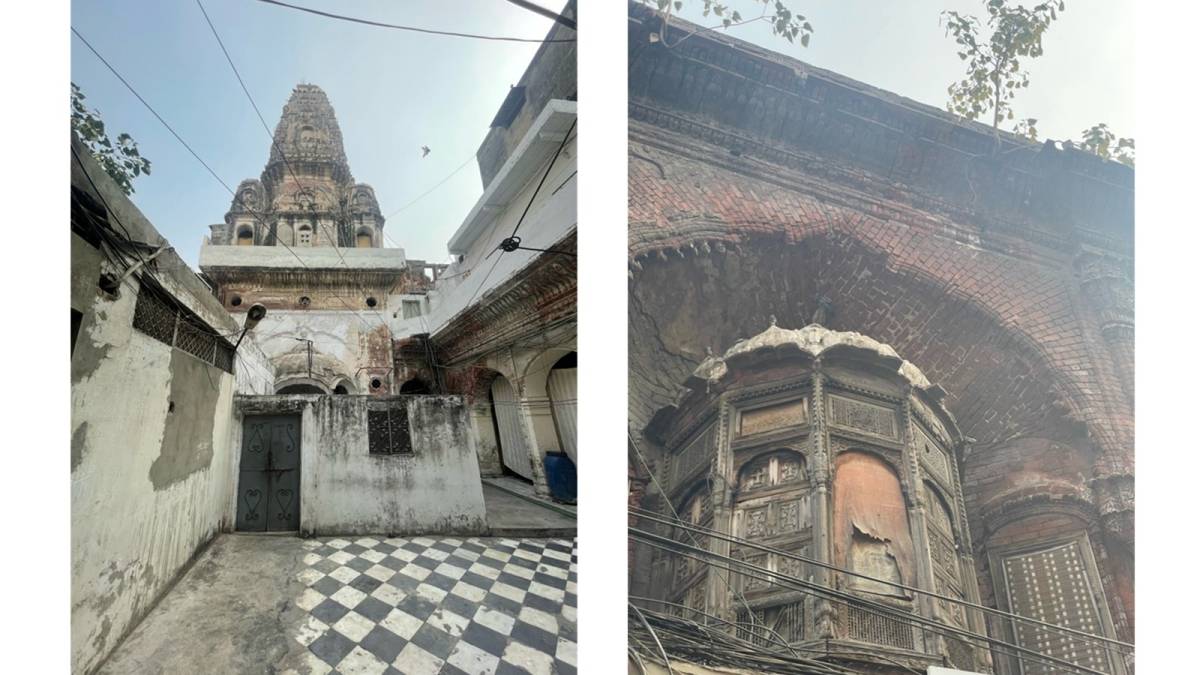
A rooster greeted me before history did. Hidden behind the bustle of Anarkali Bazaar, only a few steps from the tomb of Sultan Qutb-ud-Din Aibak, stands one of Lahore’s most overlooked heritage sites: Bansi Lal Mandir, also known as the Basuli Hanuman Temple. Like many Lahoris, I had passed through Anarkali countless times. The neighbourhood is famous for its markets, food streets, and colonial-era buildings. Yet tucked away among crowded shops and residential quarters is a monument that speaks of another chapter in Lahore’s history—one that is increasingly fading from public memory. When I visited the temple, I found families living within its premises. Children played in the courtyard. Household belongings occupied spaces that once served a religious purpose. A rooster wandered through the compound as if it, too, belonged to the building’s everyday life. The scene was neither dramatic nor unusual. It was simply life unfolding within a structure that has quietly transitioned from a place of worship into a place of residence. Yet beneath this ordinary activity lies an extraordinary piece of Lahore’s architectural and cultural heritage. The most striking feature of the complex is a magnificent wooden jharoka overlooking the bazaar. Despite decades of neglect, the intricately carved balcony remains remarkably beautiful. The craftsmanship reflects a tradition of woodwork that once flourished throughout Punjab. Every detail speaks of skilled artisans who understood that architecture was not merely functional—it was also an expression of beauty. Researchers studying Lahore’s historic jharokas have identified the Bansi Mandir jharoka as an important example of late nineteenth-century architectural craftsmanship, distinguished by its intricate woodwork and fusion of local and colonial influences. Ceasefire Holds, But Iran’s History Warns Of What Comes Next Standing beneath the balcony, it was impossible not to wonder how many people had looked out from this very spot over the past century. How many conversations had taken place here? How many festivals, ceremonies, and family gatherings had animated these spaces? Unfortunately, such questions are difficult to answer because the history of the temple remains only partially documented. Historical records suggest that Bansi Lal Mandir, officially known as the Basuli Hanuman Temple, was constructed during the late nineteenth or early twentieth century when Lahore was expanding beyond the boundaries of the old walled city. Dedicated to the Hindu deity Hanuman, the complex included a temple, courtyard, haveli, Sanskrit inscriptions, and a prominent shikhara, or temple tower. Every detail of the magnificent wooden jharoka speaks of skilled artisans who understood that architecture was not merely functional — it was also an expression of beauty Its location is significant. The temple stands near the tomb of Qutb-ud-Din Aibak, the founder of the Mamluk Dynasty and the first Sultan of Delhi, who died in Lahore in 1210. The coexistence of these structures within the same urban landscape illustrates the layered and diverse history that has shaped Lahore for centuries. Before Partition, Lahore was home to thriving Muslim, Sikh, Hindu, and Christian communities. Its architecture reflected this diversity. Temples, gurdwaras, mosques, shrines, churches, and havelis shared the same cityscape, creating a rich cultural tapestry. The events of 1947 dramatically altered that landscape. Like many Hindu religious sites across Lahore, Bansi Lal Mandir was abandoned when much of the city’s Hindu population migrated to India. Over time, the structure was occupied for residential purposes. The building survived, but its original function disappeared. Subsequent decades brought further deterioration, and conservation efforts remained largely absent. Heritage scholars have identified the temple as one of Lahore’s neglected historic structures requiring urgent preservation. From Oil Markets To War Rooms: The Forces Shaping The Next Iran Conflict What makes the temple’s condition particularly troubling is not simply physical decay. It is the fact that so few people know it exists. The monument is hidden in plain sight. Thousands pass through Anarkali every day. Many visit the nearby tomb of Qutb-ud-Din Aibak. Yet few are aware that behind surrounding buildings stands a temple containing architectural features of considerable historical value. The wooden jharoka survives. Parts of the temple tower survive. Fragments of decorative work survive. But survival should not be mistaken for preservation. A building can remain standing while steadily losing the very features that make it historically significant. Water damage, structural neglect, insensitive alterations, and simple indifference often prove more destructive than dramatic acts of demolition. The families living within the complex should not be viewed as the problem. For them, the site provides shelter and a place to live. Their presence reflects broader social and economic realities. The real challenge is the absence of a meaningful conservation strategy that acknowledges both human needs and heritage value. Around the world, historic structures have been successfully adapted for contemporary use while preserving their architectural character. Such approaches require planning, investment, and public commitment. Most importantly, they require recognition that heritage belongs not only to the past but also to the future. Lahore often celebrates its grand monuments—the Fort, the Badshahi Mosque, and the Shalimar Gardens. Yet the city’s identity is equally preserved in smaller, lesser-known structures scattered throughout its neighbourhoods. These buildings tell stories that cannot be found in official histories alone. Bansi Lal Mandir is one such story. An Indigenous History Of the Pukhtuns As I prepared to leave, the rooster crowed once more. Around me, everyday life continued uninterrupted. The residents went about their routines. The market outside remained busy. The wooden jharoka watched silently over it all. For now, the temple still stands. The question is whether Lahore will remember it before it is too late.



GrowthPakistan brings you the latest news to keep an eye on Pakistan’s startup ecosystem. Business keeps you growing when you stay aware of your competitors' moves. GrowthPakistan offers Business, Tech, Global Tech, Global, Auto, and Startup News straight from industries all around the globe. This platform will help you identify upcoming opportunities not only in Pakistan but worldwide.
Email : growthpakistan@gmail.com
Whatsapp : +92320-9497079
© growthpakistan