

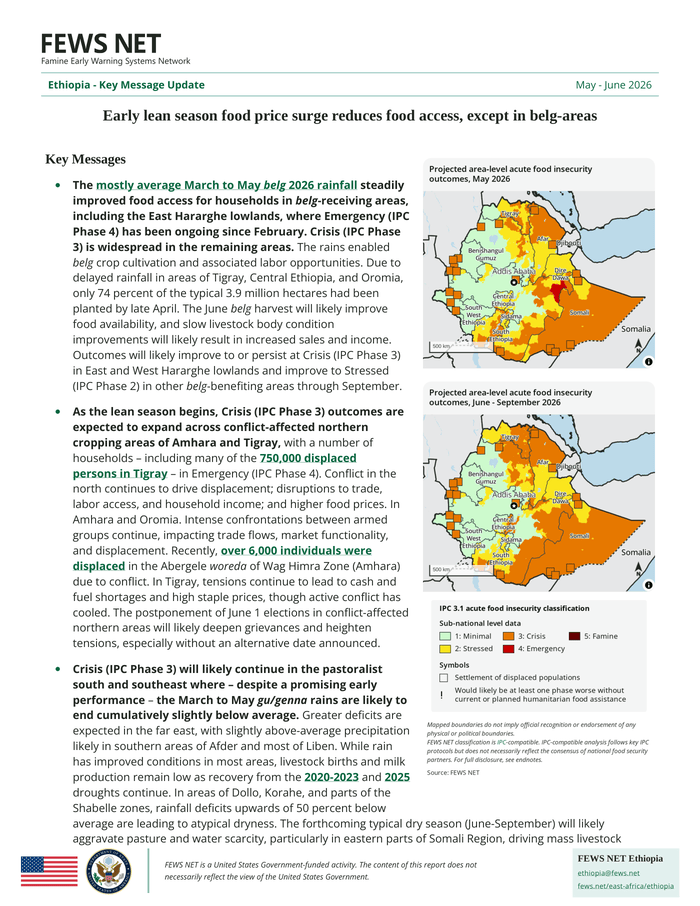
Countries: Ethiopia, South Sudan Source: Famine Early Warning System Network Please refer to the attached file. Key Messages The mostly average March to May belg 2026 rainfall steadily improved food access for households in belg **-receiving areas, including the East Hararghe lowlands, where Emergency (IPC Phase 4) has been ongoing since February. Crisis (IPC Phase 3) is widespread in the remaining areas. ** The rains enabled belg crop cultivation and associated labor opportunities. Due to delayed rainfall in areas of Tigray, Central Ethiopia, and Oromia, only 74 percent of the typical 3. 9 million hectares had been planted by late April. The June belg harvest will likely improve food availability, and slow livestock body condition improvements will likely result in increased sales and income. Outcomes will likely improve to or persist at Crisis (IPC Phase 3) in East and West Hararghe lowlands and improve to Stressed (IPC Phase 2) in other belg -benefiting areas through September. As the lean season begins, Crisis (IPC Phase 3) outcomes are expected to expand across conflict-affected northern cropping areas of Amhara and Tigray, with a number of households – including many of the 750, 000 displaced persons in Tigray – in Emergency (IPC Phase 4). Conflict in the north continues to drive displacement; disruptions to trade, labor access, and household income; and higher food prices. In Amhara and Oromia. Intense confrontations between armed groups continue, impacting trade flows, market functionality, and displacement. Recently, over 6, 000 individuals were displaced in the Abergele woreda of Wag Himra Zone (Amhara) due to conflict. In Tigray, tensions continue to lead to cash and fuel shortages and high staple prices, though active conflict has cooled. The postponement of June 1 elections inconflict-affected northern areas will likely deepen grievances and heighten tensions, especially without an alternative date announced. Crisis (IPC Phase 3) will likely continue in the pastoralist south and southeast where – despite a promising early performance – the March to May gu/genna rains are likely to end cumulatively slightly below average. Greater deficits are expected in the far east, with slightly above-average precipitation likely in southern areas of Afder and most of Liben. While rain has improved conditions in most areas, livestock births and milk production remain low as recovery from the 2020-2023 and 2025 droughts continue. In areas of Dollo, Korahe, and parts of the Shabelle zones, rainfall deficits upwards of 50 percent below average are leading to atypical dryness. The forthcoming typical dry season (June-September) will likely aggravate pasture and water scarcity, particularly in eastern parts of Somali Region, driving mass livestock migration toward Shabelle riverine areas, the northern Somali Region, and areas bordering Oromia. Competition over grazing and water resources increases risk of conflict. Crisis (IPC Phase 3) is likely to persist in northern areas of Afar, with the March to May ***diraac/*** sugum rains in Afar and northern Somali zone expected to end with average cumulative precipitation. The precipitation will likely increase pasture and water availability, driving improved livestock body conditions and goat milk consumption. In northern areas of Afar, such as Bidu, Elidar, and Kori woredas, however, high daytime temperatures have caused rapid evaporation, limiting water and pasture recovery. Insecurity in Tigray and northeastern Amhara continues to disrupt cross-border trade flows into Afar, constraining livestock sales and staple food access, while herd sizes remain below baseline despite gradual recovery following consecutive favorable seasons. Many of the South Sudanese refugees who recently arrived at Gambela camp in Emergency (IPC Phase 4) temporarily traveled back to Akobo County, South Sudan, to access food assistance airdrops before returning to Ethiopia, improving outcomes to Crisis (IPC Phase 3). According to key informants, many households sent one member to collect food while children and belongings remained in Gambela. Meanwhile, intercommunity conflict in Gambela involving a local Anuak armed group and refugee populations continues, highlighting persistent insecurity that could further disrupt humanitarian access and livelihoods for both refugee and host populations. Staple food prices increased sharply in April, driven by surging fuel prices, seasonal tightening of staple food supplies ahead of the lean season, and conflict-related trade disruptions. According to the Ethiopian Statistics Service (ESS), annual food inflation reached 13. 5 percent in April, up from 11. 0 percent in March. FEWS NET price data found that staple food prices remained exceptionally high in May. In Sodo, maize prices remained stable compared to April after increasing 51 percent between March and April and were 122 percent above the five-year average. In Degehabur, maize prices were 14 percent above April levels and 60 percent above average. Forecasts for the June to September kiremt – Ethiopia’s primary meher crop rain season – are below average, due to the anticipated emergence of El Nino. Severe localized deficits are likely in northeastern and central areas where there is a 50 percent chance or higher of rainfall deficits of 50 percent or more. Nevertheless, meher planting has begun in anticipation of the rains: in Oromia, Amhara and Tigray 166, 783 hectares were planted as of early May. Fuel and fertilizer prices continue to increase due to instability in the Middle East. Higher fuel prices are driving increased transportation costs for food and agricultural inputs. Diesel prices rose by about 40 percent between December 2025 and May 2026 through three price revisions in March, April, and May by the Ministry of Trade and Regional Integration. Diesel prices were 55 and 155 percent higher than the same time last year and the five-year average, respectively. Meanwhile, although fertilizer supply is available, prices remain elevated compared to last year, and high prices are expected to reduce application rates and agricultural productivity, particularly for the meher season.
Ethiopia Key Message Update, May – June 2026: Early lean season food price surge reduces food access, except in belg-areas

RELATED ARTICLES


