

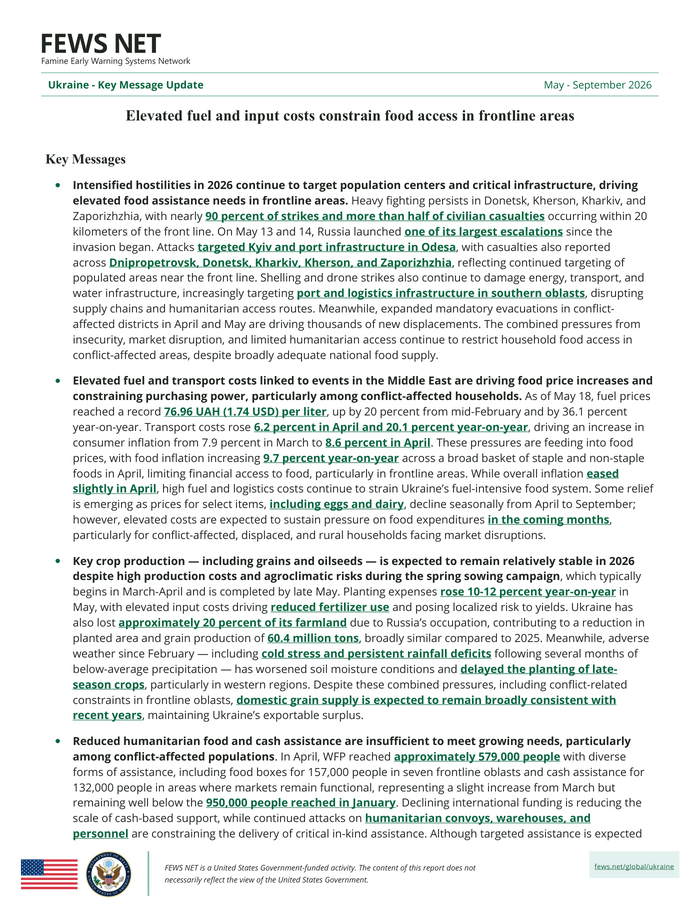
Country: Ukraine Source: Famine Early Warning System Network Please refer to the attached file. Key Messages Intensified hostilities in 2026 continue to target population centers and critical infrastructure, driving elevated food assistance needs in frontline areas. Heavy fighting persists in Donetsk, Kherson, Kharkiv, and Zaporizhzhia, with nearly 90 percent of strikes and more than half of civilian casualties occurring within 20 kilometers of the front line. On May 13 and 14, Russia launched one of its largest escalations since the invasion began. Attacks targeted Kyiv and port infrastructure in Odesa, with casualties also reported across Dnipropetrovsk, Donetsk, Kharkiv, Kherson, and Zaporizhzhia, reflecting continued targeting of populated areas near the front line. Shelling and drone strikes also continue to damage energy, transport, and water infrastructure, increasingly targeting port and logistics infrastructure in southern oblasts, disrupting supply chains and humanitarian access routes. Meanwhile, expanded mandatory evacuations in conflict-affected districts in April and May are driving thousands of new displacements. The combined pressures from insecurity, market disruption, and limited humanitarian access continue to restrict household food access in conflict-affected areas, despite broadly adequate national food supply. Elevated fuel and transport costs linked to events in the Middle East are driving food price increases and constraining purchasing power, particularly among conflict-affected households. As of May 18, fuel prices reached a record 76. 96 UAH (1. 74 USD) per liter, up by 20 percent from mid-February and by 36. 1 percent year-on-year. Transport costs rose 6. 2 percent in April and 20. 1 percent year-on-year, driving an increase in consumer inflation from 7. 9 percent in March to 8. 6 percent in April. These pressures are feeding into food prices, with food inflation increasing 9. 7 percent year-on-year across a broad basket of staple and non-staple foods in April, limiting financial access to food, particularly in frontline areas. While overall inflation eased slightly in April, high fuel and logistics costs continue to strain Ukraine’s fuel-intensive food system. Some relief is emerging as prices for select items, including eggs and dairy, decline seasonally from April to September; however, elevated costs are expected to sustain pressure on food expenditures in the coming months, particularly for conflict-affected, displaced, and rural households facing market disruptions. Key crop production — including grains and oilseeds — is expected to remain relatively stable in 2026 despite high production costs and agroclimatic risks during the spring sowing campaign, which typically begins in March-April and is completed by late May. Planting expenses rose 10-12 percent year-on-year in May, with elevated input costs driving reduced fertilizer use and posing localized risk to yields. Ukraine has also lost approximately 20 percent of its farmland due to Russia’s occupation, contributing to a reduction in planted area and grain production of 60. 4 million tons, broadly similar compared to 2025. Meanwhile, adverse weather since February — including cold stress and persistent rainfall deficits following several months of below-average precipitation — has worsened soil moisture conditions and delayed the planting of late-season crops, particularly in western regions. Despite these combined pressures, including conflict-related constraints in frontline oblasts, domestic grain supply is expected to remain broadly consistent with recent years, maintaining Ukraine’s exportable surplus. Reduced humanitarian food and cash assistance are insufficient to meet growing needs, particularly among conflict-affected populations. In April, WFP reached approximately 579, 000 people with diverse forms of assistance, including food boxes for 157, 000 people in seven frontline oblasts and cash assistance for 132, 000 people in areas where markets remain functional, representing a slight increase from March but remaining well below the 950, 000 people reached in January. Declining international funding is reducing the scale of cash-based support, while continued attacks on humanitarian convoys, warehouses, and personnel are constraining the delivery of critical in-kind assistance. Although targeted assistance is expected to provide localized relief, overall humanitarian food assistance levels remain insufficient to meet increasing needs in 2026 driven by heightened hostilities, rising costs, and poor income-earning opportunities. As a result, conflict-affected households not receiving assistance are increasing their reliance on negative coping strategies to meet their minimum food needs, including borrowing, reducing meal size, and shifting to less diverse diets
Ukraine Key Message Update, May – September 2026: Elevated fuel and input costs constrain food access in frontline areas

RELATED ARTICLES


