

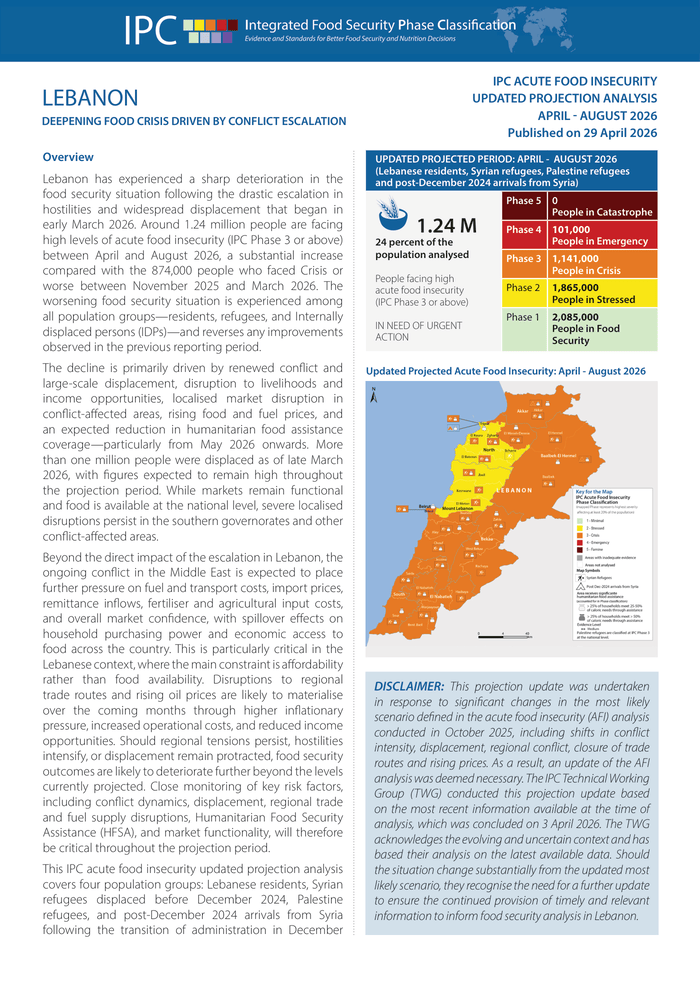
Country: Lebanon Source: Integrated Food Security Phase Classification Please refer to the attached file. Key results The food security situation in Lebanon has worsened following the drastic escalation in hostilities and widespread displacement that began in early March 2026. Around 1. 24 million people are facing high levels of acute food insecurity (IPC Phase 3 or above) between April and August 2026, which is worse than was previously projected for this period in the IPC analysis released in October 2025. The declining food security conditions are experienced among all population groups and reverses any improvements observed in the previous reporting period. The biggest increases in populations in Phase 3 or above are found in the southern governorates, particularly in Bent Jbeil, Marjaayoun, El Nabatieh and Sour districts, among both Lebanese and Syrian refugee populations. In these areas, high levels of acute food insecurity are affecting 55 to 65 percent of the population, including approximately 10 percent of people who are in IPC Phase 4 (Emergency). The decline is primarily driven by renewed conflict and large-scale displacement, disruption to livelihoods and income opportunities, localised market disruption in conflict-affected areas, rising food and fuel prices, and an expected reduction in humanitarian food assistance coverage. Beyond the direct impact of the escalation in Lebanon, the ongoing conflict in the Middle East is expected to place further pressure on fuel and transport costs, import prices, remittance inflows, fertiliser and agricultural input costs, and overall market confidence, with spillover effects on household purchasing power and economic access to food across the country. Recommendations & next steps Lifesaving and HFSA: Sustained and adequately funded humanitarian food security assistance remains the most immediate priority to prevent a further deterioration in food security outcomes during the projection period. Particular attention should be given to the population groups and geographic areas facing the highest severity, especially conflict-affected southern districts, highly vulnerable hosting areas, Syrian refugees, Palestine refugees, and post-December 2024 arrivals from Syria. Social protection and nationally led response mechanisms: Given the scale of deterioration among Lebanese households, continued support to social protection responses and nationally led mechanisms remains important. Efforts to sustain and strengthen existing systems, such as AMAN, and including those that can support rapid emergency response, such as the Shock Responsive Safety Nets (SRSN), should continue where feasible, in parallel with humanitarian assistance. Market support and affordability monitoring: Continued monitoring of market functionality, food prices, fuel costs, bread prices, transport costs, and supply chain performance remains essential to guide response adjustments. In conflict-affected and hosting areas, interventions that help maintain market access and reduce affordability constraints should be prioritised wherever operationally feasible. Agricultural support and recovery: Agricultural households in conflict-affected areas require urgent support to prevent further losses in production and income. Priority interventions should include access to seeds, fertilisers, pesticides, irrigation support, feed, veterinary inputs, and cash-based support for agricultural production where feasible. Livelihood assistance: Protecting and restoring livelihoods is critical given the role of income loss, displacement, and rising living costs in driving the projected deterioration. Support should prioritise households dependent on informal labour, agriculture, daily wage work, retail, and service-sector activities, especially in conflict-affected and hosting areas. Education and school feeding programs: Scaling up school feeding programs targeting displaced and host community children in priority districts, linking school feeding to local food production, and integrating nutrition and psychosocial services into education responses will help mitigate negative coping strategies such as child labour and school dropout. Integrate nutrition sensitive activities: Embedding nutrition-sensitive interventions across food security and humanitarian efforts is necessary to improve dietary diversity and nutritional outcomes. This includes promoting community education, ensuring access to fortified foods, and strengthening collaboration between agriculture, health, and social protection systems.
Lebanon: Deepening food crisis driven by conflict escalation – IPC Acute Food Insecurity and Acute Malnutrition Analysis (April – August 2026), Published on 29 April 2026

RELATED ARTICLES


