

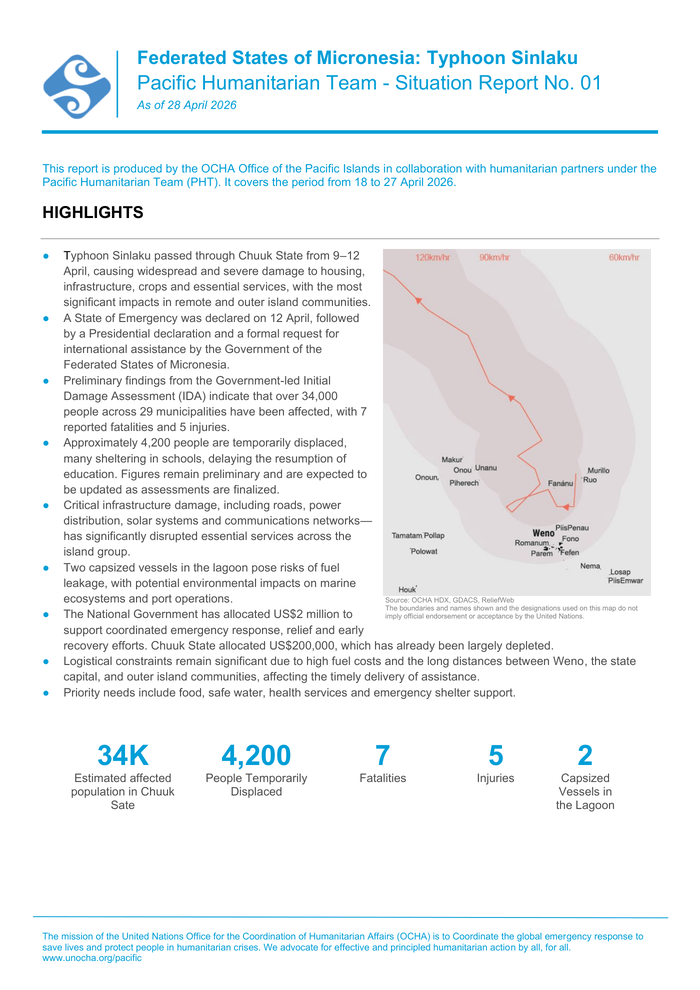
Country: Micronesia (Federated States of) Source: Pacific Humanitarian Team Please refer to the attached file. This report is produced by the OCHA Office of the Pacific Islands in collaboration with humanitarian partners under the Pacific Humanitarian Team (PHT). It covers the period from 18 to 27 April 2026. HIGHLIGHTS Typhoon Sinlaku passed through Chuuk State from 9–12 April, causing widespread and severe damage to housing, infrastructure, crops and essential services, with the most significant impacts in remote and outer island communities. A State of Emergency was declared on 12 April, followed by a Presidential declaration and a formal request for international assistance by the Government of the Federated States of Micronesia. Preliminary findings from the Government-led Initial Damage Assessment (IDA) indicate that over 34, 000 people across 29 municipalities have been affected, with 7 reported fatalities and 5 injuries. Approximately 4, 200 people are temporarily displaced, many sheltering in schools, delaying the resumption of education. Figures remain preliminary and are expected to be updated as assessments are finalized. Critical infrastructure damage, including roads, power distribution, solar systems and communications networks—has significantly disrupted essential services across the island group. Two capsized vessels in the lagoon pose risks of fuel leakage, with potential environmental impacts on marine ecosystems and port operations. The National Government has allocated US$2 million to support coordinated emergency response, relief and early recovery efforts. Chuuk State allocated US$200, 000, which has already been largely depleted. Logistical constraints remain significant due to high fuel costs and the long distances between Weno, the state capital, and outer island communities, affecting the timely delivery of assistance. Priority needs include food, safe water, health services and emergency shelter support. SITUATION OVERVIEW The full extent of damage caused by Typhoon Sinlaku continues to emerge as preliminary Initial Damage Assessment (IDA) data are analyzed. The severity of impact across sectors is profound, with more than 27 schools completely damaged, including damage to their water sources, whether rainwater catchment systems or groundwater supplies. The impact is particularly severe on 9 of the 16 islands within the lagoon, where crops and food sources have been wiped out, sanitation facilities damaged, and drinking water contaminated. Preliminary damage assessment data indicates that more than 2, 900 houses have been damaged, along with telecommunications infrastructure and the electricity system. Restoration of telecommunications and power is ongoing, though many solar systems in affected areas remain damaged. A heightened need for food and water has emerged among those severely affected by Typhoon Sinlaku. Temporary sheltering in schools is impeding the resumption of classes and increasing the need for food supplies, cafeteria spaces, and proper sanitation within these temporary shelters. At the same time, there is a need for household shelter support to assist affected communities in rehabilitation, as well as pre-positioned medicines in preparation for post-disaster health risks. The only frontline services for gender-based violence have been affected. Psychosocial support is needed both for affected populations and for responders. Coordination efforts are being led by the State Government, with support from the National Government’s Emergency Management Division and an integrated OCHA/UNDAC team. PHT partners are on the ground in Chuuk, supporting assessments, provision of non-food items, relief distribution, and sector-specific services.
Federated States of Micronesia: Typhoon Sinlaku, Pacific Humanitarian Team (PHT) – Situation Report No. 01 (28 April 2026)

RELATED ARTICLES


