

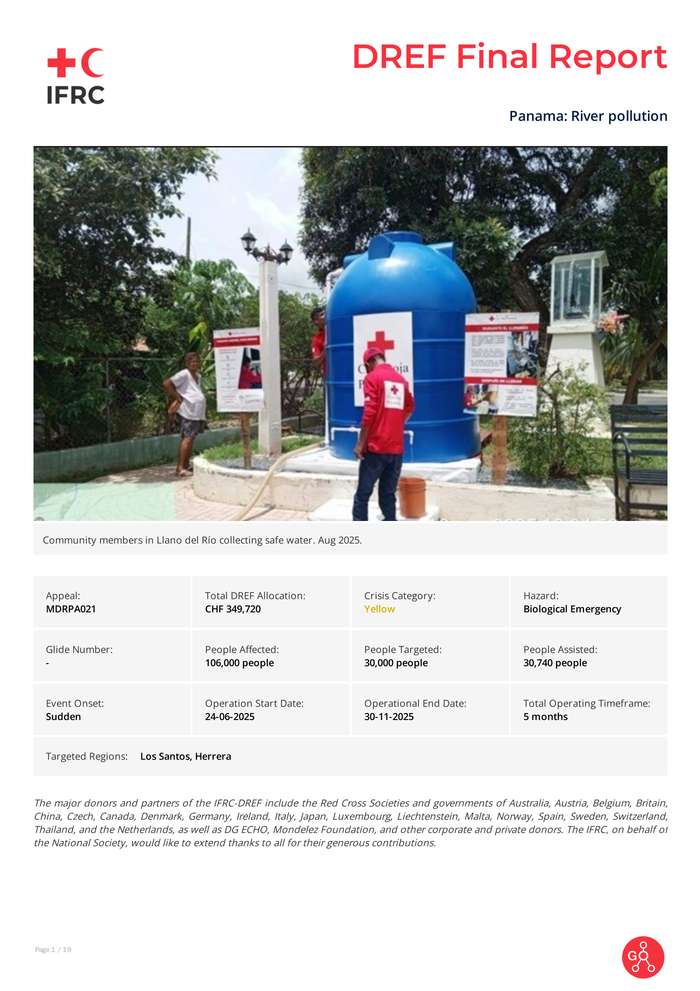
Country: Panama Source: International Federation of Red Cross and Red Crescent Societies Please refer to the attached file. Description of the Event Date of event 10-06-2025 What happened, where and when? Since late May 2025, the La Villa River — the main water source for the provinces of Herrera and Los Santos — experienced a critical situation due to severe contamination. Between 27 May and 6 June 2025, the Ministry of Environment (MiAmbiente) conducted field inspections in the La Villa and Estibaná river basins and identified at least 23 critical contamination points. The main sources of pollution include pig farms, industrial discharges, and a municipal landfill in the district of Macaracas. These have contributed to the presence of animal fecal matter, sediments, and other solid waste in the river, significantly deteriorating water quality (1). During the inspection — which covered 20 km of the La Villa River and 19 km of the Estibaná River — a substantial decline in both physical and biological water parameters was documented, posing a direct threat to public health and the well-being of local communities (2). In response to this environmental emergency, the National Government declared a state of emergency on June 10, through Resolution No. 69-25, covering both provinces. This measure led to the temporary suspension of water treatment plant operations due to high levels of turbidity and organic matter in the river (3). The most affected districts are Chitré, Los Santos, Las Tablas, and Guararé, where thousands of people rely directly on the La Villa River for access to drinking water. The situation has generated growing concern among the population, which is now facing water supply restrictions and increased health risks. While early mitigation measures were implemented to contain priority contamination sources and improve conditions in the river basin, disruptions and recovery actions continued throughout 2025, including additional interruptions linked to high sediment loads and the launch of network disinfection measures in early November 2025. As a result, the impacts of the crisis extended beyond the initial emergency peak and continued to affect household coping capacity. In November 2025, MiAmbiente also strengthened watershed governance by updating and training nine La Villa sub-basin committees and initiating baseline work to support a detailed basin diagnostic under the Restoration and Sustainable Management Plan. (4)
Panama: River pollution – DREF Final Report (MDRPA021)

RELATED ARTICLES


