


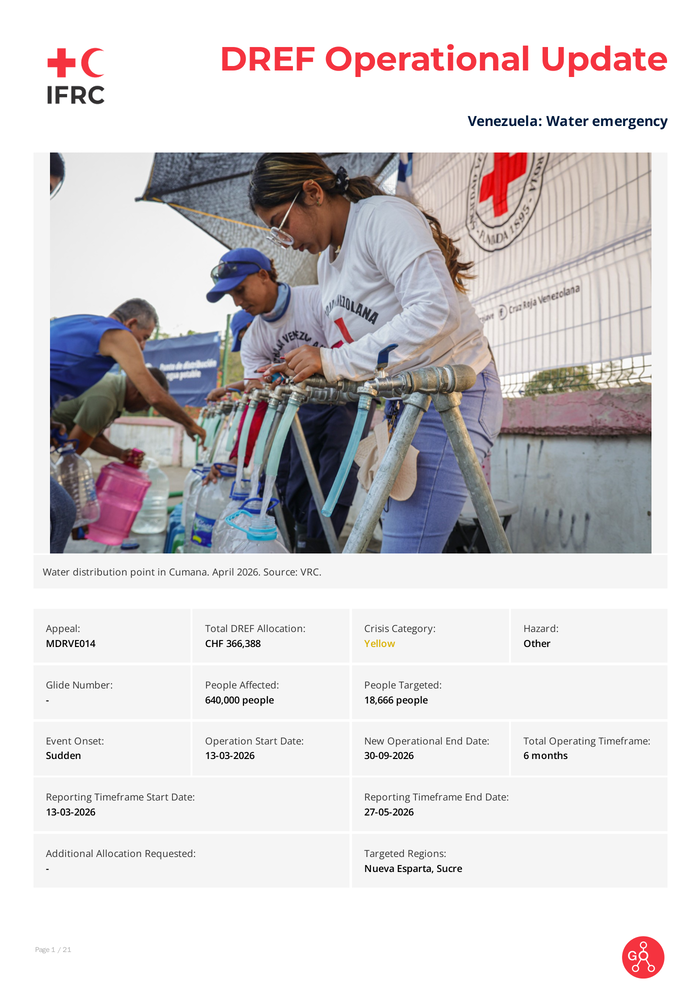
Country: Venezuela (Bolivarian Republic of) Source: International Federation of Red Cross and Red Crescent Societies Please refer to the attached file. Description of the Event Date of event 06-03-2026 What happened, where and when? The Bolivarian Republic of Venezuela is currently experiencing a major crisis affecting basic services in its eastern regions, particularly in the states of Sucre and Nueva Esparta. This follows the formal declaration of a Critical Water Emergency in the Official Gazette of the State of Sucre No. 3, 247, dated 5 March 2026. This measure responds to a large-scale structural failure in the Turimiquire collection and distribution system — the most important strategic infrastructure in eastern Venezuela — which supplies drinking water to the continental area of Sucre State (covering the municipalities of Sucre, Bolívar and Cruz Salmerón Acosta) and the island area. The system affects 45% of the population of Margarita Island in the state of Nueva Esparta, which depends on its underwater branch via a complex network of underwater pipelines and aqueducts. According to the technical report by the regional hydrological agency (Hidrocaribe), dated 3 March 2026, a rockslide at kilometre 7. 6 of the 12. 5 km transfer tunnel caused an obstruction of 82% of the tunnel’s capacity. This drastically reduced the system’s response capacity from 5, 000 litres per second to 1, 100 litres per second. This explains why there is not enough pressure in the water supply to reach the ‘high areas’ of Sucre and Nueva Esparta. According to the media and local authorities, the collapse has been directly attributed to aftershocks and ground instability caused by an earthquake recorded in the region on 22 February 2026. This earthquake weakened infrastructure that was already compromised by decades of use, according to official spokespeople, including Governor Jhoanna Carrillo. This emergency has had a negative multidimensional impact, affecting the lives of approximately 95, 108 families in one of the three affected municipalities in Sucre state. It has also compromised access to water for 45% of Nueva Esparta state’s population, who depend on the underwater branch of the same system. In health terms, there is an imminent risk of an increase in waterborne and dermatological diseases due to inadequate storage of the resource in open containers and use of untreated alternative sources such as the Manzanares River. The event has led to the suspension of educational, commercial and tourism activities in the city of Cumaná in Sucre State, which are vital to the local economy, while extreme water rationing has undermined general well-being by prohibiting its use for anything other than basic human consumption and hygiene (Sucre State Government, Emergency Decree, 2026). The people most likely to suffer severe impacts from this hazard are those living in the so-called ‘high areas’ of Cumaná and Margarita Island, where low water pressure physically prevents water from reaching homes, even during emergency pumping cycles (Hidrocaribe, Operational Statement, 03/05/2026). The most vulnerable groups within these communities include children and the elderly, who are more susceptible to dehydration and viral infections, as well as people with disabilities, who face physical barriers when collecting water from tanker trucks or community sources. Vulnerability is accentuated in families living in poverty who lack the financial resources to purchase water from private suppliers, whose prices have escalated due to high demand (Public Expenditure Observatory/Local Reports, 2026). The Turimiquire system has historically had chronic weaknesses, with leaks documented over the last 30 years. In July 2023, a critical incident occurred when an eight-metre underground leak caused the collapse of the western branch of the underwater aqueduct, leaving thousands of families in Margarita without access to this basic resource. This demonstrates that the current event is not an isolated incident, but rather the culmination of systematic structural deterioration, requiring major engineering intervention to prevent total collapse of the sanitation system in the eastern region (Historical Archive of Water Infrastructure / El Sol de Margarita, 2023–2026). The Red Cross has mobilized following the declaration of a water emergency, conducting initial needs assessments with local staff and mobilizing national personnel since 6 March 2026, in addition to identifying potential sites for the installation of water treatment plants and coordinating with local authorities who have requested support from the branches to supplement the response plan. During March and April 2026, the Ministry of Popular Power for Water Attention (MinAguas) and the government of the state of Sucre carried out the physical sediment removal phase. The works included the use of heavy machinery recommended by the National Scientific Council for deep excavation. The operational process recorded critical occupational safety complications; at the end of March 2026, an internationally coordinated rescue operation was carried out to extract eight specialized technicians who were temporarily trapped and isolated inside the Transfer Tunnel due to residual ground instability. Although the workers were rescued safe, the event forced a slowdown in the progress of clearing 82% of the original rock blockage. Faced with extreme rationing and low pressure in the Turimiquire submarine pipeline, local authorities in Margarita Island (Nueva Esparta) adjusted their response strategy by shifting toward autonomous, island-based systems: – Activation of desalination plants: In key municipalities such as Santiago Mariño (Porlamar), the local mayor’s office reported the reactivation and conditioning of local desalination infrastructure to inject an estimated flow of up to 80, 000 liters of drinking water per day directly into the system. – Community distribution: The water processed by coastal desalination plants is being distributed exclusively through tanker truck fleets in the most vulnerable sectors of the island, gradually attempting to reduce immediate dependence on the damaged submarine aqueduct. Meanwhile, the Government of Sucre implemented strict regulations through complementary decrees, establishing: – An absolute ban on the use of hoses for cleaning sidewalks, facades, or non-essential commercial activities. – A total restriction on vegetation and solid waste burning, due to the regional fire department lacking a regular water supply necessary to respond to forest or structural fires. – The deployment of permanent contingency plans based on tanker truck routes coordinated by local municipalities, prioritizing supply to health centers and critical communities, although residents in “high-altitude zones” continue to report severe distribution failures. By the end of May 2026, the water emergency in eastern Venezuela had exceeded 80 continuous days without the regular restoration of piped drinking water services. The scope of the contingency increased compared to initial estimates: according to local media monitoring reports and civil protection updates, the number of affected people rose to an estimated 210, 000 families (approximately 840, 000 people) across the mainland areas of Sucre and the sectors of Nueva Esparta directly dependent on the pipeline. The severity of the structural collapse prompted formal intervention from multilateral agencies due to documented health risks. In May 2026, the United Nations (UN) formally allocated USD 2 million specifically aimed at the technical rehabilitation of the Turimiquire infrastructure and the provision of community water purification supplies for affected families.



GrowthPakistan brings you the latest news to keep an eye on Pakistan’s startup ecosystem. Business keeps you growing when you stay aware of your competitors' moves. GrowthPakistan offers Business, Tech, Global Tech, Global, Auto, and Startup News straight from industries all around the globe. This platform will help you identify upcoming opportunities not only in Pakistan but worldwide.
Email : growthpakistan@gmail.com
Whatsapp : +92320-9497079
© growthpakistan