

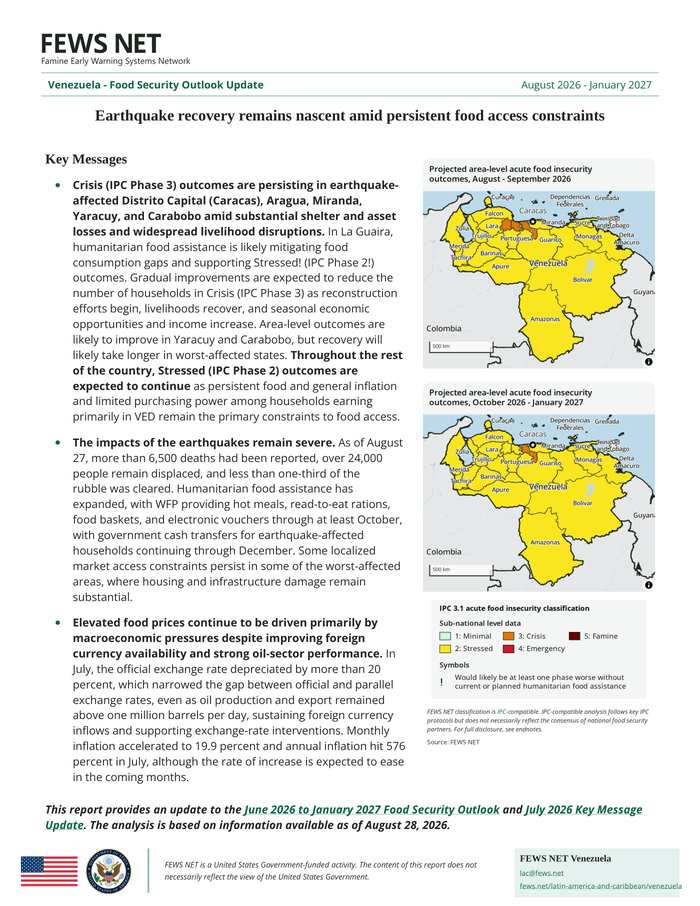
Country: Venezuela (Bolivarian Republic of) Source: Famine Early Warning System Network Please refer to the attached file. Key Messages Crisis (IPC Phase 3) outcomes are persisting in earthquake-affected Distrito Capital (Caracas), Aragua, Miranda, Yaracuy, and Carabobo amid substantial shelter and asset losses and widespread livelihood disruptions. In La Guaira, humanitarian food assistance is likely mitigating food consumption gaps and supporting Stressed! (IPC Phase 2!) outcomes. Gradual improvements are expected to reduce the number of households in Crisis (IPC Phase 3) as reconstruction efforts begin, livelihoods recover, and seasonal economic opportunities and income increase. Area-level outcomes are likely to improve in Yaracuy and Carabobo, but recovery will likely take longer in worst-affected states. Throughout the rest of the country, Stressed (IPC Phase 2) outcomes are expected to continue as persistent food and general inflation and limited purchasing power among households earning primarily in VED remain the primary constraints to food access. The impacts of the earthquakes remain severe. As of August 27, more than 6, 500 deaths had been reported, over 24, 000 people remain displaced, and less than one-third of the rubble was cleared. Humanitarian food assistance has expanded, with WFP providing hot meals, read-to-eat rations, food baskets, and electronic vouchers through at least October, with government cash transfers for earthquake-affected households continuing through December. Some localized market access constraints persist in some of the worst-affected areas, where housing and infrastructure damage remain substantial. Elevated food prices continue to be driven primarily by macroeconomic pressures despite improving foreign currency availability and strong oil-sector performance. In July, the official exchange rate depreciated by more than 20 percent, which narrowed the gap between official and parallel exchange rates, even as oil production and export remained above one million barrels per day, sustaining foreign currency inflows and supporting exchange-rate interventions. Monthly inflation accelerated to 19. 9 percent and annual inflation hit 576 percent in July, although the rate of increase is expected to ease in the coming months.
Venezuela Food Security Outlook Update: Earthquake recovery remains nascent amid persistent food access constraints, August 2026 – January 2027

RELATED ARTICLES


