

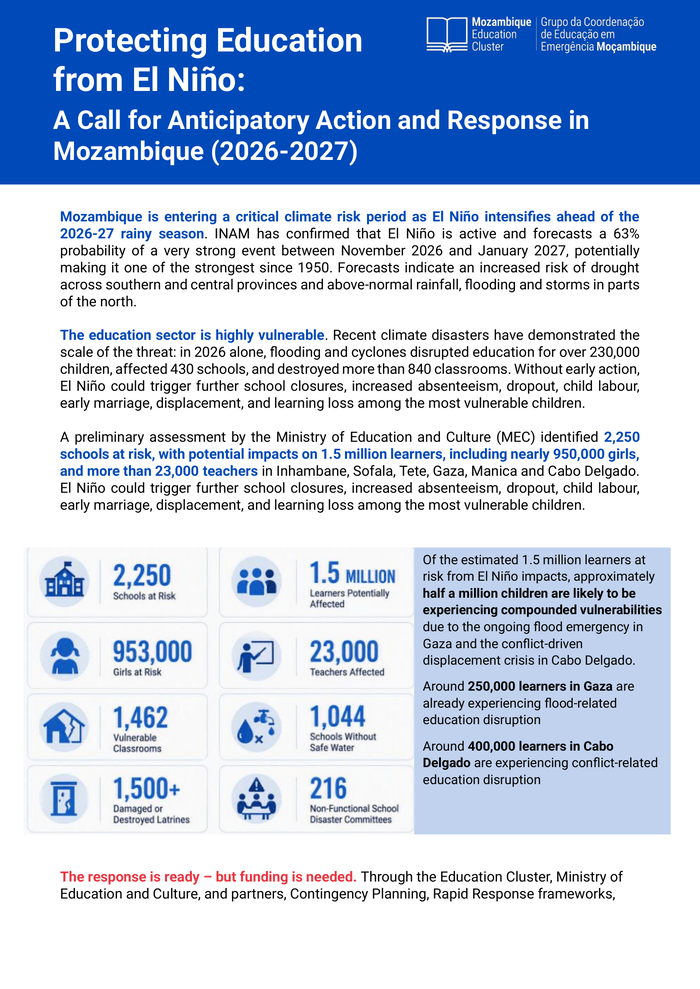
Country: Mozambique Sources: Education Cluster, Save the Children, UN Children’s Fund Please refer to the attached file. Mozambique is entering a critical climate risk period as El Niño intensifies ahead of the 2026-27 rainy season. INAM has confirmed that El Niño is active and forecasts a 63% probability of a very strong event between November 2026 and January 2027, potentially making it one of the strongest since 1950. Forecasts indicate an increased risk of drought across southern and central provinces and above-normal rainfall, flooding and storms in parts of the north. The education sector is highly vulnerable. Recent climate disasters have demonstrated the scale of the threat: in 2026 alone, flooding and cyclones disrupted education for over 230, 000 children, affected 430 schools, and destroyed more than 840 classrooms. Without early action, El Niño could trigger further school closures, increased absenteeism, dropout, child labour, early marriage, displacement, and learning loss among the most vulnerable children. A preliminary assessment by the Ministry of Education and Culture (MEC) identified 2, 250 schools at risk, with potential impacts on 1. 5 million learners, including nearly 950, 000 girls, and more than 23, 000 teachers in Inhambane, Sofala, Tete, Gaza, Manica and Cabo Delgado. El Niño could trigger further school closures, increased absenteeism, dropout, child labour, early marriage, displacement, and learning loss among the most vulnerable children. The response is ready – but funding is needed. Through the Education Cluster, Ministry of Education and Culture, and partners, Contingency Planning, Rapid Response frameworks, and Anticipatory Action mechanisms have already been established and strengthened under the ongoing ECHO-supported Rapid Response Action. Frontline capacity, coordination systems, and implementation arrangements are in place and ready to be activated. We Call on Donors and Education Partners to: • Provide immediate, flexible and/or earmarked anticipatory funding before November 2026 to activate pre-agreed education contingency plans ahead of the forecasted El Niño impacts, enabling the rapid deployment of learning materials, temporary learning solutions, psychosocial support, and school WASH interventions. Early financing will allow action during the current window of opportunity rather than after impacts have materialized. • Prioritize Education in Emergencies as an essential, protective, and life-sustaining investment, NiñoNiño 2026/7 ensuring that it is included within multi-sector humanitarian and climate response financing alongside child protection, nutrition, health, WASH, and social protection interventions. • Support rapid response and recovery mechanisms already established by the Education Cluster and partners, enabling timely assistance to affected schools and learners while safeguarding learning continuity. • Invest in resilient and climate-smart education systems including safer school infrastructure, disaster risk reduction, and preparedness measures that reduce future humanitarian costs and strengthen community resilience. The forecast is clear, and the window for action is narrowing. More than 1. 5 million children risk disruption to their education if anticipatory measures are not activated before the peak impacts of El Niño. The coordination mechanisms, contingency plans, and response capacities are already in place through the Ministry of Education and Culture, the Education Cluster, and partners. What is needed now is timely and flexible financing to trigger action before schools are affected. Investing today in anticipatory action will protect learning, reduce humanitarian needs, and avoid higher response costs in the future. Protect Learning. Protect Children. Act Before the Crisis Escalates.
Protecting Education from El Niño: A Call for Anticipatory Action and Response in Mozambique (2026-2027)

RELATED ARTICLES


