

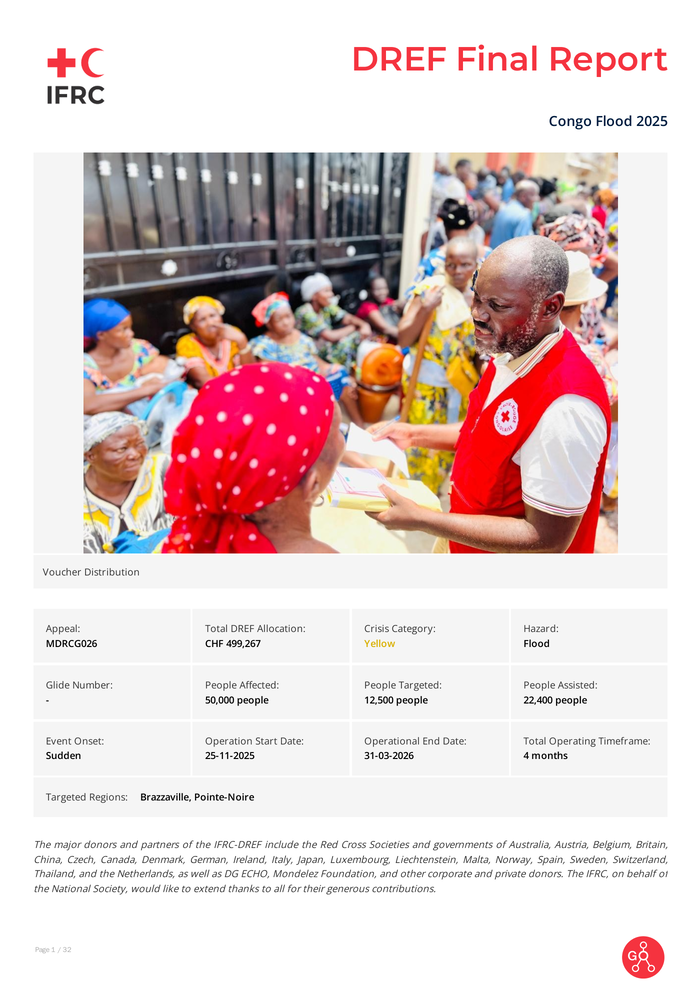
Country: Congo Source: International Federation of Red Cross and Red Crescent Societies Please refer to the attached file. Description of the Event Date of event 19-11-2025 What happened, where and when? Exceptionally heavy rainfall during November 2025 triggered flash floods and severe flooding across the departments of Brazzaville and Pointe-Noire in the Republic of the Congo, causing significant humanitarian consequences and widespread material destruction. According to the Congolese Red Cross (CRC), approximately 50, 000 people were affected, 22, 842 people were displaced or evacuated, and at least 55 people were injured. The floods particularly affected low-lying and densely populated neighbourhoods in Brazzaville and Pointe-Noire, where water levels rose rapidly following torrential rains and the overflow of rivers and drainage systems. Several neighbourhoods were submerged after the Tsiémé River in Brazzaville and the Nzoko River in Pointe-Noire exceeded normal levels. Meteorological services reported rainfall levels nearly twice the seasonal average, accompanied by a significant rise in the water level of the Congo River and its tributaries, reaching approximately 5. 62 metres above normal levels. The floods caused extensive damage to homes, community infrastructure and livelihoods. Thousands of houses were partially or completely destroyed, roads and drainage systems were damaged, and more than 1, 750 hectares of agricultural land were flooded across the two targeted departments. Many affected families lost household belongings, productive assets and sources of income. Most displaced households sought shelter with relatives, neighbours or host families, often in overcrowded and precarious living conditions. The disaster also generated significant public health and WASH concerns. Floodwaters damaged water points, sanitation facilities and household latrines, increasing the risk of waterborne diseases, including cholera, diarrhoea and typhoid. In several affected communities, access to safe drinking water and adequate sanitation was severely disrupted, while stagnant water increased exposure to malaria and other vector-borne diseases. In response to the emergency and following the Government’s appeal for humanitarian assistance, the Congolese Red Cross rapidly deployed 60 volunteers (30 in Brazzaville and 30 in Pointe-Noire) to support search and rescue activities, rapid assessments, first aid and community sensitization. With the support of the International Federation of Red Cross and Red Crescent Societies (IFRC) through the DREF operation MDRCG026, the National Society implemented a four-month emergency response targeting 2, 500 vulnerable households (approximately 12, 500 people) through multipurpose assistance delivered via voucher-based support, alongside health, WASH, PGI and community engagement activities. The operation also mobilized 150 trained volunteers and community actors who supported epidemic prevention activities, hygiene promotion, psychosocial support, community-based surveillance and accountability mechanisms throughout the intervention. Lessons learned and Post-Distribution Monitoring (PDM) findings later confirmed that the operation contributed positively to meeting urgent household needs and restoring dignity among affected populations, despite persistent humanitarian needs and operational challenges in some areas, particularly in Brazzaville.
Congo Flood 2025 – DREF Final Report (MDRCG026)

RELATED ARTICLES


