

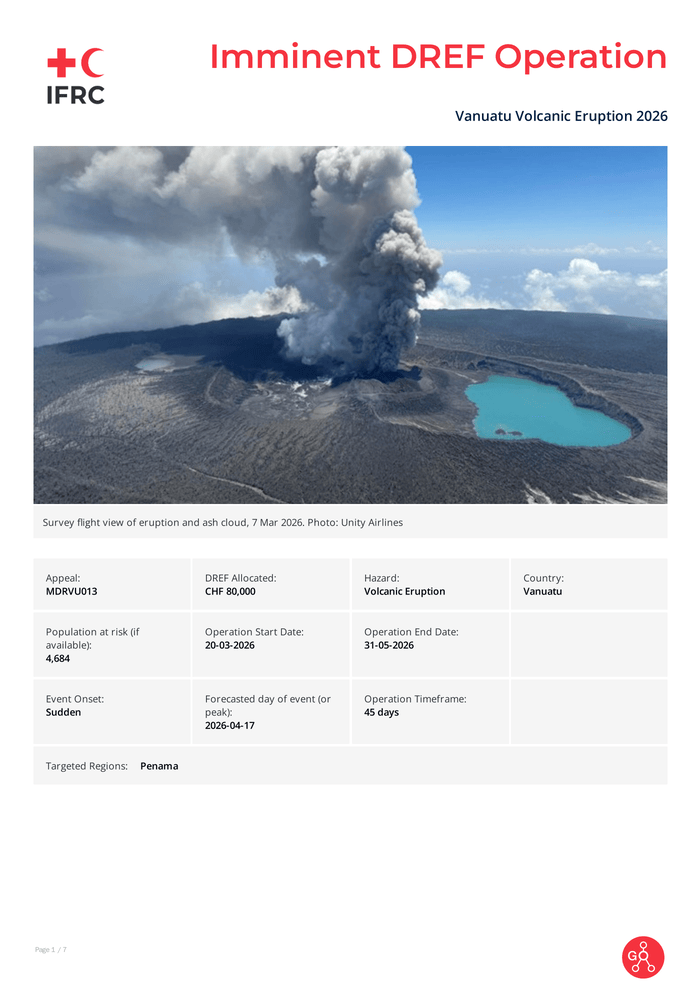
Country: Vanuatu Source: International Federation of Red Cross and Red Crescent Societies Please refer to the attached file. Scenario analysis When and where is the hazard expected to happen? Ambae Island remains an active volcanic environment due to ongoing activity at Manaro Voui. Increased volcanic activity was observed in early 2026, with reports of gas emissions, ashfall, and environmental impacts affecting surrounding communities. On 19 February 2026, the Vanuatu Meteorology and Geo-Hazards Department (VMGD) reported increased volcanic activity, including gas emissions and dark plumes from the vent. On 23 February 2026, the volcanic alert level was raised to Level 3 (Minor Eruption), indicating increased activity but with impacts largely localised. At present, the volcanic activity remains confined within Lake Voui at the summit crater. The officially designated volcanic hazard area corresponds to Danger Zone B, which covers approximately a 3 km radius around the active vent. This zone is considered hazardous due to the risk of volcanic projectiles, ashfall, gas emissions, and other volcanic hazards that may occur at any time. While the immediate danger zone is limited to the summit area, ashfall has already been reported in several communities on Ambae. Ground observations between 22 and 23 February 2026 confirmed that communities in the southern and south-eastern parts of Ambae, particularly those located downwind of the volcano, are experiencing volcanic ashfall. Ashfall may continue depending on wind direction and plume height, potentially affecting additional areas of the island as well as nearby islands exposed to prevailing trade winds. Volcanic ash and gas emissions are already affecting surrounding communities. Ashfall has been reported in several parts of Ambae, particularly in the southern and south-eastern areas located downwind of the volcano. The ashfall has begun to contaminate rainwater harvesting systems and surface water sources, which are the primary sources of drinking water for many households. Communities have also reported health concerns associated with ash exposure, including respiratory irritation, coughing, red eyes, and skin irritation. In addition, ash accumulation on roofs and agricultural land is beginning to affect household living conditions and local food production, raising concerns about the continued safety of shelters and potential impacts on livelihoods. VMGD monitoring indicates that volcanic activity may continue in the coming weeks. Should volcanic activity intensify further, an escalation of the alert level could lead to heavier ashfall, increased gas emissions, and wider environmental impacts affecting additional communities across Ambae Island. Streams and watercourses may also pose a risk during periods of heavy rainfall due to ash deposits, which may lead to abnormal water flow or contamination. Given the uncertainty surrounding the evolution of the volcanic activity and the potential for rapid escalation, preparedness measures are required to reduce humanitarian risks and support communities that may be affected by ashfall, water contamination, and related health impacts.
Vanuatu Volcanic Eruption 2026 – Imminent DREF Operation (MDRVU013)

RELATED ARTICLES


