


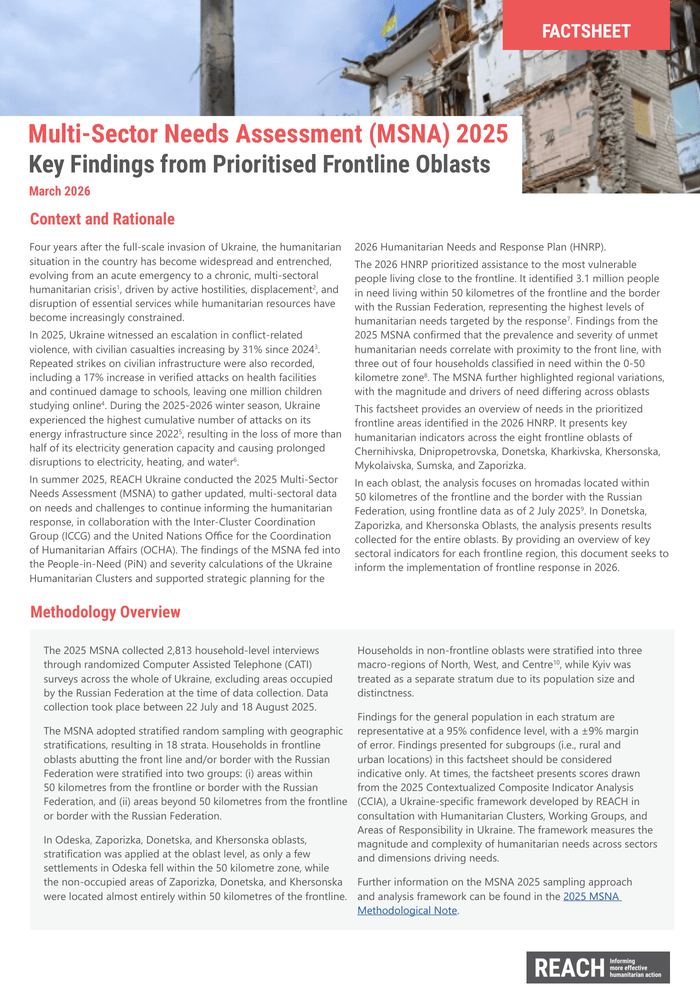
Country: Ukraine Source: REACH Initiative Please refer to the attached file. Context and Rationale Four years after the full-scale invasion of Ukraine, the humanitarian situation in the country has become widespread and entrenched, evolving from an acute emergency to a chronic, multi-sectoral humanitarian crisis1, driven by active hostilities, displacement2, and disruption of essential services while humanitarian resources have become increasingly constrained. In 2025, Ukraine witnessed an escalation in conflict-related violence, with civilian casualties increasing by 31% since 20243. Repeated strikes on civilian infrastructure were also recorded, including a 17% increase in verified attacks on health facilities and continued damage to schools, leaving one million children studying online4. During the 2025-2026 winter season, Ukraine experienced the highest cumulative number of attacks on its energy infrastructure since 20225, resulting in the loss of more than half of its electricity generation capacity and causing prolonged disruptions to electricity, heating, and water6. In summer 2025, REACH Ukraine conducted the 2025 Multi-Sector Needs Assessment (MSNA) to gather updated, multi-sectoral data on needs and challenges to continue informing the humanitarian response, in collaboration with the Inter-Cluster Coordination Group (ICCG) and the United Nations Office for the Coordination of Humanitarian Affairs (OCHA). The findings of the MSNA fed into the People-in-Need (PiN) and severity calculations of the Ukraine Humanitarian Clusters and supported strategic planning for the 2026 Humanitarian Needs and Response Plan (HNRP). The 2026 HNRP prioritized assistance to the most vulnerable people living close to the frontline. It identified 3. 1 million people in need living within 50 kilometres of the frontline and the border with the Russian Federation, representing the highest levels of humanitarian needs targeted by the response7. Findings from the 2025 MSNA confirmed that the prevalence and severity of unmet humanitarian needs correlate with proximity to the front line, with three out of four households classified in need within the 0-50 kilometre zone8. The MSNA further highlighted regional variations, with the magnitude and drivers of need differing across oblasts This factsheet provides an overview of needs in the prioritized frontline areas identified in the 2026 HNRP. It presents key humanitarian indicators across the eight frontline oblasts of Chernihivska, Dnipropetrovska, Donetska, Kharkivska, Khersonska, Mykolaivska, Sumska, and Zaporizka. In each oblast, the analysis focuses on hromadas located within 50 kilometres of the frontline and the border with the Russian Federation, using frontline data as of 2 July 2025. In Donetska, Zaporizka, and Khersonska Oblasts, the analysis presents results collected for the entire oblasts. By providing an overview of key sectoral indicators for each frontline region, this document seeks to inform the implementation of frontline response in 2026.



GrowthPakistan brings you the latest news to keep an eye on Pakistan’s startup ecosystem. Business keeps you growing when you stay aware of your competitors' moves. GrowthPakistan offers Business, Tech, Global Tech, Global, Auto, and Startup News straight from industries all around the globe. This platform will help you identify upcoming opportunities not only in Pakistan but worldwide.
Email : growthpakistan@gmail.com
Whatsapp : +92320-9497079
© growthpakistan