


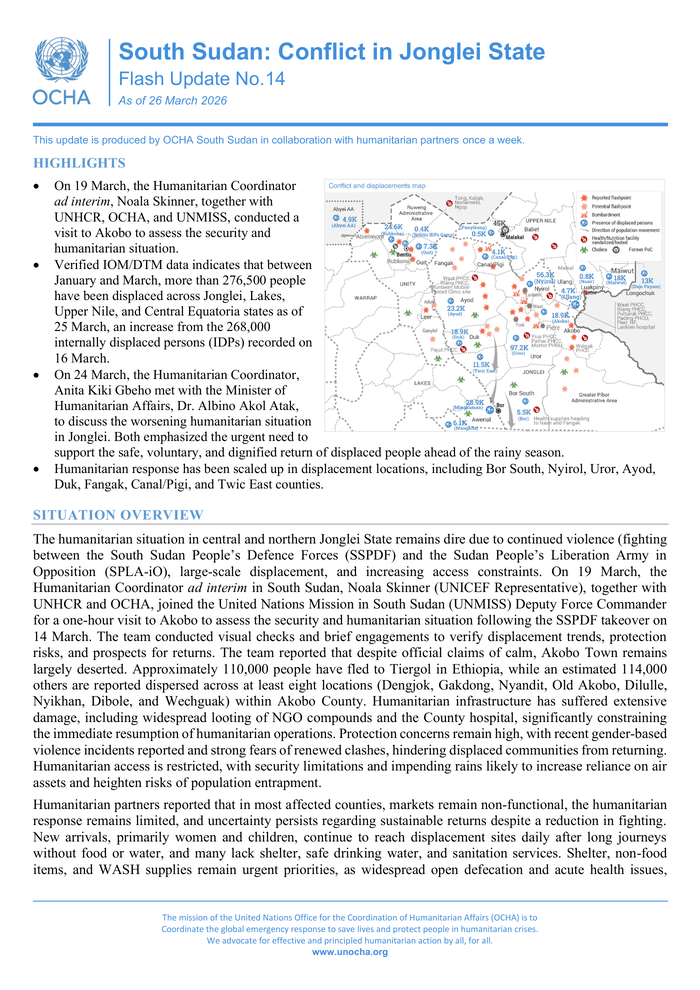
Country: South Sudan Source: UN Office for the Coordination of Humanitarian Affairs Please refer to the attached file. HIGHLIGHTS On 19 March, the Humanitarian Coordinator ad interim, Noala Skinner, together with UNHCR, OCHA, and UNMISS, conducted a visit to Akobo to assess the security and humanitarian situation. Verified IOM/DTM data indicates that between January and March, more than 276, 500 people have been displaced across Jonglei, Lakes, Upper Nile, and Central Equatoria states as of 25 March, an increase from the 268, 000 internally displaced persons (IDPs) recorded on 16 March. On 24 March, the Humanitarian Coordinator, Anita Kiki Gbeho met with the Minister of Humanitarian Affairs, Dr. Albino Akol Atak, to discuss the worsening humanitarian situation in Jonglei. Both emphasized the urgent need to support the safe, voluntary, and dignified return of displaced people ahead of the rainy season. Humanitarian response has been scaled up in displacement locations, including Bor South, Nyirol, Uror, Ayod, Duk, Fangak, Canal/Pigi, and Twic East counties. SITUATION OVERVIEW The humanitarian situation in central and northern Jonglei State remains dire due to continued violence (fighting between the South Sudan People’s Defence Forces (SSPDF) and the Sudan People’s Liberation Army in Opposition (SPLA-iO), large-scale displacement, and increasing access constraints. On 19 March, the Humanitarian Coordinator ad interim in South Sudan, Noala Skinner (UNICEF Representative), together with UNHCR and OCHA, joined the United Nations Mission in South Sudan (UNMISS) Deputy Force Commander for a one-hour visit to Akobo to assess the security and humanitarian situation following the SSPDF takeover on 14 March. The team conducted visual checks and brief engagements to verify displacement trends, protection risks, and prospects for returns. The team reported that despite official claims of calm, Akobo Town remains largely deserted. Approximately 110, 000 people have fled to Tiergol in Ethiopia, while an estimated 114, 000 others are reported dispersed across at least eight locations (Dengjok, Gakdong, Nyandit, Old Akobo, Dilulle, Nyikhan, Dibole, and Wechguak) within Akobo County. Humanitarian infrastructure has suffered extensive damage, including widespread looting of NGO compounds and the County hospital, significantly constraining the immediate resumption of humanitarian operations. Protection concerns remain high, with recent gender-based violence incidents reported and strong fears of renewed clashes, hindering displaced communities from returning. Humanitarian access is restricted, with security limitations and impending rains likely to increase reliance on air assets and heighten risks of population entrapment. Humanitarian partners reported that in most affected counties, markets remain non-functional, the humanitarian response remains limited, and uncertainty persists regarding sustainable returns despite a reduction in fighting. New arrivals, primarily women and children, continue to reach displacement sites daily after long journeys without food or water, and many lack shelter, safe drinking water, and sanitation services. Shelter, non-food items, and WASH supplies remain urgent priorities, as widespread open defecation and acute health issues, including diarrhoea, malnutrition, and pneumonia, continue to increase needs. Nutrition supplies have been unavailable in displacement locations for months, further exacerbating vulnerabilities, while the risk of cholera remains imminent. Between 18 and 24 March, 155 new cholera cases and two deaths were reported in nine counties: Ayod (62), Yirol East (28), Duk (22), Mayom (13), Uror (10), Awerial (7), Bor South (7), Panyijiar (5), and Juba (1). On 24 March, the Humanitarian Coordinator in South Sudan, Ms. Anita Kiki Gbeho, met with the Minister of Humanitarian Affairs and Disaster Management, Dr. Albino Akol Atak, to discuss the worsening humanitarian situation following renewed armed clashes in central and northern Jonglei State. Both sides stressed the urgent need to support the safe, voluntary, and dignified return of displaced people, especially with the rainy season approaching. The Minister confirmed the Government’s readiness to coordinate assistance for the most vulnerable. Ms. Gbeho reaffirmed the UN’s support to ensure returnees can access essential services, including shelter, water, health care, and food, so they can rebuild their lives. The meeting highlighted the shared commitment of national and international partners to scale up a coordinated response and address both immediate needs and longer-term recovery in Jonglei State. The Minister and the Humanitarian Coordinator further agreed to activate the 2026 Floods Task Force, which will be co-chaired by the Chairperson of the Relief and Rehabilitation Commission and OCHA. The State Inter-Cluster Coordination Group in Bor is planning an inter-agency rapid needs assessment mission to Akobo East Payam in Akobo County to assess the needs of an estimated 100, 000 reported IDPs across Nyandit, Gakdong, Dengjok, Wechguak, Dilulle, Dibole, and Nyikhan, where people are reported to be concentrated. The mission is scheduled to depart Bor on 30 March and return on 2 April. HUMANITARIAN IMPACT AND NEEDS Displacement: Verified IOM/DTM data indicates that between January and March, more than 276, 500 people have been displaced across Jonglei, Lakes, Upper Nile, and Central Equatoria states as of 25 March, an increase from the 268, 000 internally displaced persons (IDPs) recorded on 16 March. According to UNHCR, an estimated 110, 000 people have fled across the border into Ethiopia since the start of the crisis. Civilians continue to flee daily, many facing repeated displacement and heightened protection concerns. Looting of health facilities and impact on the population: Since the conflict began in late December 2025, reports from the World Health Organization (WHO) confirm that 26 health facilities have been destroyed, looted, or rendered non-functional across six counties of Akobo (10), Nyirol (5), Uror (4), Canal/Pigi (3), Ayod (3), and Duk (1). Based on WHO standard service coverage estimates, approximately 1. 35 million people in Jonglei State have lost access to essential health services due to damage, looting, and service disruptions. Health Cluster partners have called for immediate rehabilitation and re-equipping of conflict-affected health facilities. Between 18 and 24 March, 155 new cholera cases and two deaths were reported in nine counties including four in Jonglei State. Measles cases have also been reported in Ayod County, and some health facilities remain only partially functional. On 25 March, at least three international NGOs and one national NGO (Oxfam, CORDAID, Danish Refugee Council and Community in Need Aid) reported a loss of more than US$538, 000 because of looting of their equipment and assets including vehicles, WASH, education supplies, fuel and office assets during conflict in Uror, Akobo and Nyirol counties, impacting humanitarian response to thousands of vulnerable people in the area. On 23 March, a Médecins Sans Frontières (MSF) team returned to Akobo Town and visited the hospital for the first time since the government-led offensive on 6 March and the subsequent evacuation of staff on 7 March. The team found that the hospital and MSF’s office had been fully looted and were no longer functional. The facility, which previously provided care for more than 100, 000 people, has been rendered inoperable, preventing the resumption of medical services in the near term. According to MSF, medicines were not only taken but also deliberately damaged, and all furniture and equipment, including 50 hospital beds, were removed. MSF reports that the hospital was not damaged by fighting but had been emptied. The international NGO is calling for clarity on the circumstances of the looting, assurances of safety, and guarantees that similar incidents will not occur before considering any return. On 25 March, Nutrition Cluster partners reported a complete suspension of nutrition services in several conflict-affected counties in northern and central Jonglei State, particularly in Akobo and Canal/Pigi counties. In southern Canal/Pigi, 12 nutrition sites are non-functional due to infrastructure damage and looting. This suspension places over 4, 600 children under five and nearly 3, 000 pregnant and breastfeeding women (PBW) previously enrolled in treatment at heightened risk, increasing vulnerability to disease outbreaks and worsening acute malnutrition. Urgent priorities include restoration of severe acute malnutrition (SAM) and moderate acute malnutrition (MAM) treatment services for more than 7, 000 children and 3, 600 pregnant and breastfeeding women at risk in the southern payams of Canal/Pigi County. Re-establishment of functional health facilities in Akobo and Canal/Pigi, including replenishment of looted essential medicines and nutrition commodities. HUMANITARIAN RESPONSE AND CHALLENGES Humanitarian partners have scaled up assistance in displacement locations, including Bor South, Nyirol, Uror, Ayod, Duk, Fangak, Canal/Pigi, and Twic East counties. Logistics Cluster: On 24 March, the Logistics Cluster reported that it facilitated and coordinated the delivery of 54 metric tons of education, logistics, nutrition, and protection supplies by air and road to locations across Jonglei, including Chuil in Nyirol County, and Boma and Pibor in the Greater Pibor Administrative Area (GPAA). The Cluster airlifted 14 metric tons of logistics, nutrition, and protection supplies to Chuil and Boma on behalf of two international NGOs (MSF and ForAfrika). In addition, the Cluster coordinated a road convoy to Pibor, transporting approximately 40 metric tons of education supplies on behalf of UNICEF. The Logistics Cluster continues to provide a weekly road convoy schedule, which partners are encouraged to maximize while roads remain accessible, as road transport remains the most cost‐efficient modality. Food Security and Livelihoods Cluster: As of 25 March, the Food Security and Livelihoods (FSL) Cluster partners have verified more than 152, 000 displaced people and host community members in need of food assistance across Duk, Akobo, Nyirol, Ayod, and Uror counties. As of 22 March, partners have provided general food assistance to over 113, 300 people, equivalent to approximately 1, 100 metric tons of food commodities and cash assistance in four counties of Duk, Twic East, Ayod, and Nyirol in Jonglei State. Distributions are ongoing in conflict-affected locations. Verification and distribution exercise is also ongoing in Uror and Nyirol counties. On 23 March, the Food and Agriculture Organization of the United Nations (FAO), with support from the World Bank and in partnership with the Ministry of Agriculture and Food Security, distributed an unspecified number of cool boxes to fish processors to help preserve fish freshness, reduce spoilage, and support income generation as an important step toward strengthening resilience and livelihoods. FAO, with support from the African Development Bank Group, has also begun constructing classrooms and a fully equipped laboratory at the Dr. John Garang Memorial University of Science and Technology in Bor Town. These facilities will enhance youth training in the agriculture and fisheries sectors, contributing to improved resilience and livelihood opportunities for local communities. Health Cluster: Health Cluster Partners continue to provide services across several conflict-affected counties despite ongoing insecurity and access constraints. WHO is leading Health Cluster coordination and information sharing, including updates on attacks on health care, cholera response, and service disruptions in Jonglei and the Greater Pibor Administrative Area (GPAA). Since January, Health Cluster, through WHO, has received 54 supply requests from 20 implementing partners and has handed over or delivered 14. 45 metric tons of emergency supplies valued at US$1. 1 million. Of this, 11. 17 metric tons worth approximately US$600, 000 were delivered for operations in Jonglei State. In Ayod County, a national NGO (WART) is supporting the response through the Health Sector Transformation Project (HSTP), including support to four health facilities, seven Primary Health Care Centres (PHCCs), and seven Primary Health Care Units (PHCUs). WART also reported that supplies have been pre‐positioned through the HSTP programme since September last year, with no new consignments received since then. Partners currently present in Ayod town include CMD, HFO, MSF‐France, WART, and ACF. In Uror County, MSF‐Holland is supporting the Pieri health facility, where outpatient services have been expanded, and Pulchuol PHCC, which is receiving donor support for cholera response. In Akobo, the national NGO (CIDO) reported that some villages remain out of contact, Nyadin is inaccessible, and some areas have no functional health facilities. The international NGO (Medair) reported looting of its compound, relocation or evacuation of staff, and movement of medical equipment to Ethiopia. The International Rescue Committee (IRC) reported funding to sustain a limited presence for an additional three to four months. On 24 March, Médecins Sans Frontières (MSF) reported that they are scaling up medical and humanitarian support for people displaced in Chuil, Nyirol County, and in Ulang County, Upper Nile State. In Chuil, MSF upgraded the health-care centre, increasing capacity to 60 beds to provide emergency care, malnutrition treatment, maternal health services, and stabilizing trauma cases. Additionally, MSF teams travelled by boat through swamps and rivers to run mobile clinics in areas around Chuil. WASH Cluster: MSF teams distributed relief items—including mosquito nets, blankets, soap, jerry cans, sanitary pads, plastic sheeting, and empty sandbags—to more than 1, 600 families (approximately 9, 000 people) in Chuil and Wesh Nyawaan in Nyirol County. MSF also plans to install a SWAT system to support displaced populations in the area and distribute an additional 5, 000 WASH kits in other affected locations. Solidarités International reported completing minor repairs on three hand pumps serving 1, 500 people and establishing emergency SWAT systems to improve access to safe water for displaced people in Nyangore (Ulang County) and in three IDP sites in Mingkaman, Awerial County (Lakes State). The organization also constructed two blocks of semi‐permanent latrines at a health facility and distributed WASH non‐food items to 1, 500 displaced households in Mingkaman. In addition, the WASH Cluster partner PAH provided WASH non‐food items to 1, 000 households (approximately 6, 000 individuals) in Akobo East Payam, Akobo County. IOM is repairing hand pumps and has begun distributing WASH non‐food items to 2, 000 households in Uror County. UNICEF and CMD distributed WASH supplies, including soap, buckets, filter cloths, and Aquatabs to 1, 000 displaced households in Ayod County. Another WASH Cluster partner provided menstrual hygiene management (MHM) kits to 500 women and girls of reproductive age in Mingkaman, Awerial County. Hygiene promotion activities reached approximately 5, 880 people in Mingkaman displacement sites. Nutrition Cluster: Security dialogues are ongoing between community leaders, local commissioners, and military commanders. Partners are monitoring the situation, relocating staff to safer areas, and using community networks to identify and refer malnutrition cases despite the suspension of services at several sites. Cholera outbreak: In the last seven days (18–24 March), 155 new cholera cases and 2 deaths, a Case Fatality Rate (CFR) of 1. 3 per cent, were reported across nine counties. New cases were recorded in Ayod (62), Yirol East (28), Duk (22), Mayom (13), Uror (10), Awerial (7), Bor South (7), Panyijiar (5), and Juba (1). Both reported deaths occurred in Yirol East and were community deaths. Five of the seven cases in Awerial were from IDP camps. Since the outbreak began on 28 September 2024, a cumulative 100, 759 cases and 1, 653 deaths have been reported across 55 counties in nine states and all three administrative areas. According to the WHO, the outbreak has increasingly shifted toward Jonglei and Lakes states, driven by population displacement and poor WASH conditions in IDP sites. Follow‐up oral cholera vaccination activities are underway across Jonglei, including completion of targeted mop‐up in Duk and preparation of a micro‐plan for Pariak. In Duk, preliminary oral cholera vaccine (OCV) results indicate that 24, 169 people have been vaccinated. WHO and the Health Cluster continue to provide core pipeline and other emergency supplies to partners. CHALLENGES State‐level storage and logistics capacity remain insufficient for large‐scale pre‐positioning, while damaged facilities, looted equipment, and temporary structures continue to limit partners’ ability to quickly restore full services. Insecurity and active fighting continue to impede access and disrupt services, including in Canal/Pigi and New Fangak in Fangak County. Road access to parts of Jonglei remains unfeasible, and staff displacement is affecting continuity of care and supervision. Insecurity is impacting operations, and pre‐positioning is not being carried out due to the risk of further looting in the current environment. Systematic looting of warehouses and the destruction of nutrition sites require significant reconstruction and replenishment of supplies. Reaching communities in remote, swampy border areas also remains extremely challenging. Persistent military presence and active clashes prevent the safe return of civilians and the movement of aid workers. Access to Akobo County remains severely constrained, hindering the timely movement of relief supplies and partner operations. Restoring road access to Akobo should be a priority response modality, with all efforts directed toward safely reopening the Walgak–Akobo route. WFP operations in Akobo East and Akobo West in Akobo County remain suspended following the 72‐hour military evacuation order. Ongoing humanitarian access constraints and the displacement of communities toward Akobo Tiergol on the Ethiopian border have prevented the continuation of activities. Reports indicate urgent food needs among IDPs, mainly women and children, in Nyatim Boma, Nyirol County.



GrowthPakistan brings you the latest news to keep an eye on Pakistan’s startup ecosystem. Business keeps you growing when you stay aware of your competitors' moves. GrowthPakistan offers Business, Tech, Global Tech, Global, Auto, and Startup News straight from industries all around the globe. This platform will help you identify upcoming opportunities not only in Pakistan but worldwide.
Email : growthpakistan@gmail.com
Whatsapp : +92320-9497079
© growthpakistan