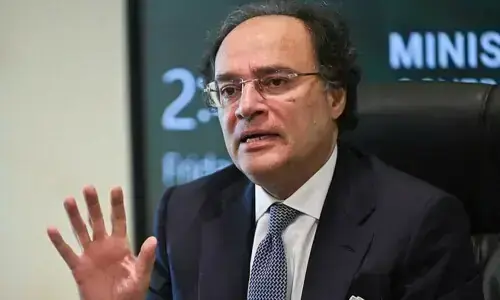
ISLAMABAD: Finance Minister Muhammad Aurangzeb has strictly opposed any changes to the existing structure of private and government representation on the Policy Board of the Securities and Exchange Commission of Pakistan (SECP).The alleged abuse of financial autonomy by the SECP Policy Board was taken up during a meeting of the Senate Standing Committee on Finance here on Wednesday.Deliberations were held on the private member’s bill titled “The Securities and Exchange Commission of Pakistan (Amendment) Bill, 2026,” introduced by Senator Anusha Rahman Ahmad Khan. The mover highlighted concerns regarding governance and accountability within the SECP, including the retrospective increase of Salaries and emoluments of the commissioners and the composition of the Board, which presently has a majority from the private sector. It was noted that the related misappropriation matter is also under discussion in the Public Accounts Committee (PAC).READ MORE: FY21 audit report for FD: There’s need to reform SECP: PACThe Finance Minister stated that the SECP Policy Board comprises very reputable people from the private sector. A balanced approach is needed, as we cannot change the entire institution as a consequence of an act by a few individuals. “We will strongly oppose any move to change the composition of the SECP Policy Board”, he said.Chairman of the SECP, Dr. Kabir Sidhu, stated that the government is a signatory to the agreement of the reform package/loan with the Asian Development Bank (ADB) to ensure financial independence for the regulator. The number of private members was increased, and government members were deceased at the SECP Policy Board following this financial transaction with the international donor agency. Globally, financial regulators are always financially and administratively independent, and we will breach this agreement if we go ahead with the proposed Bill, he added. Senator Anusha recommended a decrease in the number of private members on the SECP Policy Board from six to four and an increase in government representation from five to seven by including one member of the National Assembly and one member from the Senate. The SECP is in the hands of the private sector, and the SECP Policy Board must have equal representation of all provinces.The Minister of Finance and Revenue opposed certain proposed amendments. The Committee was further informed by the mover of the bill about the proposal to deposit SECP revenues into the Federal Consolidated Fund and the suggestion to include one member each from the Senate and National Assembly on the SECP Board to enhance parliamentary oversight and accountability. Following a detailed discussion, the bill was passed with amendments. Senator Anusha Rahman highlighted that the SECP is a regulator and its Board cannot be run by the private sector and needs to be harmonized in line with other regulatory bodies. Presently, the SECP Act, 1997, allows the Securities and Exchange Commission of Pakistan to retain and utilize its receipts outside the Federal Consolidated Fund. Such retention of public money limits effective Parliamentary oversight and is inconsistent with Articles 78 to 81 of the Constitution. The object of this Bill is to ensure that all receipts of the SECP are credited to the Federal Consolidated Fund and that its expenditure is regulated through Parliamentary appropriations, thereby promoting transparency, financial discipline, and accountability in accordance with constitutional principles.The Committee also considered “The Securities and Exchange Commission of Pakistan (Amendment) Bill, 2025”, which was also passed with amendments.The meeting was attended by Senator Anusha Rahman Ahmad Khan, Senator Muhammad Talha Mahmood, and Senator Shahzaib Durrani, while Senator Danesh Kumar, Senator Hidayatullah Khan, and Senator Zamir Hussain Ghumro participated as movers of agenda items.Copyright Business Recorder, 2026