

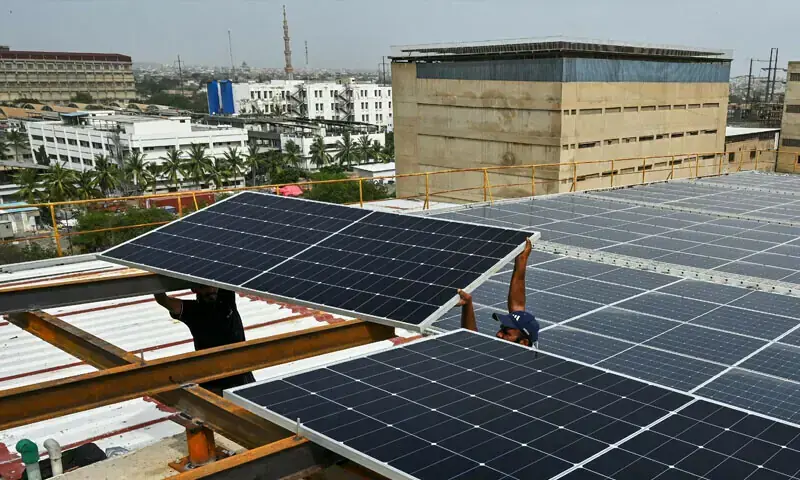
Pakistan’s power sector is living through a paradox. On the one hand, rooftop solar has become the most organic energy reform the country has ever witnessed, financed by households, powered by falling global module prices, and accelerated by affordability concerns.On the other hand, recent amendments to the net-metering regime by the National Electric Power Regulatory Authority (Nepra) and the policy posture of the Ministry of Energy (Power Division) suggest an institutional discomfort with this bottom-up transition. The result may not be stabilisation, but a classic J-curve.The J-curve phenomenon, borrowed from trade and macroeconomics, describes an initial deterioration before eventual improvement. The dynamic is less a J-curve of temporary pain followed by recovery, and more a short-term stabilisation masking long-term disengagement. By tightening export compensation through net-billing and lower buyback rates, the grid’s immediate revenue losses may slow as prosumer growth is curtailed. On paper, this can appear as fiscal relief. Yet the altered incentive structure encourages consumers to maximise self-consumption rather than abandon solar altogether. Higher-income households add batteries, commercial users redesign load profiles, and over time, even middle-income clusters reduce reliance on the grid.Atempting to suppress its adoption through tariff spreads will likely deepen off-grid autonomy via BESSThus, while short-run losses to the national grid may decline, the long-run outcome could be more structural: gradual but decisive movement toward complete or near-complete off-grid autonomy through Battery Energy Storage Systems (BESS), leaving the grid with a narrower and more vulnerable consumer base.This trajectory reflects a deeper philosophical fault line in planning. The prevailing doctrine within the Power Division remains capacity-centric, rooted in a legacy model of centralised expansion under long-term contracts.Planning documents emphasise megawatts installed rather than megawatts utilised; capacity payments rather than system flexibility; and procurement rather than optimisation. Solar proliferation is treated as a disruption rather than a structural signal. And yet, the demand decline is not evidence of decentralisation triumph, but evidence of price failure. Consumers are not exiting the grid out of ideology; they are escaping tariff distress.The autonomy of Nepra also merits scrutiny. A regulator’s legitimacy rests on independence, evidence-based deliberation, and full institutional quorum. Major recalibrations to prosumer regulations, particularly when they affect investment behaviour and financial flows, should emerge from comprehensive cost-of-service studies and transparent modelling.An integrated response requires reimagining external financing as well. Under the World Bank Country Partnership Framework, an outcome linked to an additional 10GW of installed capacity reflects an outdated premise: that supply expansion is the central constraint. Pakistan today suffers not from insufficient capacity, but from excess contracted generation with low utilisation.The government should proactively negotiate a reorientation of this envelope. Rather than adding megawatts, concessional resources can modernise transmission corridors, deploy grid-scale BESS, upgrade dispatch software, and invest in advanced metering infrastructure. In doing so, rooftop solar becomes an asset rather than a liability, absorbed during midday, discharged during evening peaks, and orchestrated through digital control systems.Similarly, subsidy reform under the International Monetary Fund programme requires nuance. The removal of tariff subsidies for protected consumers, with compensation channelled through Benazir Income Support Programme cash transfers, is fiscally unsustainable and politically fragile. Cash grants indexed imperfectly to volatile tariffs will struggle to maintain purchasing power.A more durable solution lies in asset-based protection: providing eligible protected households with standardised rooftop solar kits, small lithium or sodium-ion batteries, and high-efficiency DC fans. The capital expenditure is front-loaded but reduces recurring subsidy liabilities. It shields vulnerable consumers from tariff shocks, cuts peak demand, and aligns social protection with climate objectives. In energy policy, ownership can be more empowering than compensation.Beyond households, surplus green electricity should be strategically directed toward export-oriented industry via the Competitive Trading Bilateral Contracts Market. As the European Union’s Carbon Border Adjustment Mechanism tightens compliance for embedded emissions, Pakistan’s industrial competitiveness will hinge on credible decarbonisation pathways. Dedicated green feeders, backed by renewable generation and storage, can enable steel, cement, and textiles to certify lower carbon intensity.Rather than curtailing solar during low-demand hours, the grid can channel it to industrial clusters at negotiated tariffs, reducing capacity payments per unit and improving load factors. Solar then becomes not a fiscal threat, but a trade policy instrument.The most innovative pillar of integrated planning lies in repurposing underutilised coal plants. Several imported coal facilities operate at low-capacity factors yet carry heavy fixed obligations. Instead of perpetuating stranded assets, selected sites can be converted into grid-scale BESS hubs. Early retirement, financed through blended climate funds, can be paired with carbon credit generation under high-integrity methodologies. Emissions avoided by replacing coal dispatch with stored renewable energy create monetisable mitigation outcomes. Revenues can service transition costs while improving system flexibility. In effect, yesterday’s baseload becomes tomorrow’s buffer.Such a roadmap embodies genuine integration: aligning multilateral finance, social protection, industrial policy, and climate markets under a unified system lens. It acknowledges that Pakistan’s solar surge is not an aberration but a structural shift in consumer behaviour. Attempts to suppress it through tariff spreads will likely deepen the J-curve trough. Harnessing it through grid modernisation, storage deployment, and market reform can convert disruption into resilience.Pakistan’s solar saga is therefore not a tale of excess panels or regulatory anxiety. It is a test of planning philosophy. The choice is between defending an eroding paradigm or orchestrating a coordinated transition, where distributed generation, centralised infrastructure, and climate finance reinforce rather than undermine each other. Integrated planning is not about adding more capacity; it is about adding coherence.The writer has a doctorate in Energy Economics and serves as a Research Fellow in Sustainable Development Policy Institute.Email: khalidwaleed@sdpi.org,X: @KhalidwaleedPublished in Dawn, The Business and Finance Weekly, March 2nd, 2026



GrowthPakistan brings you the latest news to keep an eye on Pakistan’s startup ecosystem. Business keeps you growing when you stay aware of your competitors' moves. GrowthPakistan offers Business, Tech, Global Tech, Global, Auto, and Startup News straight from industries all around the globe. This platform will help you identify upcoming opportunities not only in Pakistan but worldwide.
Email : growthpakistab@gmail.com
Whatsapp : +92320-9497079
© growthpakistan