


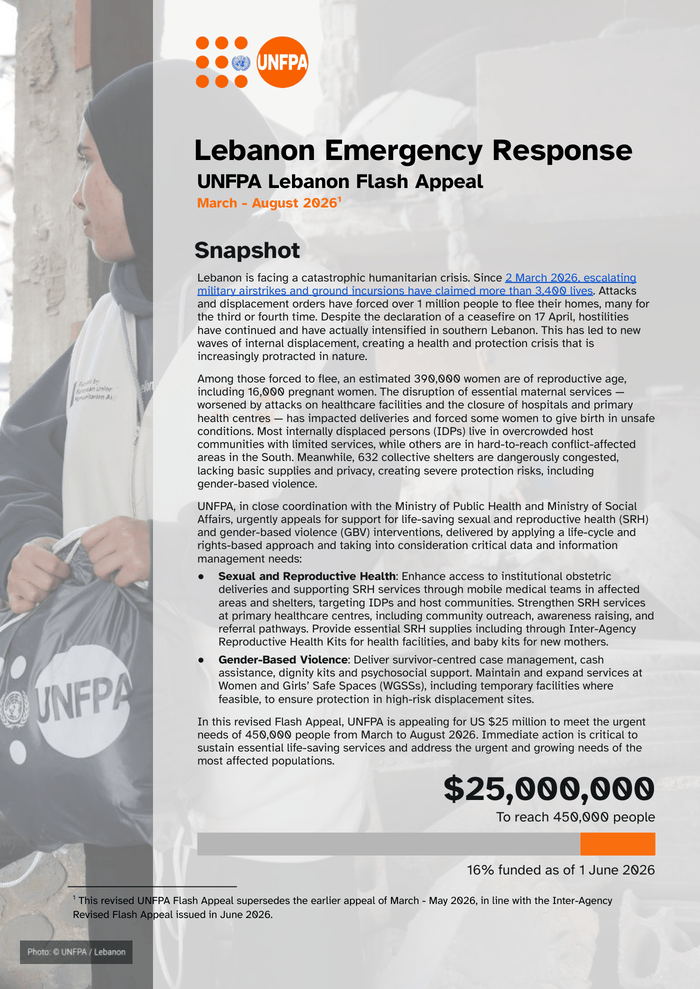
Country: Lebanon Source: United Nations Population Fund Please refer to the attached file. Lebanon is facing a catastrophic humanitarian crisis. Since 2 March 2026, escalating military airstrikes and ground incursions have claimed more than 3, 400 lives. Attacks and displacement orders have forced over 1 million people to flee their homes, many for the third or fourth time. Despite the declaration of a ceasefire on 17 April, hostilities have continued and have actually intensified in southern Lebanon. This has led to new waves of internal displacement, creating a health and protection crisis that is increasingly protracted in nature. Among those forced to flee, an estimated 390, 000 women are of reproductive age, including 16, 000 pregnant women. The disruption of essential maternal services — worsened by attacks on healthcare facilities and the closure of hospitals and primary health centres — has impacted deliveries and forced some women to give birth in unsafe conditions. Most internally displaced persons live in overcrowded host communities with limited services, while others are in hard-to-reach conflict-affected areas in the South. Meanwhile, 632 collective shelters are dangerously congested, lacking basic supplies and privacy, creating severe protection risks, including gender-based violence. UNFPA’s urgent appeal focuses on life-saving sexual and reproductive health (SRH) and gender-based violence (GBV) interventions, prioritizing support to mobile medical teams, strengthening SRH services at primary healthcare centres, and providing SRH medicines and Inter-Agency Reproductive Health kits to health facilities and baby kits for new mothers. UNFPA will also deliver survivor-centred case management, cash assistance, and dignity kits along with psychosocial support to ensure critical GBV services are available and accessible. In this revised Flash Appeal, UNFPA is appealing for US $25 million to meet the urgent needs of 450, 000 people from March to August 2026. Immediate action is critical to sustain essential life-saving services and address the urgent and growing needs of the most affected populations.



GrowthPakistan brings you the latest news to keep an eye on Pakistan’s startup ecosystem. Business keeps you growing when you stay aware of your competitors' moves. GrowthPakistan offers Business, Tech, Global Tech, Global, Auto, and Startup News straight from industries all around the globe. This platform will help you identify upcoming opportunities not only in Pakistan but worldwide.
Email : growthpakistan@gmail.com
Whatsapp : +92320-9497079
© growthpakistan