


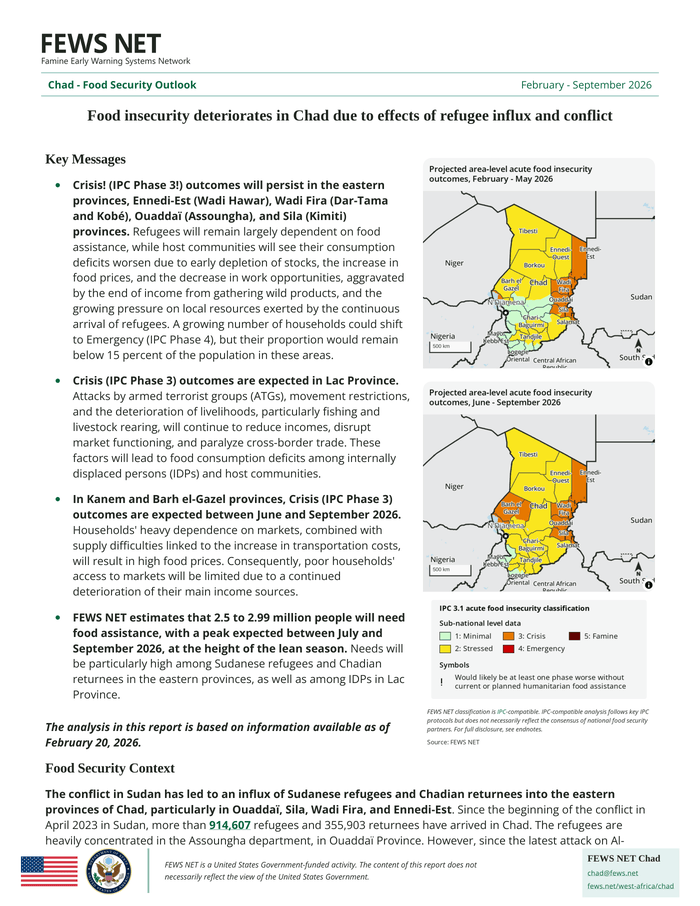
Countries: Chad, Sudan Source: Famine Early Warning System Network Please refer to the attached file. Key Messages Crisis! (IPC Phase 3!) outcomes will persist in the eastern provinces, Ennedi-Est (Wadi Hawar), Wadi Fira (Dar-Tama and Kobé), Ouaddaï (Assoungha), and Sila (Kimiti) provinces. Refugees will remain largely dependent on food assistance, while host communities will see their consumption deficits worsen due to early depletion of stocks, the increase in food prices, and the decrease in work opportunities, aggravated by the end of income from gathering wild products, and the growing pressure on local resources exerted by the continuous arrival of refugees. A growing number of households could shift to Emergency (IPC Phase 4), but their proportion would remain below 15 percent of the population in these areas. Crisis (IPC Phase 3) outcomes are expected in Lac Province. Attacks by armed terrorist groups (ATGs), movement restrictions, and the deterioration of livelihoods, particularly fishing and livestock rearing, will continue to reduce incomes, disrupt market functioning, and paralyze cross-border trade. These factors will lead to food consumption deficits among internally displaced persons (IDPs) and host communities. In Kanem and Barh el-Gazel provinces, Crisis (IPC Phase 3) outcomes are expected between June and September 2026. Households’ heavy dependence on markets, combined with supply difficulties linked to the increase in transportation costs, will result in high food prices. Consequently, poor households’ access to markets will be limited due to a continued deterioration of their main income sources. FEWS NET estimates that 2. 5 to 2. 99 million people will need food assistance, with a peak expected between July and September 2026, at the height of the lean season. Needs will be particularly high among Sudanese refugees and Chadian returnees in the eastern provinces, as well as among IDPs in Lac Province. The analysis in this report is based on information available as of February 20, 2026.



GrowthPakistan brings you the latest news to keep an eye on Pakistan’s startup ecosystem. Business keeps you growing when you stay aware of your competitors' moves. GrowthPakistan offers Business, Tech, Global Tech, Global, Auto, and Startup News straight from industries all around the globe. This platform will help you identify upcoming opportunities not only in Pakistan but worldwide.
Email : growthpakistan@gmail.com
Whatsapp : +92320-9497079
© growthpakistan