


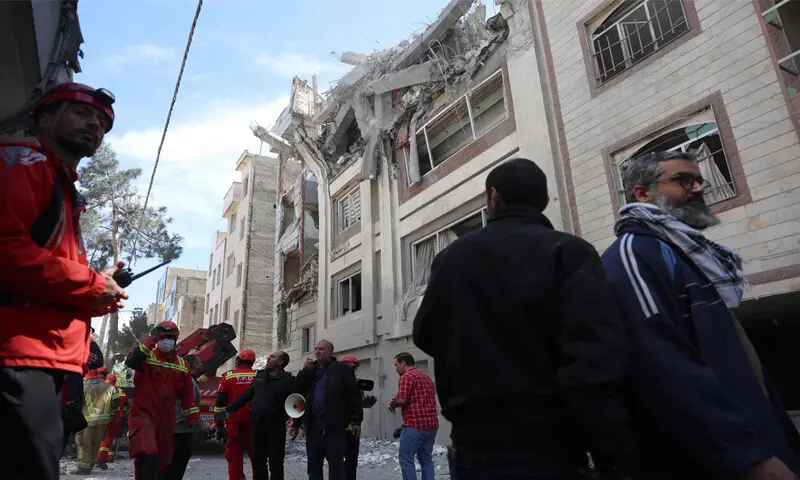
• IAEA voices concern as US-Israeli air strikes hit uranium plant, heavy water facility • Araghchi vows to exact heavy price; IRGC says industrial sites in region are now targets • UN forms task force to keep ships moving thru Hormuz as Guards vow to block ‘enemy vessels’ • Rubio confirms exchange of messages, says US still doesn’t know who they’ll be talking to TEHRAN / WASHINGTON: Despite talking peace, the US and Israel invoked concern from the world nuclear watchdog when air strikes hit a uranium processing facility in Arak and a heavy water reactor in Khondab. The attacks came a day after US President Donald Trump extended a deadline by 10 days for Iran to reopen the blockaded Strait of Hormuz or face att acks against its civilian energy grid. Israel’s army confirmed that it struck the two facilities, while Iranian sources said there was no release of radioactive material at either site. The International Atomic Energy Agency (IAEA) said it had been informed by Iran “that the Shahid Rezayee Nejad Yellow Cake Production Facility in Yazd province” was attacked, but noted that “no increase in off-site radiation levels” was reported. Foreign Minister Abbas Araghchi said Tehran would exact a “HEAVY price for Israeli crimes”. He revealed that that strikes had also targeted, Khuzestan Steel and Mobarakeh Steel, two of Iran’s largest steel factories. The attack “contradicts [Donald Trump’s] extended deadline for diplomacy”, he said. Meanwhile Iran’s Revolutionary Guards (IRGC) warned that they would strike industrial sites in the region in response to the attacks, and warned civilians working in such plants to “leave their workplaces immediately”. Iran’s Vice President Esmael Saghab Esfahani threatened on X to attack Saudi Arabia’s Red Sea port of Yanbu, home to the Samref oil refinery, as well as the coastal Fujairah oil complex in the United Arab Emirates, should a ground invasion take place. Hormuz task force The troubled Hormuz waterway also remained a focus of international attention, as the United Nations moved to set up a task force to keep trade flowing through the strait, even as Iran’s Revolutionary Guards (IRGC) turned back three ships, saying that the route was closed to vessels travelling to and from ports linked to its “enemies”. The envisaged task force would be based on initiatives like the Black Sea Grain Initiative for Ukraine and the UN2720 Mechanism for Gaza, and be led by UN Under-Secretary-General Jorge Moreira da Silva, executive director of the United Nations Office for Project Services. In Paris, meanwhile, G7 allies pressed US Secretary of State Marco Rubio for clarity on American plans for Iran. After the meeting, Rubio claimed to have won support from his G7 colleagues to oppose Iran’s attempts to impose a toll on ships crossing the Strait of Hormuz, a key sea lane for oil and gas shipments from the Gulf. A total of 34 ships have been approved by Iran to transit the strait recently, using a route around Larak Island just off the country’s coast, according to analysts at leading shipping journal Lloyd’s List — which dubs the system the “Tehran toll booth”. Separately, Kuwait said on Friday its main commercial port was damaged in a drone attack at dawn. Exchange of messages But the top US diplomat declared that Washington expects its military operation to prove victorious within a couple of weeks. “When we are done with them here in the next couple weeks, they will be weaker than they’ve been in recent history, ” Rubio told reporters in Paris after G7 talks. While he said Washington could achieve its aims without ground troops, he acknowledged that it was deploying some to the region “to give the President maximum optionality and maximum opportunity to adjust the contingencies, should they emerge”. Washington has dispatched two contingents of thousands of Marines to the region, the first of which is due to arrive around the end of March aboard a huge amphibious assault ship. The Pentagon is also expected to deploy thousands of elite airborne soldiers. The deployments have raised concern that an air war that has already disrupted global energy supplies could turn into a prolonged ground battle. Talking about the ongoing negotiations between the two warring sides, which are being facilitated by Pakistan, Mr Rubio said: “We’ve had an exchange of messages and indications from the Iranian system. .. about a willingness to talk about certain things”. “We’re waiting for further clarification about. .. who is it that we will be talking to, what will we be talking about and when will we be talking, ” he told reporters. While Iranian officials have publicly rebuffed US diplomacy, they have said they are keeping channels open through third countries to exchange messages. An Iranian official told Reuters on Thursday that senior officials had reviewed the US proposal and felt it served only US and Israeli interests, although diplomacy had not ended. Published in Dawn, March 28th, 2026



GrowthPakistan brings you the latest news to keep an eye on Pakistan’s startup ecosystem. Business keeps you growing when you stay aware of your competitors' moves. GrowthPakistan offers Business, Tech, Global Tech, Global, Auto, and Startup News straight from industries all around the globe. This platform will help you identify upcoming opportunities not only in Pakistan but worldwide.
Email : growthpakistan@gmail.com
Whatsapp : +92320-9497079
© growthpakistan