


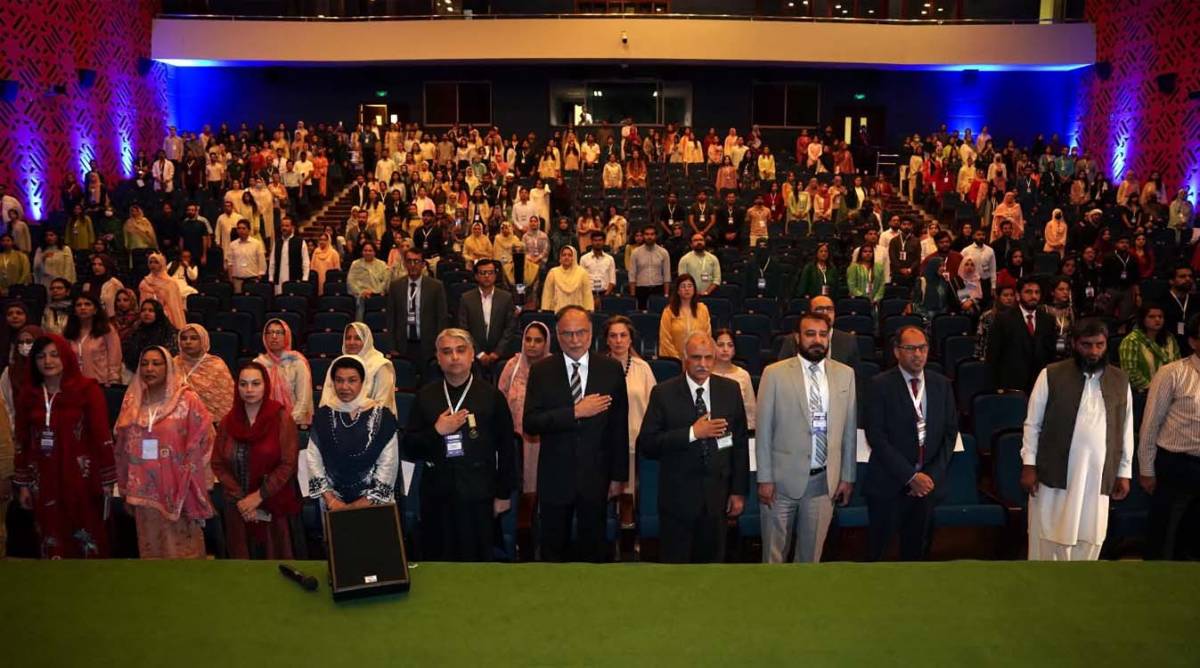
ISLAMABAD: Pakistan’s dental community gathered around some of the biggest questions shaping the future of oral healthcare — from artificial intelligence and digital dentistry to research innovation, international career pathways and the need for a comprehensive National Oral Health Policy. Those issues took centre stage at the 1st SOD SZABMU International Dental Conference 2026 and the 9th Annual Conference of the Pak Association for Dental Research (IADR Pakistan Section), which concluded in Islamabad after bringing together more than 1, 000 registered participants from Pakistan and abroad. Held at the Pak-China Friendship Center, the two-day conference was jointly hosted by the Pak Association for Dental Research (IADR Pakistan Section) and the School of Dentistry, Shaheed Zulfiqar Ali Bhutto Medical University (SZABMU), Islamabad. Its theme — “Innovations in Dental Research: Bridging Knowledge, Clinical Practice, and Education” — reflected a profession increasingly being transformed by artificial intelligence, digital technologies, advanced biomaterials and evidence-based research. But one proposal emerging from the conference could carry consequences far beyond the academic sessions. Call for a National Oral Health Policy Chief Guest Prof. Ahsan Iqbal, Federal Minister for Planning and Development, called on the IADR Pakistan Section to develop a comprehensive National Oral Health Policy for Pakistan. The call placed the country’s dental research community at the centre of a potentially significant policy conversation. Prof. Ahsan Iqbal emphasised the importance of advanced education, research, artificial intelligence and digitalisation in shaping Pakistan’s healthcare future. He said Pakistan’s young generation needed to prepare for rapidly changing technologies and emerging opportunities in science, medicine and dentistry. For young dentists, the message went beyond conventional clinical practice. They were encouraged to develop advanced skills, embrace innovation, use digital technologies effectively and contribute solutions to longstanding healthcare challenges. In an era where artificial intelligence is increasingly influencing healthcare delivery, research and education, Prof. Ahsan Iqbal stressed the importance of preparing young dental professionals to become innovators, researchers and leaders — not merely practitioners. His call for a National Oral Health Policy was widely seen as an important recognition of the role dental professionals and researchers can play in translating scientific evidence into broader healthcare planning. More than 1, 000 participants join global scientific programme The conference attracted dental and medical academics, clinicians, researchers and students from across Pakistan, while prominent international speakers from the United States, United Kingdom, Qatar, Saudi Arabia and Malaysia participated in the scientific programme. Principals, deans, heads of dental institutions, senior professors and faculty members from across Pakistan also attended and contributed as speakers and panellists. The conference was chaired by Prof. Abdul Samad Khan, Founding Member and former President of the IADR Pakistan Section. Prof. Tanvir Khaliq (T. I.), Vice Chancellor of SZABMU, served as Patron-in-Chief. The patrons included Prof. Bilal Ahmad (T. I.), Principal of the School of Dentistry, Islamabad, and Prof. Saroosh Ehsan, President of PADR/IADR Pakistan Section. The conference leadership addressed issues ranging from dental education and institutional development to research and the need to bring Pakistani dental academia closer to international standards. Another important academic contribution came from Prof. Nazia Yazdani, who presented a historical and professional perspective on the development of Prosthodontics in Pakistan. Research, not just technology, is the foundation of progress In his keynote address, Prof. Abdul Samad Khan focused on a question that affects not only dentistry but Pakistan’s broader development trajectory: the role of research. He stressed that sustainable progress in healthcare, education, technology and economic development requires investment in research. Research, he noted, enables countries to understand their own problems, develop evidence-based solutions, create indigenous technologies and formulate informed policies rather than relying entirely on knowledge and technologies developed elsewhere. Prof. Khan placed particular emphasis on the role of basic sciences faculty members in strengthening Pakistan’s research ecosystem. Basic science research, he said, provides the foundation for clinical innovation and evidence-based healthcare. He encouraged researchers to develop meaningful questions, collaborate with clinicians, establish multidisciplinary partnerships and translate laboratory findings into clinically relevant solutions. The message was particularly significant for a profession increasingly moving towards the intersection of clinical care, artificial intelligence, digital technology, biomaterials and biomedical research. AI takes its place in the future of dentistry Artificial intelligence emerged as one of the defining themes of the conference. The scientific programme comprised 14 sessions covering a wide spectrum of contemporary dental sciences, including: Dental Materials Basic Sciences Research Comprehensive Care Dentistry Prosthodontics Operative Dentistry Endodontics Paediatric Dentistry Medical Education Artificial Intelligence in dental research AI applications in dental education Emerging digital approaches in clinical practice The programme reflected how rapidly dentistry is becoming interdisciplinary. Modern dental practice is no longer limited to traditional clinical skills. Increasingly, dentists are working in an environment shaped by digital imaging, artificial intelligence, biomaterials, 3D technologies, data-driven research and advanced treatment planning. The conference also included an interactive session on workload management and career pathways, providing practical guidance to professionals navigating growing demands within the profession. US career pathway session draws young dentists One of the sessions that attracted particular attention focused on professional pathways to the United States. The session was led by Dr. Khalid Chaudhry, President, Dental APPNA, USA, and provided young dentists with insights into international career opportunities and professional pathways in the United States. For many young participants, the discussion added a practical dimension to a conference otherwise heavily focused on research and scientific innovation. It reflected another important shift within Pakistan’s dental community: growing interest among students and young professionals in global mobility, international qualifications and career development beyond traditional pathways. Young researchers compete as AI study earns recognition The conference placed major emphasis on young researchers through oral and poster presentation competitions, alongside an undergraduate students’ quiz. The competitions highlighted the diversity of research now emerging from Pakistani dental institutions. In the Dentists Poster Presentation Competition, Manahil Niazi of BMY Health, Pakistan, won for her work on Learning Preferences and Styles of Generation Z Dental and Medical Students. The PG Oral Presentation Competition/Research Excellence Award was won by Dr. Amna Rajpoot of Postgraduate Medical Institute, Lahore, for her research titled From an Antimicrobial Agent to a Constituent of 3D Printed Heterogeneous Scaffolds Stimulating Bone Characteristics: An In-vitro and Animal Model Evaluation. Dr. Tooba Siddiqi of Bahria University Medical and Dental College, Karachi, was runner-up for research comparing the diagnostic accuracy of AI models with orthodontists for dental and skeletal stage estimation. The AI-focused study offered a particularly relevant glimpse into one of the biggest questions facing dentistry: how artificial intelligence may increasingly work alongside clinicians in diagnosis and decision-making. Regenerative dentistry and digital prosthodontics also recognised In the PG Poster Presentation Competition for Excellence in Research Posters, Kinza Iftikhar of HITEC Institute of Medical Sciences Dental College, Taxila, won for research comparing postoperative pain and periapical healing following regenerative endodontics using platelet-rich plasma with conventional root canal treatment in mature single-rooted teeth. The runner-up was Rashmi of the School of Dentistry, SZABMU, Islamabad, for research examining perceived barriers and future preparedness regarding digital prosthodontic competency among prosthodontic residents. The studies reflected two parallel transformations in dentistry: the search for improved biological and regenerative treatment approaches, and the growing importance of digital competency among future specialists. Undergraduate researchers bring fresh ideas to dental science The UG Poster Presentation Competition for the Rising Scholar Award was won by Immad Ahmad of University College of Medicine & Dentistry, University of Lahore, for his research on the formulation and comparative evaluation of aqueous and oil-emulsion pomegranate extract mouthwashes against chlorhexidine. Taha Kashif Rana of de’Montmorency College of Dentistry, Lahore, was runner-up for research on public perception and awareness of oral potentially malignant disorders. Nimra Shah of Hamdard College of Dentistry, North Nazimabad, was also recognised as runner-up for research examining awareness of dental erosion caused by commonly consumed beverages. The range of topics — from natural alternatives to conventional mouthwashes to oral cancer awareness and dietary risks — demonstrated how undergraduate research is increasingly addressing practical public-health and clinical questions. School of Dentistry wins students’ quiz The Students’ Quiz Competition generated considerable enthusiasm among participants. The School of Dentistry, Islamabad, secured first prize, while the team from HITEC Institute of Medical Sciences Dental College finished second. The quiz provided another platform for undergraduate engagement and academic competition during the two-day gathering. Dental industry exhibition connects research with technology Alongside the scientific programme, a trade exhibition featured stalls from dental companies displaying contemporary materials, equipment, instruments, technologies and products. The exhibition created an important connection between academia and industry, allowing practitioners, researchers and students to explore developments in modern dental technology. That bridge is becoming increasingly important as innovation in dentistry moves rapidly from research laboratories into clinical practice. Extensive teamwork behind the two-day event The successful organisation of the conference involved extensive collaboration across institutions and organising teams. Prof. Muhammad Imran Rahbar, Prof. Khalid Mahmood Siddiqi, Dr. Maria Shakoor, Dr. Hafiz Muhammad Owais Nasim and Dr. Aqsa Arfi played significant roles in organising and coordinating the event. The wider organising teams of the University of Lahore, School of Dentistry SZABMU and the IADR Pakistan Section also contributed to the successful conduct of the conference. Faculty members, young dentists, students, sponsors and exhibitors were among those whose contributions supported the two-day scientific gathering. A conference that could influence Pakistan’s dental agenda The successful conclusion of the conference reinforced the commitment of the IADR Pakistan Section and the School of Dentistry, SZABMU, to advancing dental research, education and professional development. But the significance of the gathering may ultimately extend beyond its scientific sessions and award ceremonies. The call for a comprehensive National Oral Health Policy introduced a potentially important direction for Pakistan’s dental research community. It raised a broader question that is likely to become increasingly important: how can research generated by Pakistani dental institutions be translated into evidence-based policies capable of improving oral health outcomes? The conference brought together many of the elements needed for that conversation — researchers, clinicians, students, policymakers, international experts and emerging technologies. From artificial intelligence and regenerative research to digital prosthodontics and international career pathways, the discussions demonstrated that Pakistan’s dental profession is confronting a rapidly changing future. And perhaps the most consequential message to emerge from Islamabad was that scientific research cannot remain confined to laboratories, lecture halls and conference presentations. If the proposed National Oral Health Policy moves from discussion towards development, the research community could find itself playing a much larger role in shaping the future of oral healthcare in Pakistan. Stay connected with Dental News Pakistan pk/02-Sep-2026/sod-padr-dental-conference-2026-spotlights-pakistan-s-oral-health-future” target=”_blank” rel=”nofollow noopener noreferrer”>Read full story on Dental News



GrowthPakistan brings you the latest news to keep an eye on Pakistan’s startup ecosystem. Business keeps you growing when you stay aware of your competitors' moves. GrowthPakistan offers Business, Tech, Global Tech, Global, Auto, and Startup News straight from industries all around the globe. This platform will help you identify upcoming opportunities not only in Pakistan but worldwide.
Email : growthpakistan@gmail.com
Whatsapp : +92320-9497079
© growthpakistan