

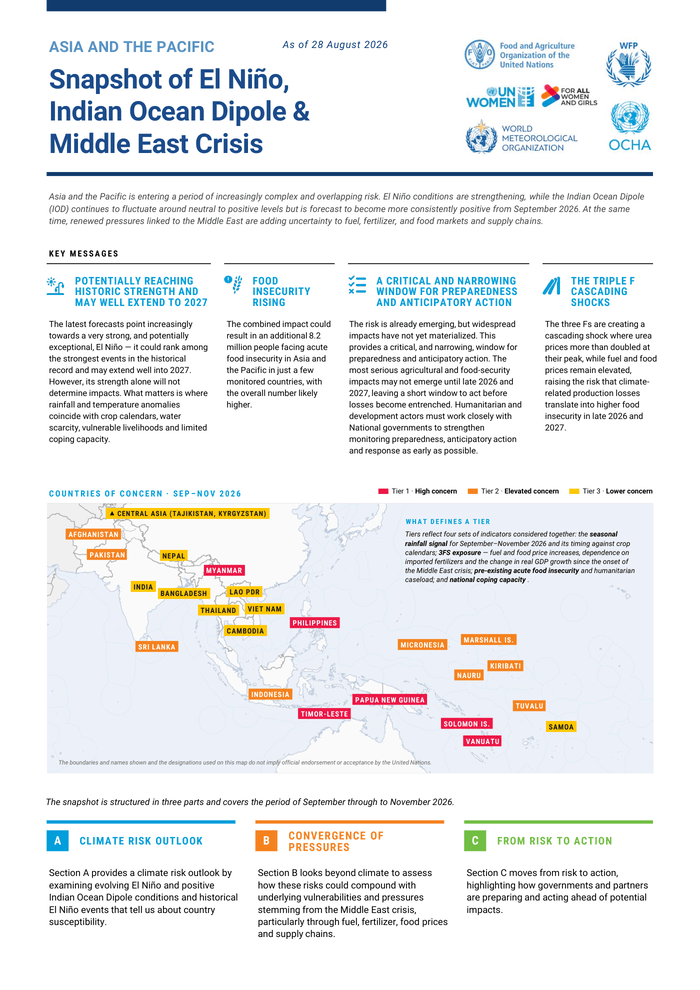
Countries: Indonesia, Afghanistan, Bangladesh, Cambodia, India, Kiribati, Lao People’s Democratic Republic (the), Marshall Islands, Micronesia (Federated States of), Myanmar, Nepal, Pakistan, Papua New Guinea, Philippines, Republic of Naoero, Samoa, Solomon Islands, Sri Lanka, Thailand, Timor-Leste, Tuvalu, Vanuatu, Viet Nam Sources: Food and Agriculture Organization of the United Nations, UN Office for the Coordination of Humanitarian Affairs, UN Women, World Food Programme, World Meteorological Organization Please refer to the attached file. Asia and the Pacific is entering a period of increasingly complex and overlapping risk. El Niño conditions are strengthening, while the Indian Ocean Dipole (IOD) continues to fluctuate around neutral to positive levels but is forecast to become more consistently positive from September 2026. At the same time, renewed pressures linked to the Middle East are adding uncertainty to fuel, fertilizer, and food markets and supply chains. KEY MESSAGES The latest forecasts point increasingly towards a very strong, and potentially exceptional, El Niño — it could rank among the strongest events in the historical record and may extend well into 2027. However, its strength alone will not determine impacts. What matters is where rainfall and temperature anomalies coincide with crop calendars, water scarcity, vulnerable livelihoods and limited coping capacity. The combined impact could result in an additional 8. 2 million people facing acute food insecurity in Asia and the Pacific in just a few monitored countries, with the overall number likely higher. The risk is already emerging, but widespread impacts have not yet materialized. This provides a critical, and narrowing, window for preparedness and anticipatory action. The most serious agricultural and food-security impacts may not emerge until late 2026 and 2027, leaving a short window to act before losses become entrenched. Humanitarian and development actors must work closely with National governments to strengthen monitoring preparedness, anticipatory action and response as early as possible. The three Fs are creating a cascading shock where urea prices more than doubled at their peak, while fuel and food prices remain elevated, raising the risk that climate-related production losses translate into higher food insecurity in late 2026 and 2027.
Indonesia: Asia and the Pacific: Snapshot of El Niño & Middle East Crisis (as of 28 August 2026)

RELATED ARTICLES


