


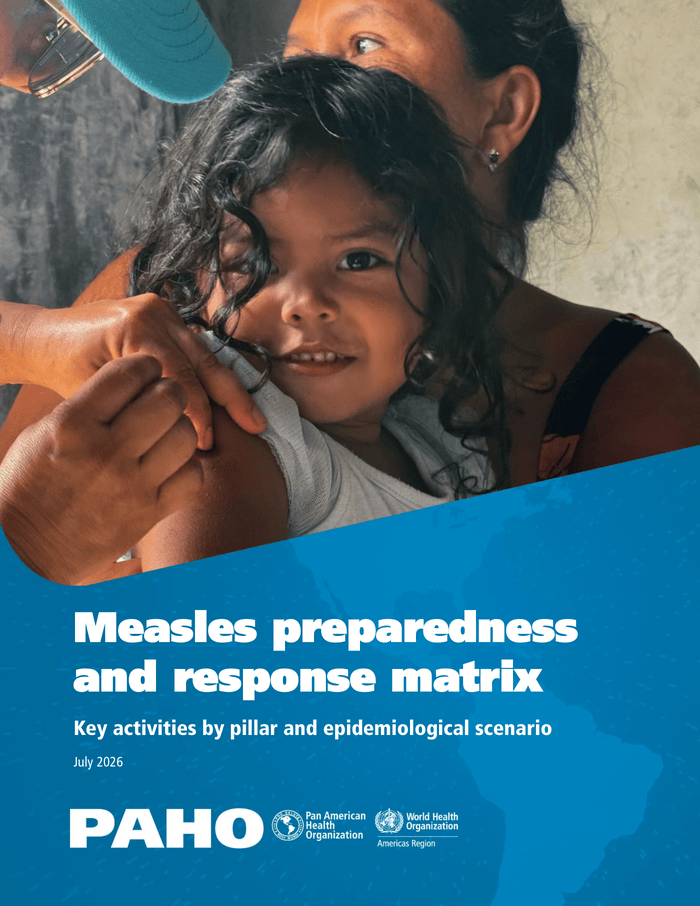
Country: World Source: Pan American Health Organization Please refer to the attached file. The Region of the Americas is experiencing the largest resurgence of measles cases since the elimination of endemic transmission was verified in 2016 and re-verified in 2024. Following a decade of suboptimal measles vaccination coverage, a sharp increase in the number of cases has been observed in 2025 and early 2026. In the first half of 2026, more than 22, 000 confirmed cases and 39 deaths were reported across 17 countries and territories—a figure that already exceeds the 14, 503 cases recorded in the Region in 2025. Outbreaks disproportionately affect young children—with the highest incidence rates among those under one year of age—as well as Indigenous populations and other historically underserved groups, where the highest mortality is concentrated. Approximately 85% of confirmed cases have no documented history of vaccination. The situation across the countries of the Region presents three distinct scenarios requiring different responses. To address this, a matrix has been established, organized as a grid of response pillars (rows) versus epidemiological scenarios (columns). Each row corresponds to one of the IMS response pillars; each column corresponds to one of the three scenarios: A) risk of importation: no current cases, but a likelihood of importation; B) limited transmission: sporadic cases or contained clusters with still-identifiable transmission chains; and C) community transmission: sustained transmission across multiple locations. At the intersection of each pillar and scenario, the matrix outlines the priority actions on which a country should focus in that situation, formulated in a direct and operational manner. Each scenario entails maintaining the capacities built during the preceding scenario; The actions in Scenario A form the preparatory foundation upon which the actions for Scenarios B and C are subsequently added. The country or subnational jurisdiction determines which scenario best describes its current situation and focuses its efforts on the corresponding column, while maintaining the capacities developed in the preceding scenarios. As the situation evolves—whether through escalation to community transmission or a return to containment following the interruption of transmission—the country shifts between columns and adjusts its actions accordingly.



GrowthPakistan brings you the latest news to keep an eye on Pakistan’s startup ecosystem. Business keeps you growing when you stay aware of your competitors' moves. GrowthPakistan offers Business, Tech, Global Tech, Global, Auto, and Startup News straight from industries all around the globe. This platform will help you identify upcoming opportunities not only in Pakistan but worldwide.
Email : growthpakistan@gmail.com
Whatsapp : +92320-9497079
© growthpakistan