

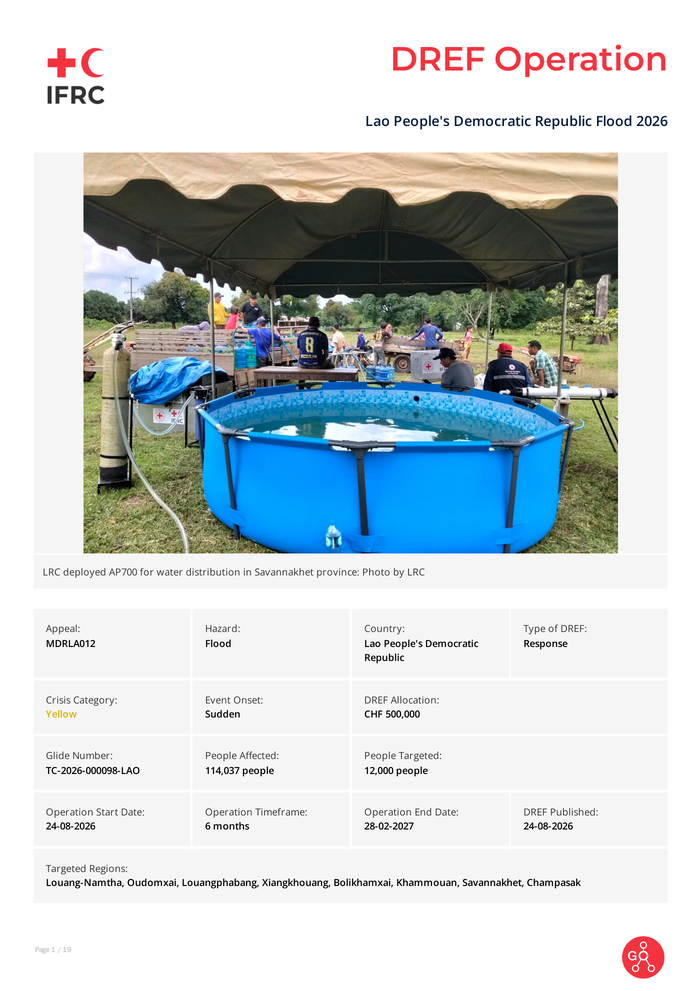
Country: Lao People’s Democratic Republic (the) Source: International Federation of Red Cross and Red Crescent Societies Please refer to the attached file. Description of the Event Date of event 14-08-2026 What happened, where and when? Since late June 2026, Lao PDR has experienced recurrent flooding, flash floods, waterlogging and landslides associated with the southwest monsoon, Tropical Storm Maysak and subsequent weather systems. While flooding was first reported in late June, the situation progressively worsened through July and August as prolonged and repeated heavy rainfall caused cumulative impacts, with already affected areas experiencing further flooding, waterlogging and landslides, increasing damage and disrupting access. By August, the scale and persistence of the emergency had exceeded Lao Red Cross (LRC)’s available resources and response capacity, leading LRC to determine on 14 August 2026 that additional resources through the DREF were required to sustain and scale up the response. According to UN site rep report release in July and August 2026, prolonged heavy rainfall caused flooding in several parts of Lao PDR. On 4 July, a wooden bridge was swept away in Vang Vieng, Vientiane Province, and a road was disrupted in Sepon District, Savannakhet Province. In Khammouane Province, flooding affected multiple districts, including Nakai, Khounkham and Xaybouathong, between 8 and 13 July, damaging houses, agricultural land and infrastructure. On 16 to 17 July, a landslide in Thabak Village, Khamkeut District, Bolikhamxay Province, resulted in three fatalities. On 21 July, severe flooding was reported in Khounkham District, Khammouane Province. Further rainfall in late July caused flash flooding in Nasangveuy Village, Luang Prabang Province, and persistent waterlogging in parts of Sikhottabong District, Vientiane Capital. At the end of the month, heavy rainfall damaged the road connecting Luang Prabang and Houaphanh provinces, disrupting transportation and leaving vehicles stranded. During early August 2026, heavy rainfall continued to cause flooding and access disruptions across several parts of Lao PDR. On 3 August, severe flash flooding was reported in Luang Prabang Province. On 4 August, the Xe Champhone River in Champhone District, Savannakhet Province, exceeded the warning level, reaching 8. 02 metres. On 5 August, flood warnings were issued for the Nam Xan, Nam Xebangfai and Nam Tha river basins as water levels continued to rise. During the same period, heavy rainfall and erosion disrupted road access in Khounkham District, Khammouane Province, including the Phou Phaman road section and parts of Route 8A. Further flooding was reported on 9 to 10 August in several affected areas, prompting assessments by Lao Red Cross branches. By mid-August, flood incidents had been reported across six provinces: Khammouane, Savannakhet, Bolikhamxay, Luang Namtha, Xiengkhouang and Champasak. As of 17 August, LRC at headquarters consolidated the assessments from its branches, flooding had affected 25 districts and 395 villages, 22, 390 households, approximately 114, 037 people across these provinces (Khammouan, Xiengkhouang, Bolikhamxay, Louang Namtha, Savannakhet, Champasak) causing damage to agricultural land, housing, roads and access to basic services. The latest UN Lao PDR Monsoon Situation Report No. 3, dated 19 August 2026, confirms that the situation continued to intensify during August, most recently, on 19 August, flash flooding struck Nan District, Luang Prabang Province, as heavy rainfall over several consecutive hours combined forest runoff with rising waters of the Nam Nan River, flooding homes and agricultural land along the riverbank; the same morning, a sudden flash flood at 3: 30 AM struck Huay La Village, Beng District, Oudomxay Province, causing severe property damage to many families. The forecast indicates an increased risk of flooding, flash floods and landslides, particularly in northern and central Lao PDR during 18-21 August 2026. Flooding was reported across several provinces, and LRC initially responded using its own available resources, including the mobilisation of provincial branches, volunteers and pre-positioned relief items. At the same time, LRC conducted rapid assessments to monitor the evolving situation, identify affected populations and determine priority needs. As the flooding became cumulative and recurrent, with continued heavy rainfall and worsening conditions in several affected areas, humanitarian needs increased beyond the capacity of affected households and local response mechanisms to cope. Government authorities activated disaster management structures and supported evacuation, emergency relief and restoration of access, while LRC continued to mobilise provincial resources, distribute emergency relief items and provide safe water. However, the assessment findings and continued monitoring indicated that the scale and persistence of the needs were exceeding LRC’s available resources and response capacity. Significant gaps remained in essential assistance, particularly as the situation continued to evolve and additional communities were affected. LRC determined on 14 August 2026 that additional resources were required to sustain and scale up its response. Therefore, LRC formally decided that DREF support was necessary, rather than the initial onset of flooding.
Lao PDR: Lao People’s Democratic Republic: Flood 2026 – DREF Operation (MDRLA012)

RELATED ARTICLES


