

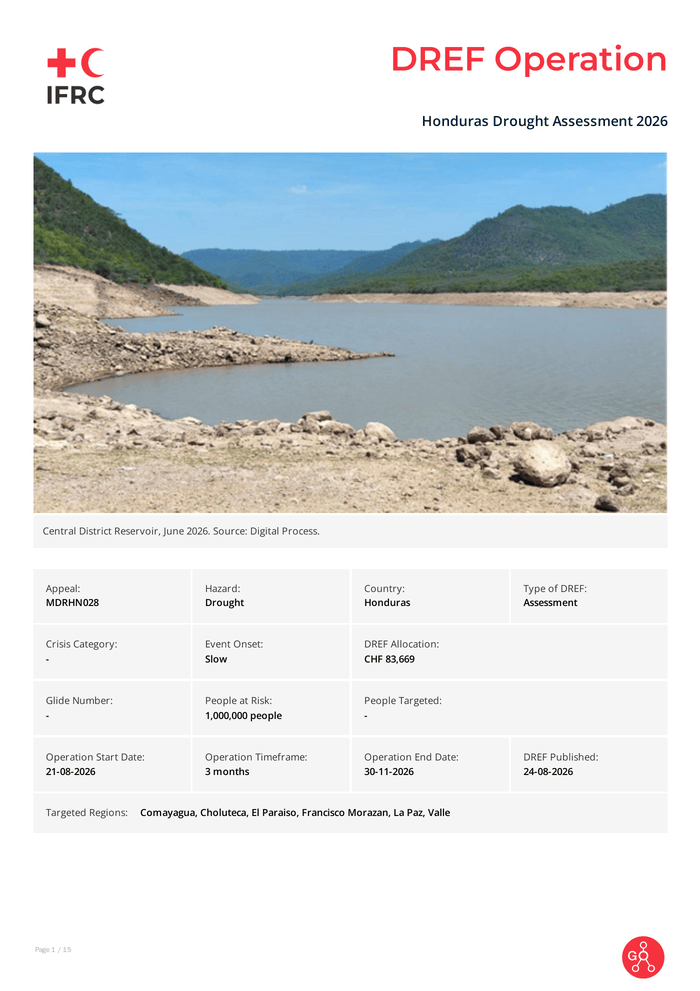
Country: Honduras Source: International Federation of Red Cross and Red Crescent Societies Please refer to the attached file. Description of the Event Date when the trigger was met 20-07-2026 What happened, where and when? Since May 2026, Honduras has been facing a progressive deterioration in climatic conditions associated with the delay in the start of the rainy season, the irregular distribution of rainfall, high temperatures, and the influence of the El Niño phenomenon. According to the Center for Atmospheric, Oceanographic and Seismic Studies (CENAOS), during May precipitation deficits of more than 50% were recorded in sectors of the center and south of the country; In June, the impact extended to municipalities in the center and east, with deficits of more than 40%, conditions that persisted during the first half of July. These developments have increased the risk of meteorological drought, potentially affecting water availability, agricultural production and the livelihoods of the most at-risk communities. (2) Faced with this scenario, on August 18, 2026, the Secretary of State in the Offices of Risk Management and National Contingencies (COPECO), through Alert Bulletin No. 028-2026, declared a Red Alert for 75 municipalities due to drought associated with the El Niño phenomenon, located in the departments of Choluteca, Comayagua, El Paraíso, Francisco Morazán, La Paz and Valle; likewise, it declared a Yellow Alert for 71 municipalities and a Green Alert for 88 municipalities. The alerts were issued indefinitely. COPECO recommended that the population make responsible use of water, stay informed through official channels and heed the recommendations of the authorities. (6) The CENAOS Seasonal Climate Outlook for the period August-November 2026 indicates the continuity of warm conditions associated with the El Niño-Southern Oscillation (ENSO) phenomenon, accompanied by above-normal temperatures and an uneven geographical distribution of rainfall. For August, particularly important rainfall deficits are projected in the south, southwest and some sectors of the center of the country. A partial recovery is expected in September, although negative anomalies could persist in areas of the south, east and center-east. For October, the outlook maintains deficits over large areas of the national territory, while in November there could be a partial and differentiated recovery. (2) These climatic conditions occur in a context of pre-existing food vulnerability. The Integrated Food Security Phase Classification (IPC) analysis identifies areas and stocks exposed to potential deterioration in food security, while FEWS NET also identifies unfavourable climatic conditions and risks to livelihoods and food security in areas of the Dry Corridor. (3) (4) The combination of poor rainfall, high temperatures and increased evapotranspiration could progressively reduce soil moisture, affect the establishment and development of crop crops, increase pressure on community water sources and systems, and deteriorate the livelihoods of households that depend on rainfed agriculture and small-scale livestock production. (2) (3) (4) In this context, and considering that there are still gaps in primary information on the magnitude, location, and characteristics of the humanitarian needs associated with the drought, the Honduran Red Cross will conduct a multisectoral assessment to generate primary evidence on humanitarian needs, complement the secondary information available, and guide decision-making on possible subsequent actions. According to information from COPECO cited by Proceso Digital on August 4, 2026, around 1 million people are being directly affected by the drought in Honduras. This figure represents a preliminary estimate of the scope of the situation. (5) Trigger: On August 18, 2026, COPECO, through Alert Bulletin No. 028-2026, declared a Red Alert for 75 municipalities, a Yellow Alert for 71 municipalities, and a Green Alert for 88 municipalities due to drought associated with the El Niño phenomenon. The municipalities on Red Alert are concentrated in the departments of Choluteca, Comayagua, El Paraíso, Francisco Morazán, La Paz and Valle. This update shows an aggravation of drought conditions and constitutes the event that activates this DREF request for Evaluation. (6)
Honduras Drought Assessment 2026 – DREF Operation (MDRHN028)

RELATED ARTICLES


