

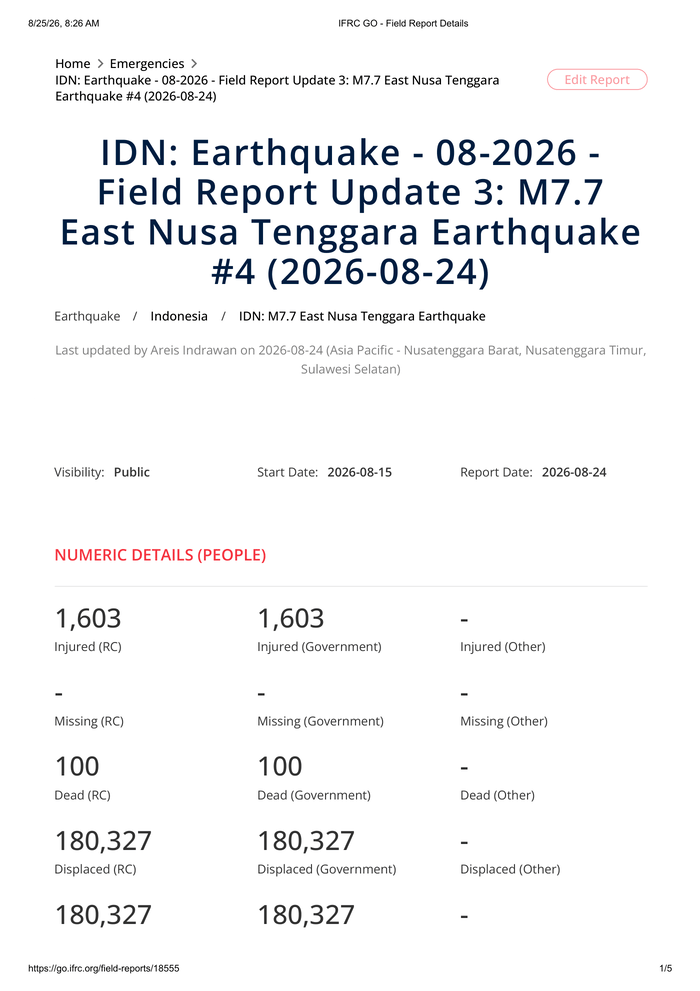
Country: Indonesia Sources: International Federation of Red Cross and Red Crescent Societies, Palang Merah Indonesia Please refer to the attached file. Description On 15 August 2026 at 04: 58 WIB, a magnitude 7. 7 earthquake struck Flores Island, East Nusa Tenggara Province. The epicentre was located offshore, approximately 30 kilometres northeast of Mbay, Nagekeo District, at a depth of 15 kilometres. The earthquake affected seven districts: Manggarai Barat, Manggarai, Manggarai Timur, Ngada, Nagekeo, Ende and Sikka. Thousands of aftershocks have continued, increasing anxiety among communities and discouraging many families from returning to damaged homes. As of 24 August 2026 at 09: 00 WIB, the National Disaster Management Agency (BNPB) reported 100 deaths, 1, 603 people injured or ill, and 180, 327 people displaced. A total of 73, 818 houses were damaged, together with 1, 378 educational facilities, 118 health facilities, 504 government offices, and 396 places of worship. The figures remain preliminary and may change as assessment and verification continue. Displaced people are staying in communal sites, temporary shelters, open areas, with relatives or in small self-established sites near their homes. Many independently displaced families remain difficult to identify and reach, particularly in remote, mountainous and island communities. Priority concerns include emergency shelter, safe water and sanitation, healthcare, essential household items, protection and psychosocial support. Children, pregnant and breastfeeding women, older people, persons with disabilities, people with chronic health conditions and families whose homes were severely damaged face increased risks. Although access along major routes has improved, several remote villages and island communities continue to experience logistical constraints. Existing water shortages linked to the dry season and El Niño, together with ongoing volcanic activity in parts of Flores, are further increasing humanitarian needs. Request For Assistance Government Requests International Assistance: No NS Requests International Assistance: No Information Bulletin Published No Actions taken by National Society General Damage/Needs assessment Search & Rescue Water & Sanitation Food aid Health Shelter Psychosocial support services RFL Evacuation First Aid Relief/Supply distribution Summary As of 24 August 2026, Palang Merah Indonesia (PMI) had recorded 76 response activities across the seven affected districts, reaching 16, 192 people. These included evacuation and first aid services for 2, 493 people, health services for 735 people, emergency shelter support for 9, 570 people, water and sanitation services for 2, 248 people, relief distribution support for 997 people, and psychosocial support for 149 people. PMI has mobilised 55 personnel and continues to conduct rapid assessments, operate mobile health services, support displacement sites, distribute safe water and essential relief items, and establish emergency tents for health facilities and displaced families. Two operational coordination hubs have been established in Nagekeo and Manggarai to support coordination, information management and the delivery of assistance across the affected districts. PMI is working in coordination with government authorities, IFRC and other humanitarian partners. Actions taken by RCRC General Damage/Needs assessment RFL Relief/Supply distribution Other Summary The American Red Cross is providing technical support to PMI for the multisectoral needs assessment and analysis of humanitarian priorities. The Australian Red Cross is supporting the procurement of essential relief items to strengthen PMI’s response and replenishment capacity. The International Committee of the Red Cross (ICRC) is supporting PMI’s Restoring Family Links (RFL) services for people affected by the earthquake. Coordination among PMI, IFRC and Movement partners continues to ensure that technical and material support is aligned with assessed needs and the planned DREF operation. Actions taken by Federation General Damage/Needs assessment Other Summary IFRC is supporting PMI with needs assessment, information management, and the development of a DREF application targeting 20, 000 people across the seven affected districts. IFRC has provided an Emergency Advance DREF allocation of CHF 100, 000 to support the initial response while the full DREF application is being finalised. Technical coordination between PMI and IFRC continues to refine the operational strategy, targeting, sectoral priorities and budget based on updated assessment findings. Actions taken by others The Government of Indonesia, through BNPB, BPBD, Basarnas, the Indonesian Armed Forces, the National Police and local authorities, continues to conduct search and rescue, evacuation, damage and needs assessments, emergency health services, management of displacement sites and relief distribution. Emergency command posts have been activated in several affected regencies. A field hospital has been established in Reok Sub-District, while efforts continue to reopen affected roads and restore electricity and communication networks. Planned International Response DREF: Requested
Indonesia: IDN: Earthquake – 08-2026 – Field Report Update 3: M7.7 East Nusa Tenggara Earthquake #4 (2026-08-24)

RELATED ARTICLES


