


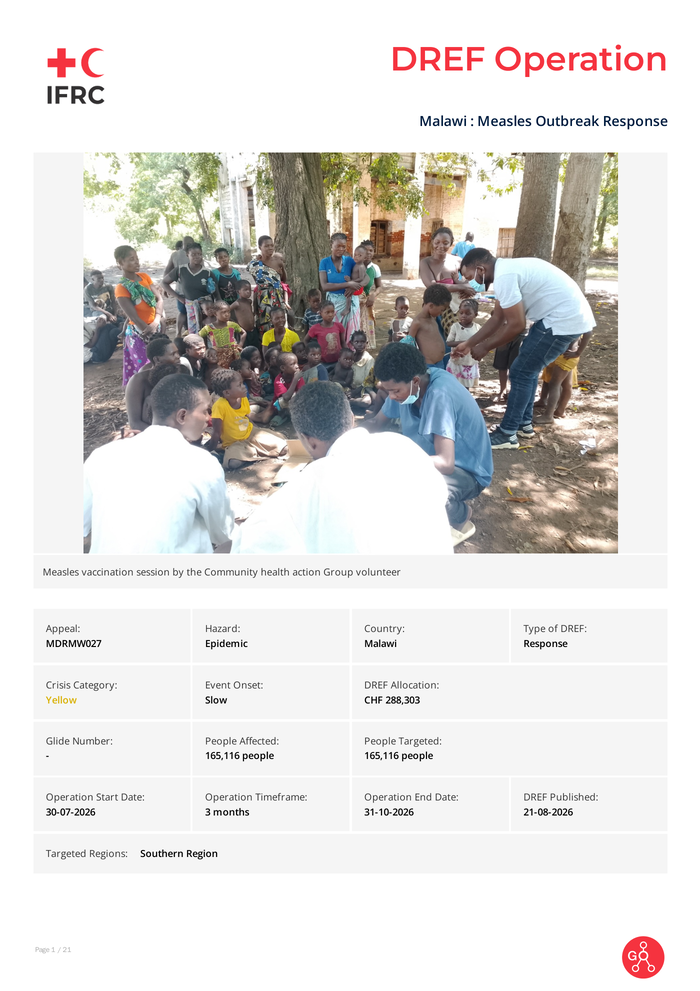
Country: Malawi Source: International Federation of Red Cross and Red Crescent Societies Please refer to the attached file. Description of the Event Date when the trigger was met 20-07-2026 What happened, where and when? Malawi is experiencing an escalating measles outbreak, with the Ministry of Health reporting 73 measles alerts through the Integrated Disease Surveillance and Response (IDSR) system during Epidemiological Week 27 (29 June to 5 July 2026). The outbreak follows months of sustained transmission that began with sporadic cases earlier in 2026 and has since developed into localized outbreaks in several districts. Cumulatively, Nsanje has reported 211 confirmed and epidemiologically linked cases since February 2026, Dedza has reported 90 confirmed cases since July 2026, and Balaka has reported 82 laboratory-confirmed cases since January 2026. Epidemiological data further indicate that more than 85% of confirmed cases have occurred among children under 15 years of age, while over 70% of cases were either unvaccinated or had an unknown vaccination status, demonstrating significant immunity gaps within affected communities. Continued reporting of new laboratory-confirmed cases indicates ongoing transmission and an increasing risk of expansion to neighbouring districts. The outbreak is most pronounced in the catchment areas of Comfort and Khwisa health facilities in Balaka District, Golomoti and Kaundu in Dedza District, and Osiyana, Ndamera, Nsanje, and Trinity health facilities in Nsanje District. These areas are experiencing a combination of factors that continue to fuel transmission, including low routine immunization coverage, high numbers of unvaccinated children, delayed health-seeking behaviour, weak community surveillance systems, inadequate risk communication, and widespread misinformation regarding vaccination. In Nsanje, cross-border population movement along the Malawi-Mozambique border has intensified the risk of disease spread, while shortages of trained health workers, volunteers, and operational resources have constrained surveillance and response efforts. In Balaka and Dedza, persistent immunity gaps and delayed case detection are contributing to continued transmission within communities. The outbreak has generated significant public health and humanitarian impacts. Increasing numbers of suspected and confirmed cases have placed additional pressure on district health services through heightened demand for surveillance, laboratory testing, case management, contact tracing, and vaccination outreach activities. Children under five years of age remain particularly vulnerable due to low vaccination uptake, malnutrition, and limited access to health services. In some communities, particularly within parts of Nsanje, religious beliefs and vaccine hesitancy have contributed to delayed treatment-seeking and reduced acceptance of vaccination services, increasing the risk of severe illness and preventable deaths. The continued accumulation of susceptible children and ongoing transmission in Balaka, Dedza, and Nsanje indicate a high likelihood of further spread unless urgent interventions are implemented to strengthen outbreak-response vaccination, community engagement, surveillance, and risk communication activities. Given the epidemiological trends and operational gaps identified, Balaka, Dedza, and Nsanje represent the highest-priority districts for immediate intervention. These districts continue to experience active transmission driven by substantial immunity gaps, weak community-level disease detection and reporting systems, and challenges in reaching at-risk populations with vaccination and health promotion services. Without rapid scale-up of surveillance, community engagement, social mobilization, and immunization activities, there is a significant risk that transmission will intensify within these districts and spread to surrounding areas, resulting in additional morbidity and mortality among vulnerable children and other susceptible populations.



GrowthPakistan brings you the latest news to keep an eye on Pakistan’s startup ecosystem. Business keeps you growing when you stay aware of your competitors' moves. GrowthPakistan offers Business, Tech, Global Tech, Global, Auto, and Startup News straight from industries all around the globe. This platform will help you identify upcoming opportunities not only in Pakistan but worldwide.
Email : growthpakistan@gmail.com
Whatsapp : +92320-9497079
© growthpakistan