

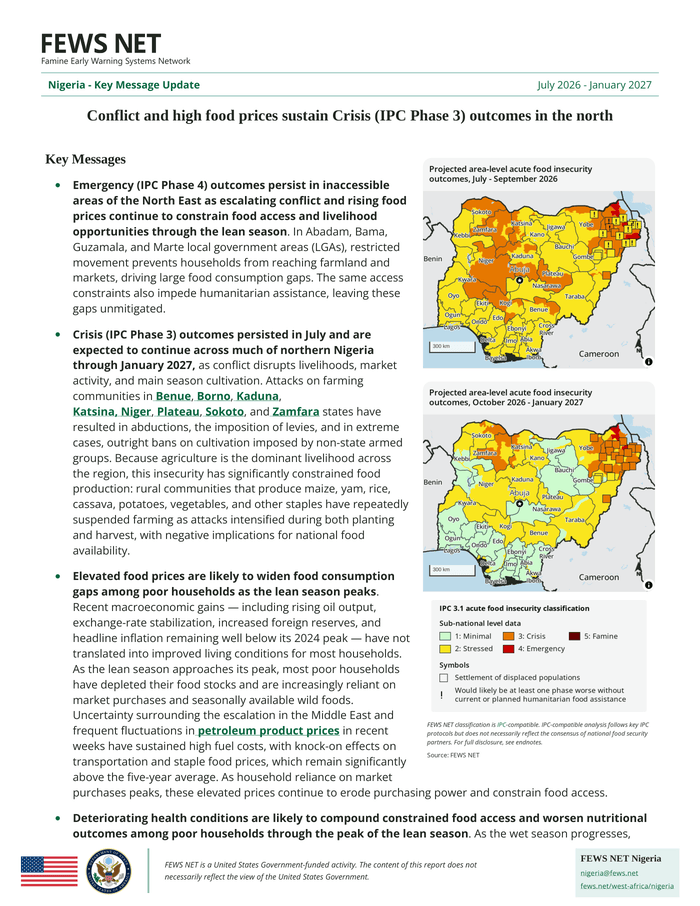
Country: Nigeria Source: Famine Early Warning System Network Please refer to the attached file. Key Messages Emergency (IPC Phase 4) outcomes persist in inaccessible areas of the North East as escalating conflict and rising food prices continue to constrain food access and livelihood opportunities through the lean season. In Abadam, Bama, Guzamala, and Marte local government areas (LGAs), restricted movement prevents households from reaching farmland and markets, driving large food consumption gaps. The same access constraints also impede humanitarian assistance, leaving these gaps unmitigated. Crisis (IPC Phase 3) outcomes persisted in July and are expected to continue across much of northern Nigeria through January 2027, as conflict disrupts livelihoods, market activity, and main season cultivation. Attacks on farming communities in Benue, Borno, Kaduna, Katsina, Niger, Plateau, Sokoto, and Zamfara states have resulted in abductions, the imposition of levies, and in extreme cases, outright bans on cultivation imposed by non-state armed groups. Because agriculture is the dominant livelihood across the region, this insecurity has significantly constrained food production: rural communities that produce maize, yam, rice, cassava, potatoes, vegetables, and other staples have repeatedly suspended farming as attacks intensified during both planting and harvest, with negative implications for national food availability. Elevated food prices are likely to widen food consumption gaps among poor households as the lean season peaks. Recent macroeconomic gains — including rising oil output, exchange-rate stabilization, increased foreign reserves, and headline inflation remaining well below its 2024 peak — have not translated into improved living conditions for most households. As the lean season approaches its peak, most poor households have depleted their food stocks and are increasingly reliant on market purchases and seasonally available wild foods. Uncertainty surrounding the escalation in the Middle East and frequent fluctuations in petroleum product prices in recent weeks have sustained high fuel costs, with knock-on effects on transportation and staple food prices, which remain significantly above the five-year average. As household reliance on market purchases peaks, these elevated prices continue to erode purchasing power and constrain food access. Deteriorating health conditions are likely to compound constrained food access and worsen nutritional outcomes among poor households through the peak of the lean season. As the wet season progresses, increased rainfall and humidity are heightening the risk of waterborne disease outbreaks: the Borno State Ministry of Health has reported more than 35, 500 suspected cholera cases and 198 deaths as of July 12, with cases also now reported outside the North East, including 102 in Plateau State. For households already stretched by elevated staple prices, illness imposes a compounding burden: out-of-pocket spending on treatment and care diverts scarce cash away from food, while lost labor — whether from sick household members or the caregiving they require — erodes income from farming, casual work, and petty trade at the point in the season when these earnings are most needed. This results in further eroded purchasing power, leaving the poorest households less able to meet consumption needs even as their exposure to illness rises.
Nigeria – Key Message Update: Conflict and high food prices sustain Crisis (IPC Phase 3) outcomes in the north, July 2026 – January 2027

RELATED ARTICLES


