


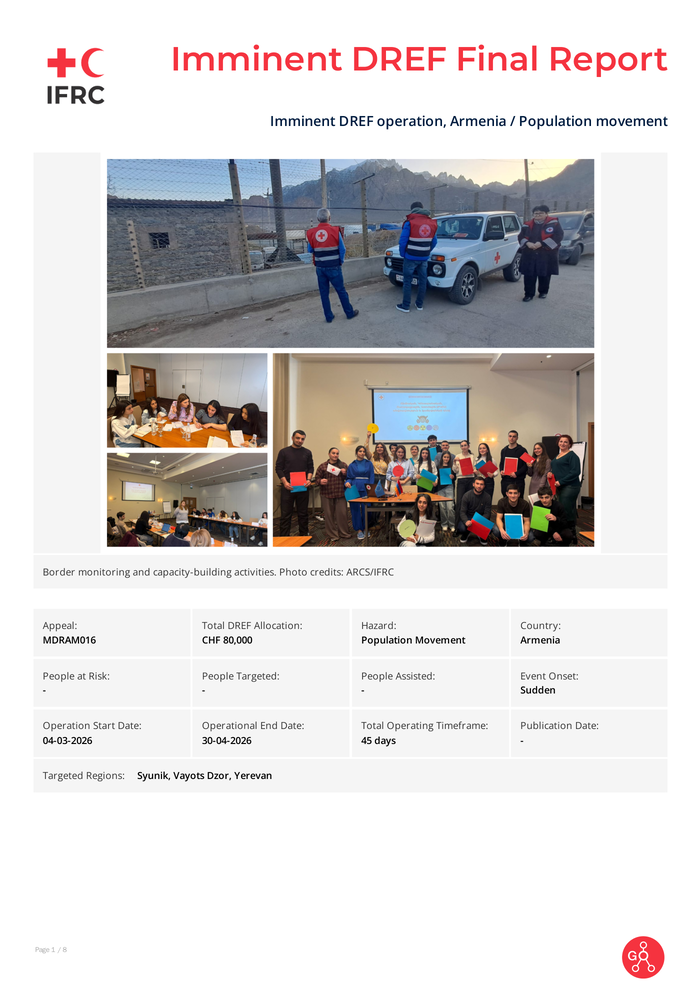
Countries: Armenia, Iran (Islamic Republic of) Source: International Federation of Red Cross and Red Crescent Societies Please refer to the attached file. Event development Update regarding the event’s development The regional escalation of conflict in the Middle East in early 2026 heightened regional tensions and disrupted air travel and regional connectivity. The escalation affected commercial air traffic, and several countries issued advisories recommending alternative evacuation routes for their citizens, indicating potential risks of restricted mobility and increased reliance on land corridors. Armenia was identified as one of the accessible transit routes, particularly through its border with the Islamic Republic of Iran. The imminent DREF operation in Armenia was therefore triggered by a potential sudden cross-border population movement into Armenia, particularly through the Syunik region and the Nurduz–Agarak border crossing point, linked to the regional escalation and continued disruption of airspace in the region. The projected movement was expected to follow a transit corridor from Meghri to Goris in Syunik region and onward to Yerevan, with Yerevan serving as a logistical hub and onward travel point. Based on scenario analysis, it was anticipated that Armenia could become one of the viable evacuation routes for Armenians living in Iran (estimated at 60, 000–80, 000 people), as well as foreign nationals, including students, business travellers, and diplomatic staff. It was estimated that approximately 70–80 per cent of arrivals would travel independently or with embassy support, while 20–30 per cent could require short-term humanitarian assistance, particularly vulnerable individuals such as older persons, families with children, and those lacking sufficient financial means or onward travel arrangements. The activation timeframe was projected at 0–4 weeks, with the situation remaining dynamic depending on the evolution of regional hostilities and transportation disruptions. Potential humanitarian concerns included congestion at border crossing points and extended travel times; fatigue, dehydration, and psychosocial stress following prolonged journeys; temporary strain on local services and infrastructure, particularly in Meghri; protection risks related to lack of documentation, language barriers, and misinformation; and family separation or communication breakdowns generating Restoring Family Links (RFL) needs. Overall, the anticipated situation was characterized as a rapid-onset, short-duration, transit-focused population movement that could create localized humanitarian pressure at entry points, even if it did not evolve into large-scale displacement within the country. During the operational period, some cross-border movements into Armenia were recorded; however, the number of arrivals remained limited and did not reach the predefined trigger thresholds for activating a large-scale humanitarian response. Available data indicates that between 28 February and 15 April 2026, approximately 18, 300 entries into Armenia and 17, 500 exits from Armenia of Iranian nationals were recorded through the Agarak border crossing point. These figures reflect continued regular two-way cross-border movements rather than a significant influx associated with the regional escalation. At the same time, according to official information from the Ministry of Foreign Affairs, Armenia facilitated the transit of foreign nationals from a significant number of countries, initially reported as 41 and subsequently increasing to up to 60 countries over time. These movements included foreign citizens, diplomats, and other individuals exiting the region through Armenia. Overall, movements remained predominantly transit-oriented, with most individuals continuing onward travel through existing arrangements or embassy-supported evacuation mechanisms, resulting in limited humanitarian needs. As a result, the anticipated escalation scenario did not materialize. The number of people requiring humanitarian assistance remained limited and did not place additional pressure on national response capacities. Therefore, while preparedness measures were justified and necessary, the predefined trigger thresholds for activating a large-scale response were not reached. Consequently, the situation remained stable throughout the operational period, and no large-scale humanitarian needs requiring activation of response activities were observed.



GrowthPakistan brings you the latest news to keep an eye on Pakistan’s startup ecosystem. Business keeps you growing when you stay aware of your competitors' moves. GrowthPakistan offers Business, Tech, Global Tech, Global, Auto, and Startup News straight from industries all around the globe. This platform will help you identify upcoming opportunities not only in Pakistan but worldwide.
Email : growthpakistan@gmail.com
Whatsapp : +92320-9497079
© growthpakistan