

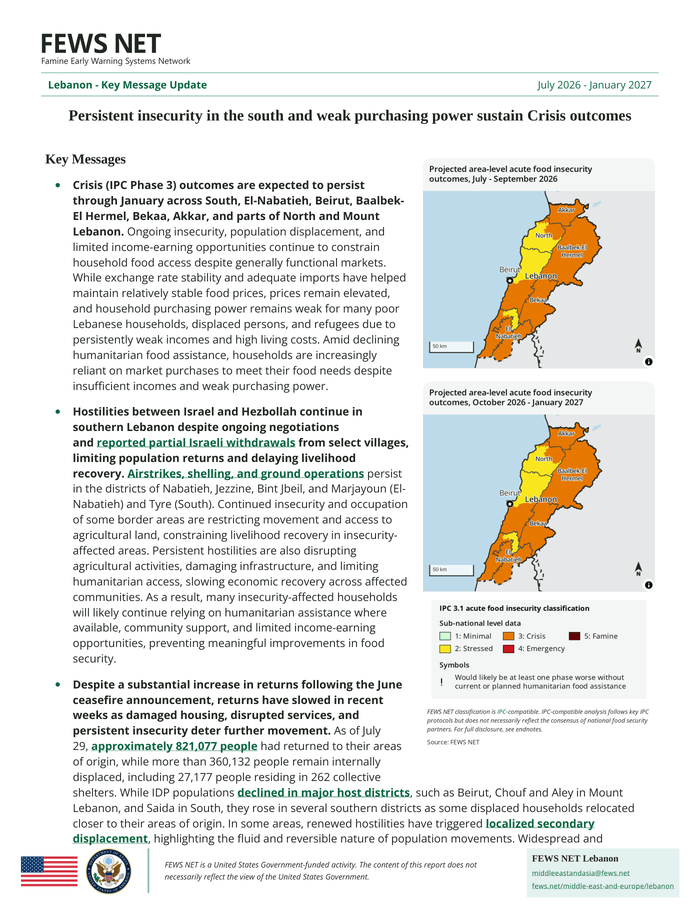
Country: Lebanon Source: Famine Early Warning System Network Please refer to the attached file. Key Messages Crisis (IPC Phase 3) outcomes are expected to persist through January across South, El-Nabatieh, Beirut, Baalbek-El Hermel, Bekaa, Akkar, and parts of North and Mount Lebanon. Ongoing insecurity, population displacement, and limited income-earning opportunities continue to constrain household food access despite generally functional markets. While exchange rate stability and adequate imports have helped maintain relatively stable food prices, prices remain elevated, and household purchasing power remains weak for many poor Lebanese households, displaced persons, and refugees due to persistently weak incomes and high living costs. Amid declining humanitarian food assistance, households are increasingly reliant on market purchases to meet their food needs despite insufficient incomes and weak purchasing power. Hostilities between Israel and Hezbollah continue in southern Lebanon despite ongoing negotiations and reported partial Israeli withdrawals from select villages, limiting population returns and delaying livelihood recovery. Airstrikes, shelling, and ground operations persist in the districts of Nabatieh, Jezzine, Bint Jbeil, and Marjayoun (El-Nabatieh) and Tyre (South). Continued insecurity and occupation of some border areas are restricting movement and access to agricultural land, constraining livelihood recovery in insecurity-affected areas. Persistent hostilities are also disrupting agricultural activities, damaging infrastructure, and limiting humanitarian access, slowing economic recovery across affected communities. As a result, many insecurity-affected households will likely continue relying on humanitarian assistance where available, community support, and limited income-earning opportunities, preventing meaningful improvements in food security. Despite a substantial increase in returns following the June ceasefire announcement, returns have slowed in recent weeks as damaged housing, disrupted services, and persistent insecurity deter further movement. As of July 29, approximately 821, 077 people had returned to their areas of origin, while more than 360, 132 people remain internally displaced, including 27, 177 people residing in 262 collective shelters. While IDP populations declined in major host districts, such as Beirut, Chouf and Aley in Mount Lebanon, and Saida in South, they rose in several southern districts as some displaced households relocated closer to their areas of origin. In some areas, renewed hostilities have triggered localized secondary displacement, highlighting the fluid and reversible nature of population movements. Widespread and sustained returns will likely remain limited while volatile security conditions persist. Poor purchasing power continues to restrict household access to food despite markets remaining generally supplied countrywide. Commercial imports, adequate trader stocks, and relative exchange rate stability are supporting market functionality across most of the country, though insecurity continues to disrupt market activity in southern areas. Prices of key imported staple foods, such as rice, wheat flour, lentils, chickpeas, and vegetable oil, held broadly stable in June but remain elevated above pre-escalation levels. Fuel prices, which peaked in late May, declined through much of June before increasing by approximately 8 percent between late June and late July. Although below peak levels, fuel prices remain well above pre-escalation levels, sustaining above-average transport, production, and distribution costs. As a result, displaced households, refugees, and poor Lebanese households continue to face constrained economic access to food as rising living costs outpace income growth and income-earning opportunities remain limited. Seasonal agricultural activity is providing localized and temporary improvements in household incomes and food access. Ongoing June-September harvests are supporting seasonal labor demand and increasing local availability of fruits and vegetables, particularly in Bekaa and northern Lebanon, providing marginal, short-term income-earning opportunities to some rural households. However, insecurity-related damage to agricultural assets, restricted access to farmland in southern Lebanon, above-average production costs, and weak macroeconomic conditions continue to constrain agricultural production and labor demand. Reduced private-sector activity and limited seasonal employment opportunities are further restricting income recovery in both urban and rural areas, and seasonal gains are expected to remain insufficient to meaningfully offset ongoing income losses. Humanitarian food assistance coverage declined in June amid funding shortfalls and access constraints. WFP reached approximately 663, 000 people with food assistance in June, a 22 percent decrease from the 850, 000 people reached in May, consistent with emerging funding gaps and ongoing access disruptions, including damaged roads, disrupted telecommunications, volatile security conditions, and unexploded ordnance. Displaced, refugee, and poor Lebanese households are expected to face increasing difficulty meeting food needs through market purchases alone, as assistance coverage contracts. Many households will likely increase their reliance on irregular informal labor, borrowing, and remittances to meet basic needs, particularly in insecurity-affected areas where livelihood recovery remains constrained.
Lebanon – Key Message Update : Persistent insecurity in the south and weak purchasing power sustain Crisis outcomes, July 2026 – January 2027

RELATED ARTICLES


