

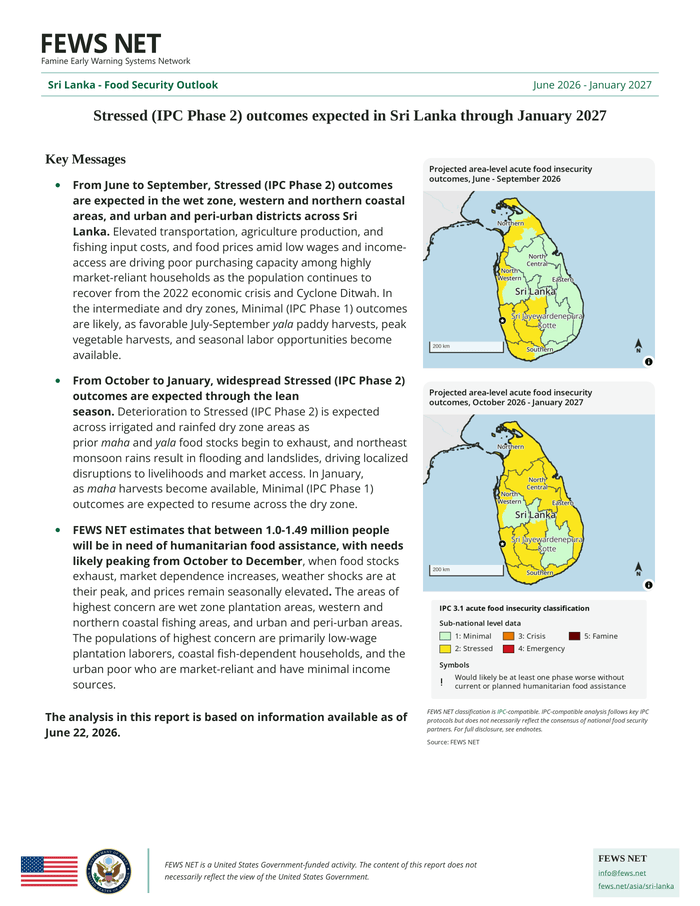
Country: Sri Lanka Source: Famine Early Warning System Network Please refer to the attached file. Key Messages From June to September, Stressed (IPC Phase 2) outcomes are expected in the wet zone, western and northern coastal areas, and urban and peri-urban districts across Sri Lanka. Elevated transportation, agriculture production, and fishing input costs, and food prices amid low wages and income-access are driving poor purchasing capacity among highly market-reliant households as the population continues to recover from the 2022 economic crisis and Cyclone Ditwah. In the intermediate and dry zones, Minimal (IPC Phase 1) outcomes are likely, as favorable July-September yala paddyharvests, peak vegetable harvests, and seasonal labor opportunities become available. From October to January, widespread Stressed (IPC Phase 2) outcomes are expected through the lean season. Deterioration to Stressed (IPC Phase 2) is expected across irrigated and rainfed dry zone areas as prior maha and yala food stocks begin to exhaust, and northeast monsoon rains result in flooding and landslides, driving localized disruptions to livelihoods and market access. In January, as maha harvests become available, Minimal (IPC Phase 1) outcomes are expected to resume across the dry zone. FEWS NET estimates that between 1. 0-1. 49 million people will be in need of humanitarian food assistance, with needs likely peaking from October to December, when food stocks exhaust, market dependence increases, weather shocks are at their peak, and prices remain seasonally elevated**. ** The areas of highest concern are wet zone plantation areas, western and northern coastal fishing areas, and urban and peri-urban areas. The populations of highest concern are primarily low-wage plantation laborers, coastal fish-dependent households, and the urban poor who are market-reliant and have minimal income sources. The analysis in this report is based on information available as of June 22, 2026.
Sri Lanka Food Security Outlook, June 2026 – January 2027: Stressed (IPC Phase 2) outcomes expected in Sri Lanka through January 2027

RELATED ARTICLES


